
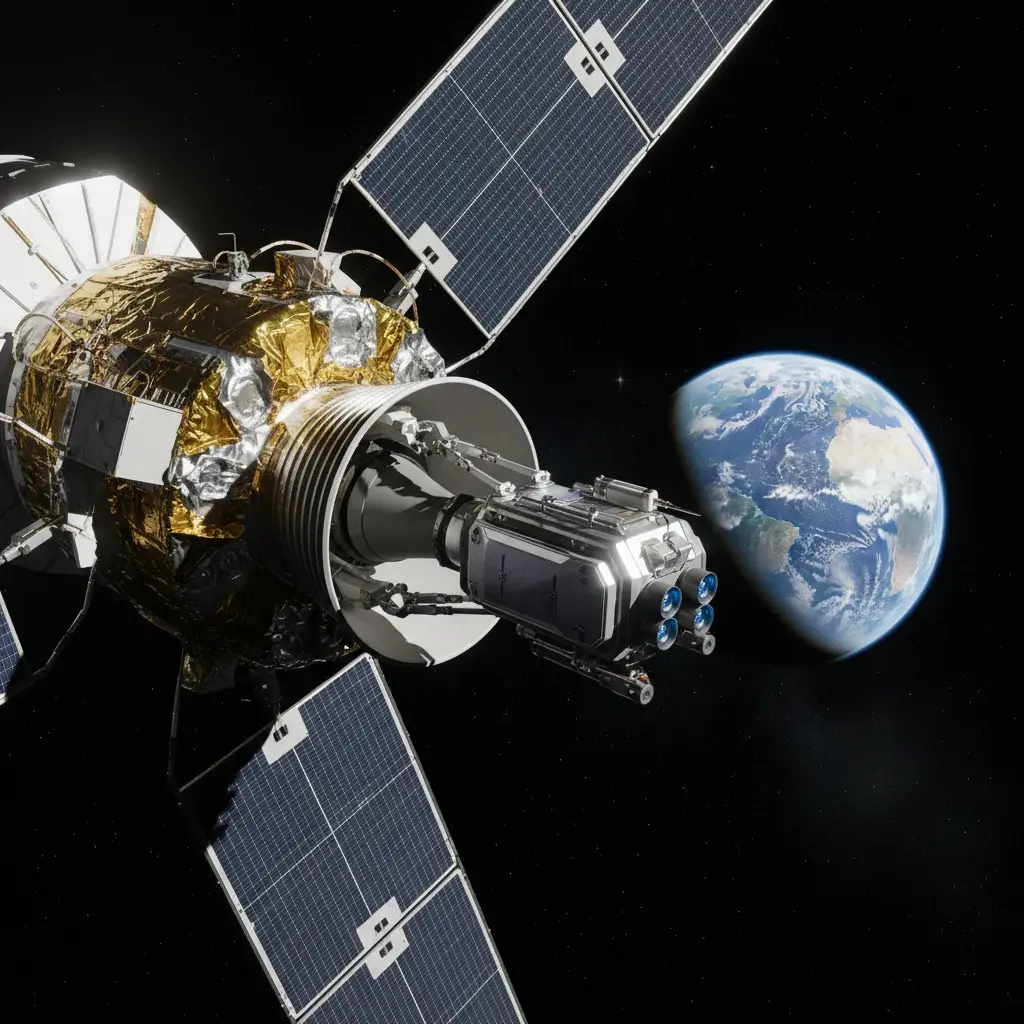
Bengaluru-based aerospace startup Aule Space announced today the successful closure of a $2 million pre-seed funding round to develop robotic “jetpacks” designed to extend the lifespan of aging satellites. The funding, led by pi Ventures, will accelerate the development of autonomous spacecraft capable of grappling onto existing assets in Geostationary Earth Orbit (GEO). By providing up to six years of supplementary propulsion, Aule Space aims to solve one of the orbital economy’s most persistent challenges: functional satellites being abandoned simply because they run out of fuel.
The GEO Graveyard and the Need for Refueling
For decades, satellite operators have faced a frustrating physical limitation in space. Once a spacecraft depletes its onboard propellant, it loses the ability to maintain its precise orbital slot, rendering it useless even if its communication payloads and solar arrays remain perfectly functional.
This dynamic forces operators to retire multi-million-dollar assets prematurely. Traditionally, satellites are sent to a distant “graveyard orbit” using their final fuel reserves, permanently removing high-revenue assets from the commercial market.
A wave of aerospace startups is now attempting to crack the code on orbital refueling and life extension. GEO life extension missions are widely considered the foundational step for the emerging in-space servicing economy.
“For the entire in-space servicing economy to kick off, the first step will be the GEO life extension [missions] because these are the satellites which are the most expensive and highest revenue generating assets in space today,” Aule Space CEO Jay Panchal stated.
A “Plug-and-Play” Jetpack Solution
Unlike some proposed orbital servicing concepts that require satellites to be pre-fitted with specialized docking plates, Aule Space is taking a universally applicable approach. The company is designing its spacecraft to act as a supplementary jetpack that physically grabs onto the existing architecture of a target satellite.
Specifically, the Aule spacecraft will grapple directly onto the thruster nozzle of a GEO satellite. This requires no preassembly or modifications to the client spacecraft prior to its original launch.
Because the liquid apogee engine nozzle is a standard feature on most large orbital assets, the potential market is vast. According to Panchal, approximately 80 percent of all GEO spacecraft currently operating are compatible with Aule’s life extension service.
The $2 million pre-seed round signals strong market confidence in this distinct approach. Alongside pi Ventures, the round attracted strategic angel investments from prominent industry veterans.
Eash Sundaram, a former board member of satellite communications giant Intelsat, participated in the funding. Arvind Lakshmikumar, CEO of Indian defense optical sensor firm Tonbo Imaging, also joined the round, bringing critical defense and hardware expertise to the cap table.
Aule Space plans to utilize the capital injection to develop advanced artificial intelligence-powered Guidance, Navigation, and Control (GNC) software. This software is the critical brain required for autonomous rendezvous and docking in the harsh environment of space.
Capitalizing on India’s Space Boom
A central pillar of Aule Space’s business strategy relies on geography. By operating out of Bengaluru, the company intends to leverage India’s rapidly maturing and highly cost-effective space supply chain.
While the critical AI and GNC software systems are being developed in-house, Aule aims to source the majority of its spacecraft components domestically. This includes essential hardware like propulsion systems and optical sensors.
This localized supply chain strategy is designed to aggressively undercut the pricing models of Western competitors.
“Operating out of India, competing with global companies…one of the unfair advantages that we have is the cost advantage,” Panchal explained. “To make a business case for life extension, the cost is the most sensitive thing, and that is in our favor.”
Aule Space is also positioning itself to benefit from the Indian government’s recent push to commercialize and expand its domestic space sector. The startup recently secured a $90,000 grant from IN-SPACe, a government body tasked with promoting the country’s commercial space initiatives.
“Space is new for India, but it is unlocking, and the funding will flow,” Panchal noted.
Expanding the In-Space Economy
Beyond commercial telecommunications satellites, Aule is exploring lucrative defense applications. The company is currently in preliminary talks with the Indian government to fly Rendezvous and Proximity Operations (RPO) missions for the country’s military.
Down the line, Aule Space envisions its technology serving as a foundational platform for a broader suite of orbital capabilities. The company plans to expand its services beyond simple life extension to include non-Earth imaging and detailed spacecraft inspection for both commercial and defense clients.
The successful deployment of Aule’s technology could fundamentally alter the economics of satellite operations. Extending the life of a massive orbital asset by six years dramatically improves return on investment for operators and reduces the frequency of costly replacement launches.
As the space industry watches Aule Space build toward its inaugural 2027 demonstration flight, the success of this mission will be a critical bellwether. If the Bengaluru startup can prove its nozzle-grappling technology works autonomously and at a fraction of standard industry costs, it will likely trigger a rapid acceleration in the adoption of in-space servicing across the global satellite market.


Leave a Reply