
Kazakhstan is facing a critical strategic crossroads in the rapidly expanding global tech and space economy. With the global space sector projected to nearly triple to $1.8 trillion by 2035, the Central Asian nation must urgently decide whether to leverage its legacy assets to become Eurasia’s active technology broker or risk becoming a passive geopolitical pawn. This decision comes as space infrastructure, artificial intelligence, and deeptech supply chains increasingly dictate global power dynamics.
Navigating Complex Geopolitical Dependencies
For decades, Kazakhstan has successfully balanced its historical ties with its future ambitions. The nation inherited a highly consequential space asset in the Baikonur Cosmodrome, along with a robust STEM legacy. However, its current geopolitical position involves complex, multi-directional dependencies.
The country maintains deep cultural, educational, and scientific connections with Russia. Simultaneously, its proximity to China is vital for global supply chain integration, fast scaling, and its position as a Eurasian transit hub. Europe serves as an indispensable trade partner and governance anchor for Kazakhstan’s developing democracy, while the United States offers unparalleled legacy innovation and highly transparent capital markets.
Balancing these superpowers requires more than simple neutrality. Industry experts and national strategists argue that in a world where data corridors and deeptech supply chains act as the nervous system of geopolitical power, neutrality without active agency provides vulnerability rather than stability.
The $1.8 Trillion Space Economy
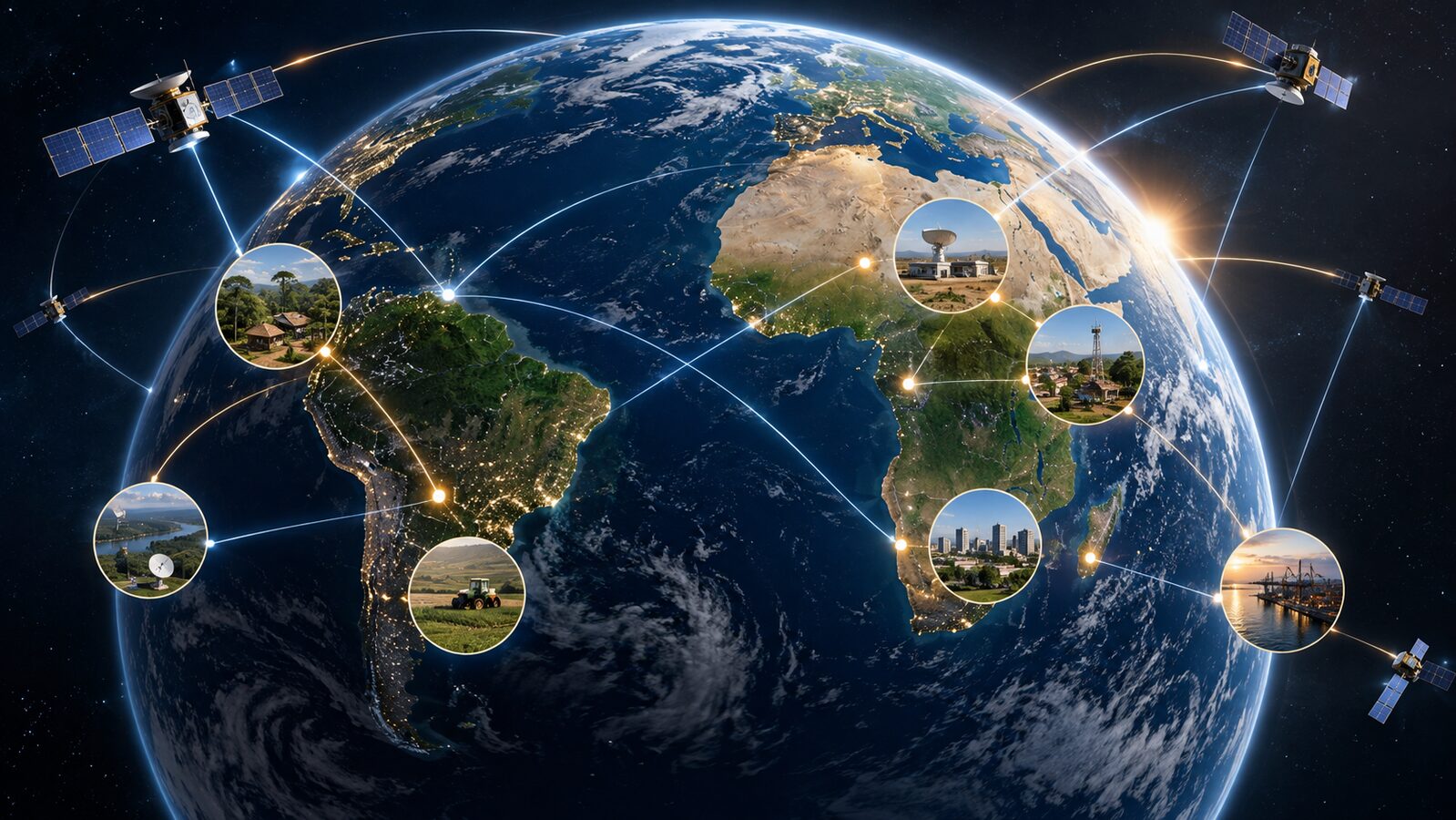
The stakes of this strategic pivot are tied to massive economic shifts. The projected $1.8 trillion global space economy will not be driven by traditional rocket launches alone. Instead, future growth relies heavily on AI-enabled earth observation, satellite logistics, collaborative robotics, advanced microgravity materials, and secure data infrastructure.
Space is rapidly transitioning from a domain of national prestige to a foundational industrial platform. Kazakhstan’s voluntary nuclear disarmament and strict adherence to UN space treaties provide a massive reserve of global trust.
H.E. Zhaslan Madiyev, Kazakhstan’s Deputy Prime Minister and Minister of Artificial Intelligence and Digital Development, emphasizes the need for strategic coordination of these high-tech sectors. The core question is whether Kazakhstan will spend its accumulated geopolitical capital to shape the rules of the emerging space economy or simply allow foreign powers to dictate terms on its territory.
Path 1: The Trusted Eurasian Broker
The preferred strategic path positions Kazakhstan as a neutral, trusted node for Eurasian space and deeptech cooperation. This involves moving from a mere launch host to a comprehensive system integrator.
In this broker scenario, Kazakhstan chooses agency over alignment. The nation’s engineers, data scientists, and roboticists become core co-designers for global missions rather than peripheral contractors. By anchoring multilateral partnerships across space robotics, climate services, and AI, Kazakhstan can accelerate its own economic diversification.
Olaf J. Groth, CEO of Cambrian Futures and an advisor on Kazakhstan’s Presidential AI Council, notes that brokerage requires severe institutional maturity. This demands professionalized national agencies, robust intellectual property protection, reliable legal enforcement, and sustained investments in human capital.
Brokerage also means actively shaping international agendas. Kazakhstan is uniquely positioned to convene global forums on dual-use technology governance, satellite data security, and responsible AI. This approach builds upon its existing Russian partnership at Baikonur while intensifying collaboration with Western, Middle Eastern, and Asian space ecosystems.
Path 2: Strategic Decay and the Pawn Scenario
The alternative scenario is politically comfortable but strategically dangerous. If Kazakhstan fails to assert agency, it risks becoming operationally relevant but strategically passive.
In the “pawn” scenario, competing global blocs utilize Kazakhstan’s space and AI assets, while high-value research, intellectual property, and critical decision-making migrate elsewhere. Launches will still happen, and data will flow, but the economic value will leak out of the country.
Askar Sinchev, a consultant to the Executive Office of the President, highlights the dangers of mistaking short-term stability for long-term strategy. When reforms lag, innovation infrastructure becomes contested ground. Global firms will inevitably relocate advanced work to jurisdictions with clearer governance.
Without proactive orchestration, Kazakhstan will devolve into a mere transit zone and testing site. Its institutions will administer, but they will not orchestrate, eventually leading the international community to question the value of its neutrality.
A Closing Window for Strategic Action
The timeline for Kazakhstan to establish itself as an active broker is shrinking rapidly. Space entrepreneurship now operates on accelerated cycles driven by digital-native firms and aggressive venture capital ecosystems.
Once global standards, data architectures, and partnerships consolidate in other jurisdictions, late entry will become prohibitively expensive. Kazakhstan’s unique combination of Baikonur’s legacy, mineral wealth, engineering know-how, and transit positioning provides a distinct but temporary advantage.
Looking ahead, global markets will closely monitor how Kazakhstan manages its institutional reforms and international partnerships. The immediate indicators of success will be its ability to attract diverse foreign direct investment in deeptech and its proactive participation in setting international space governance standards. If the nation fails to command its technological mission now, competing global hubs will rapidly relegate it to a mere venue for their own ambitions.