
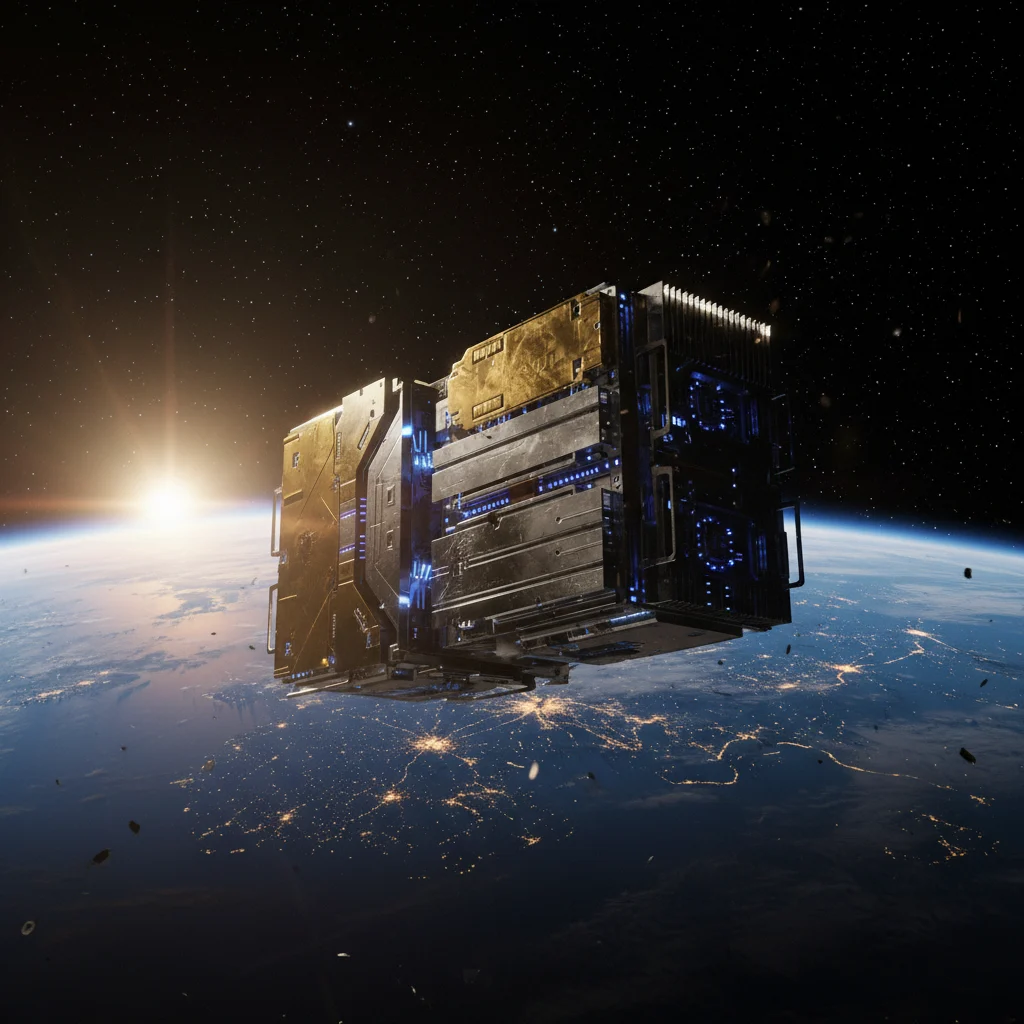
Nvidia unveiled the Space-1 Vera Rubin Module yesterday at the GTC 2026 conference, introducing purpose-built hardware designed to deliver unprecedented artificial intelligence computing power to low-Earth orbit. The new technology aims to solve the growing data bottleneck in the commercial space sector by enabling fully functional orbital data centers.
The global space economy currently relies on a cumbersome and inefficient data pipeline. Satellites collect mind-boggling volumes of imagery, telemetry, and communications data every single day.
Today, all of that raw information must be transmitted down to Earth through limited-bandwidth radio frequencies. Once terrestrial ground stations receive the data, it is stored and processed in massive, energy-intensive data centers.
This traditional downlink model introduces significant latency into the system. It also demands immense terrestrial computing power, energy, and time, creating a bottleneck that throttles real-time decision-making for critical applications like Earth observation and autonomous space operations.
Next-Generation Hardware for Extreme Environments
The Space-1 Vera Rubin Module is engineered specifically for the harsh, low-SWaP (Size, Weight, and Power) environment of space. Despite these extreme physical constraints, Nvidia has not scaled back the system’s performance capabilities.
According to the company, the new module is designed to deliver up to 25 times more AI-compute capacity than Nvidia’s flagship terrestrial H100 GPU. This massive leap in processing power is the critical threshold required to make orbital data centers a technological reality.
Moving computing power directly into orbit allows data to be processed at the edge, mere miles from where it is generated. This on-orbit processing drastically reduces latency and relies entirely on abundant, solar-generated power.
“Space computing, the final frontier, has arrived,” Nvidia CEO Jensen Huang said in a statement accompanying the release. “As we deploy satellite constellations and explore deeper into space, intelligence must live wherever data is generated.”
Early Adopters and Commercial Traction
While the Space-1 module is not yet commercially available, the space industry is not waiting to upgrade its computational capabilities. Customers are actively deploying Nvidia’s near-term in-space computing platforms, including the IGX Thor and Jetson Orin systems.
Nvidia revealed six major aerospace customers already utilizing its technology to advance in-space computing applications. The roster includes Aetherflux, Axiom Space, Kepler Communications, Planet Labs, Sophia Space, and Starcloud.
These companies are leveraging the hardware for diverse applications ranging from on-orbit data processing and real-time satellite connectivity to advanced Earth observation analytics. By processing data in space, Earth observation satellites can instantly identify critical events, such as wildfires or maritime anomalies, and transmit only the actionable insights down to Earth.
The financial markets are aggressively backing this transition to orbital infrastructure. Starcloud, one of the early adopters of Nvidia’s space hardware, recently raised a $170 million Series A funding round at a $1.1 billion valuation.
This massive fundraise highlights the overwhelming demand among venture capital investors to fund orbital data center ventures. It also underscores Starcloud’s unique market position as a data center startup possessing highly sought-after flight heritage.
Overcoming the Thermal Management Hurdle
While the Space-1 announcement pushes the industry closer to viable in-space data centers, significant engineering hurdles remain. The most pressing challenge facing commercial space computing is thermal management.
High-performance computing generates immense heat, which is notoriously difficult to dissipate in the vacuum of space. Traditional terrestrial cooling methods rely heavily on air or liquid cooling systems that simply do not function in orbit.
“Of course, in space there’s no conduction, there’s no convection, there’s just radiation,” Huang explained during the GTC 2026 conference. “We have to figure out how to cool these systems out in space, but we’ve got lots of great engineers working on it.”
The broader aerospace industry is actively mobilizing to solve this exact problem. In a related move, aerospace manufacturer Phantom Space recently acquired Thermal Management Technologies, a company specializing in advanced satellite thermal components for in-space applications.
As hardware manufacturers push the boundaries of processing power, the development of advanced radiative cooling systems will be the critical enabler for scaling orbital networks. Without efficient heat dissipation, even the most powerful GPUs will throttle or fail.
Expanding Infrastructure and Future Implications
The push for advanced space computing coincides with a massive global expansion in physical space infrastructure. Sovereign nations and private enterprises are heavily investing in launch capabilities to support the deployment of these heavy orbital assets.
Canadian officials recently announced a $200 million CDN ($146 million) investment over the next decade to lease a launch pad at a startup spaceport operated by Maritime Launch Services. This push to build sovereign launch capabilities reflects the growing strategic importance of maintaining independent access to space as orbital networks become critical data infrastructure.
As the physical and digital architectures of space merge, the demand for robust in-space computing will accelerate. Satellites will no longer function as mere mirrors bouncing signals back to Earth, but as interconnected nodes in a vast, autonomous orbital network.
Rendezvous and proximity operations (RPO)—where spacecraft navigate and interact with one another autonomously—will rely entirely on this localized computational power. Projects like the recent International Space Station robotics demonstration by Voyager and Icarus highlight the increasing complexity of in-orbit operations that require robust, real-time computing.
Looking ahead, the industry will closely monitor the commercial rollout timeline for the Space-1 Vera Rubin Module. The pace at which engineers can solve the vacuum cooling challenge will ultimately dictate how quickly orbital data centers transition from a sci-fi concept to a foundational layer of the global digital economy.