
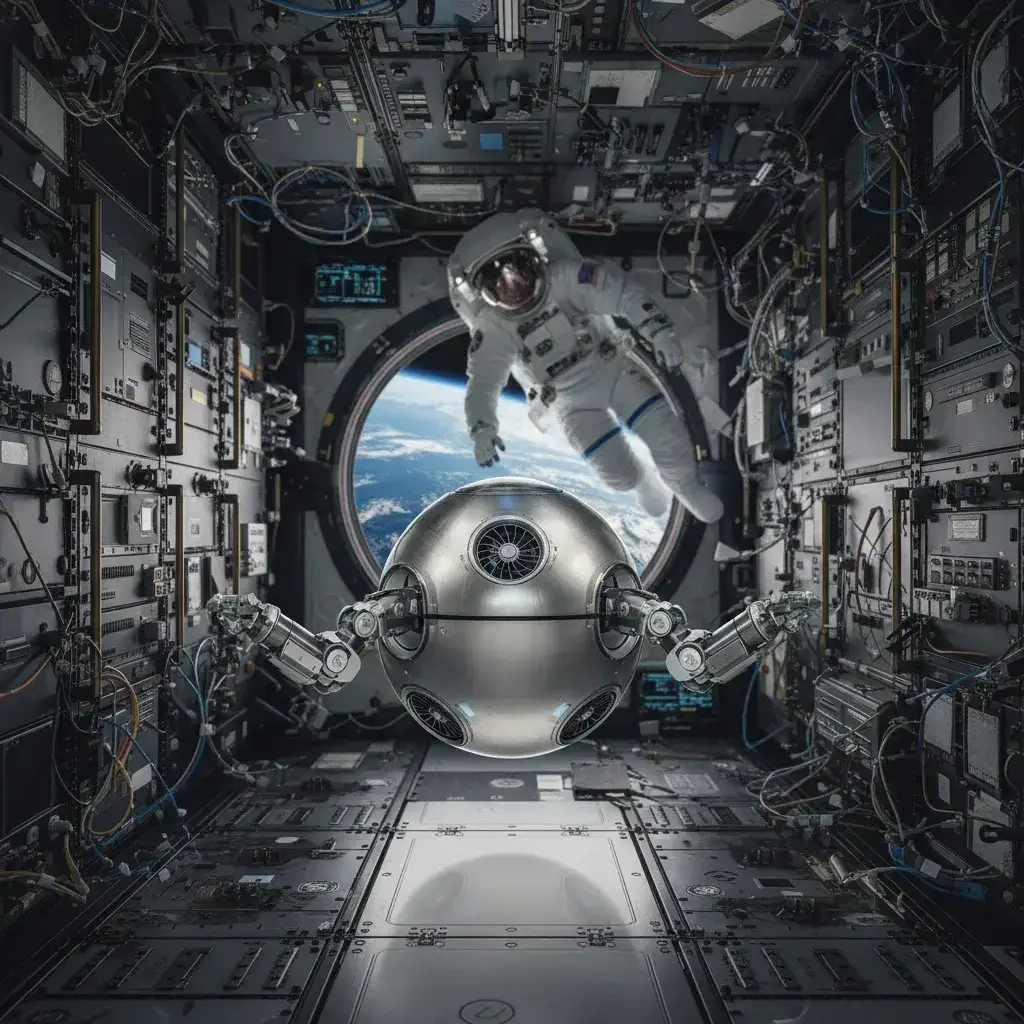
Voyager Technologies and New York-based startup Icarus Robotics announced a mission-management contract on Monday to deploy a free-flying, autonomous robotic platform called “Joy” aboard the International Space Station (ISS) in 2027. The joint demonstration aims to validate the robot’s ability to navigate pressurized microgravity environments and perform complex cargo and logistics tasks. The mission marks a significant milestone in the push to automate routine space station operations before the next generation of commercial habitats reaches orbit.
The Push for Orbital Automation
The commercial space industry is increasingly focused on maximizing human efficiency in low Earth orbit (LEO). Astronauts currently dedicate significant portions of their mission timelines to routine maintenance, inventory management, and basic logistics.
Moving cargo bags, locating lost tools, and conducting standard environmental checks consume thousands of crew hours annually. By shifting these repetitive duties to automated systems, space agencies and commercial station operators hope to free up highly trained crew members for complex scientific research.
This transition comes at a critical juncture for LEO infrastructure. The ISS is slated for retirement by the end of the decade, prompting a race among commercial entities to develop replacement habitats.
Future commercial stations will likely operate with smaller crews and tighter profit margins. This economic reality makes automated logistics a financial necessity rather than a technological luxury.
Meet Joy: The Free-Flying Assistant
Icarus Robotics designed the Joy platform specifically for pressurized spacecraft interiors. The robot navigates the station’s microgravity environment much like a miniature submarine maneuvers through water.
Equipped with internal directional fans for propulsion, the autonomous unit can fly freely through the narrow, equipment-lined modules of the ISS. The system features two highly articulated manipulator arms designed to interact with standard station hardware, open cargo transfers, and move objects around the facility.
During the 2027 ISS mission, Icarus will conduct its first in-space operational tests. The primary objective is to prove that an autonomous, multi-armed system can safely operate in close proximity to sensitive equipment and human personnel.
The company also plans to fly dedicated customer test articles alongside the robot. These components will validate Joy’s capacity for executing complex manipulation tasks beyond basic point-to-point transit.
Joy will operate directly alongside ISS crew members, collecting crucial behavioral and operational telemetry. This human-robot collaboration is designed to inform the engineering of future iterations and establish safety protocols for robotic flight in crewed environments.
Learning from Human Operations
The data gathered during the 2027 demonstration will be instrumental in training advanced machine-learning models for space applications. Observing how astronauts handle objects in zero gravity provides a unique dataset for robotic control systems.
“If we can learn from these human examples, then we can actually have these learned manipulation models, which allow us to surpass the limits of the capability of robots in space before,” Icarus co-founder and Chief Technology Officer Jamie Palmer told Payload.
The partnership with Voyager Technologies provides Icarus with an immediate pipeline to future commercial applications. Voyager is currently developing Starlab, a commercial space station intended to succeed the ISS in partnership with major aerospace contractors.
“It’s one of the big reasons why we wanted to work with Voyager,” Icarus co-founder and CEO Ethan Barajas stated. “We get to talk to them—and talk to the folks over on the Starlab side of things—to see what their future stations look like, and what moves the needle the most.”
By integrating with Voyager early in the development cycle, Icarus ensures its hardware and software interfaces will be fully compatible with next-generation orbital architecture.
Navigating an Uncertain LEO Market
The collaboration arrives amid ongoing debates regarding the financial viability and maturity of the commercial LEO economy. Developing robotics for space stations requires significant upfront capital, and the immediate customer base remains relatively small.
During a recent industry address, NASA Associate Administrator Amit Kshatriya highlighted the current “absence of a mature market” in low Earth orbit. His comments reflect a cautious approach from the agency regarding the speed at which commercial entities can replace government-run infrastructure.
However, commercial operators present a contrasting view of market demand. Voyager Technologies recently reported that commercial rack space for its upcoming Starlab station is already completely sold out, indicating strong private sector interest in orbital research and manufacturing.
Regardless of these differing market assessments, Icarus Robotics is positioning its technology as a fundamental requirement for any future orbital infrastructure. The company views LEO logistics as merely the starting point for a broader space robotics ecosystem.
Expanding Beyond Earth Orbit
The successful deployment of the Joy platform on the ISS will serve as a critical proving ground for in-space servicing, assembly, and manufacturing (ISAM) capabilities. As commercial space stations like Starlab prepare to come online in the 2030s, robotic workers will likely become baseline infrastructure rather than experimental add-ons.
Operators will watch the 2027 ISS demonstration closely to determine if autonomous systems can reliably handle the day-to-day upkeep of multimodule habitats without requiring constant ground-in-the-loop supervision.
“We look at the robotics problems that we’re solving for maintenance and logistics right now on station… we see demand and we can actually deploy,” Barajas noted. “We get excited about where it moves beyond this LEO labor… what it looks like on-orbit in ISAM, what it looks like potentially going to the Moon, and going to Mars.”
Industry observers should monitor how these early LEO demonstrations translate into deep space applications. The autonomous manipulation models developed aboard the ISS are expected to lay the groundwork for building complex lunar surface bases and maintaining eventual crewed transit vehicles bound for Mars.
Leave a Reply