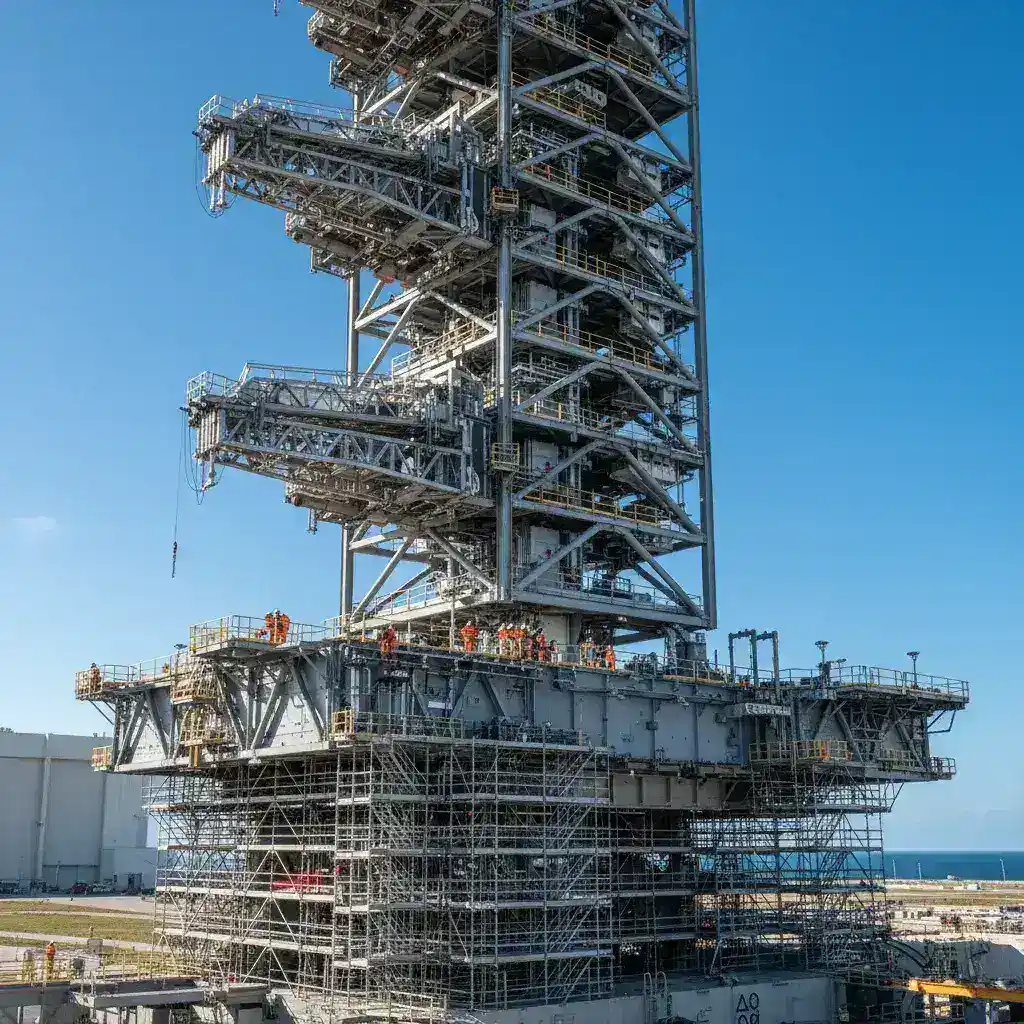
On March 29 in Washington, NASA officially issued a stop-work order for the Space Launch System (SLS) Mobile Launcher 2 (ML-2) because the agency is abandoning the upgraded rocket variant the platform was designed to support.
The decision marks a significant pivot in the ground infrastructure strategy for the Artemis program, which aims to establish a sustainable human presence on the Moon.
Shifting Rocket Configurations
NASA originally commissioned ML-2 to accommodate the SLS Block 1B rocket, a more powerful iteration of the agency’s flagship lunar launch vehicle.
This upgraded rocket would have featured the larger Exploration Upper Stage to carry heavier payloads into deep space. The new stage necessitated a completely redesigned launch platform with umbilical arms positioned at different heights along the tower.
However, NASA reversed course on February 27, announcing the definitive cancellation of the Block 1B configuration.
The agency will instead standardize future missions on a “near Block 1” version. This strategic shift is designed to streamline production and accelerate the flight cadence for upcoming crewed lunar missions.
With the Block 1B canceled, NASA must find a reliable replacement for the Interim Cryogenic Propulsion Stage (ICPS) currently used on the Block 1 rocket. Only one ICPS remains in the agency’s manufacturing inventory.
To maintain the standardized “near Block 1” configuration, NASA will integrate a version of the commercially proven Centaur upper stage for all subsequent SLS missions.
Salvaging Critical Hardware
Instead of scrapping the partially built ML-2 entirely, NASA will harvest its completed components to maintain the agency’s sole operational launch tower.
Shawn Quinn, manager of NASA’s Exploration Ground Systems program, detailed the new strategy during the March 29 briefing.
He confirmed the ground systems team is actively removing hardware common to both platforms to serve as critical spares. “We can put them to good use in future Artemis missions supporting Mobile Launcher 1,” Quinn stated.
In a subsequent March 30 interview, Quinn elaborated on the specific high-value components slated for preservation.
“The umbilical arms for the core stage and the Orion, they’re identical” between the two launch platforms, he explained.
These heavy mechanical arms provide power, communications, and vital fluids to the rocket until the moment of liftoff. They contain complex components, such as cryogenic flex lines, that require extensive manufacturing lead times.
“We’re going to take the arms off and we’re going to put them into storage and properly care for them,” Quinn said. This ensures they remain flight-ready if ML-1 requires immediate replacement parts.
Financial and Contractual Turmoil
The cancellation of ML-2 follows years of severe financial overruns and mounting schedule delays that drew intense scrutiny from government watchdogs.
In 2019, NASA awarded engineering firm Bechtel a $383 million cost-plus contract to construct the second mobile launcher. The original agreement scheduled the platform’s completion for March 2023.
The massive infrastructure project quickly spiraled out of control. A damning 2024 report published by NASA’s Office of Inspector General (OIG) revealed that ML-2 completion costs could ultimately skyrocket to $2.5 billion.
The OIG also warned the tower might not be operational until 2029, a delay that threatened to derail the entire Artemis launch timeline.
Former NASA Administrator Bill Nelson heavily criticized the contracting arrangement during a May 2022 Senate hearing.
“Because Bechtel underbid on a cost-plus contract in order to, what appears, to get it, they couldn’t perform,” Nelson testified to lawmakers. “And NASA is stuck.”
Bechtel representatives did not respond to requests for comment regarding the March 29 stop-work order.
Hardening Mobile Launcher 1
As ML-2 faces dismantlement, NASA’s operational focus shifts entirely to the durability and performance of ML-1.
The agency is currently analyzing how ML-1 withstood the successful April 1 launch of the crewed Artemis 2 mission.
This assessment is critical, as the platform sustained heavier-than-anticipated damage during the uncrewed Artemis 1 launch in late 2022. Following that inaugural flight, ground crews faced extensive repairs to ML-1’s tubing, elevators, and surface equipment.
“We learned from Artemis 1 and we redid our models for the kind of plume damage that we might get as the rocket leaves the mobile launcher,” Quinn explained.
NASA systematically hardened ML-1 prior to the Artemis 2 launch. Crews installed reinforced blast doors to shield the tower’s elevators from the rocket’s immense acoustic and thermal energy.
Engineers also overhauled the platform’s water deluge system, which sprays massive volumes of water to wash away acidic residue from the solid rocket booster exhaust.
During Artemis 1, a ruptured gaseous nitrogen line caused the deluge system to fail. This malfunction allowed corrosive residue to destroy hundreds of meters of pneumatic tubing.
Early data from the Artemis 2 launch indicates these hardening and mitigation efforts succeeded.
Lori Glaze, NASA acting associate administrator for exploration systems development, reported during an April 2 briefing that the platform fared exceptionally well.
“Our initial assessment is showing that most of the damage is largely cosmetic,” Glaze said. “Overall, everything is looking pretty good, especially when compared to Artemis 1.”
Looking Ahead
Moving forward, NASA must prove that a single, heavily utilized launch tower can support the accelerated cadence of the Artemis lunar program.
Engineers will closely monitor the longevity of ML-1’s critical systems as the agency prepares for Artemis 3 and the first crewed lunar landing in decades.
The successful integration of ML-2’s salvaged umbilical arms will be crucial to minimizing downtime between these historic missions.
Industry observers will also watch how NASA manages the transition to the Centaur upper stage, a vital shift required to keep the standardized SLS rocket flying without the financial anchor of a second mobile launcher.