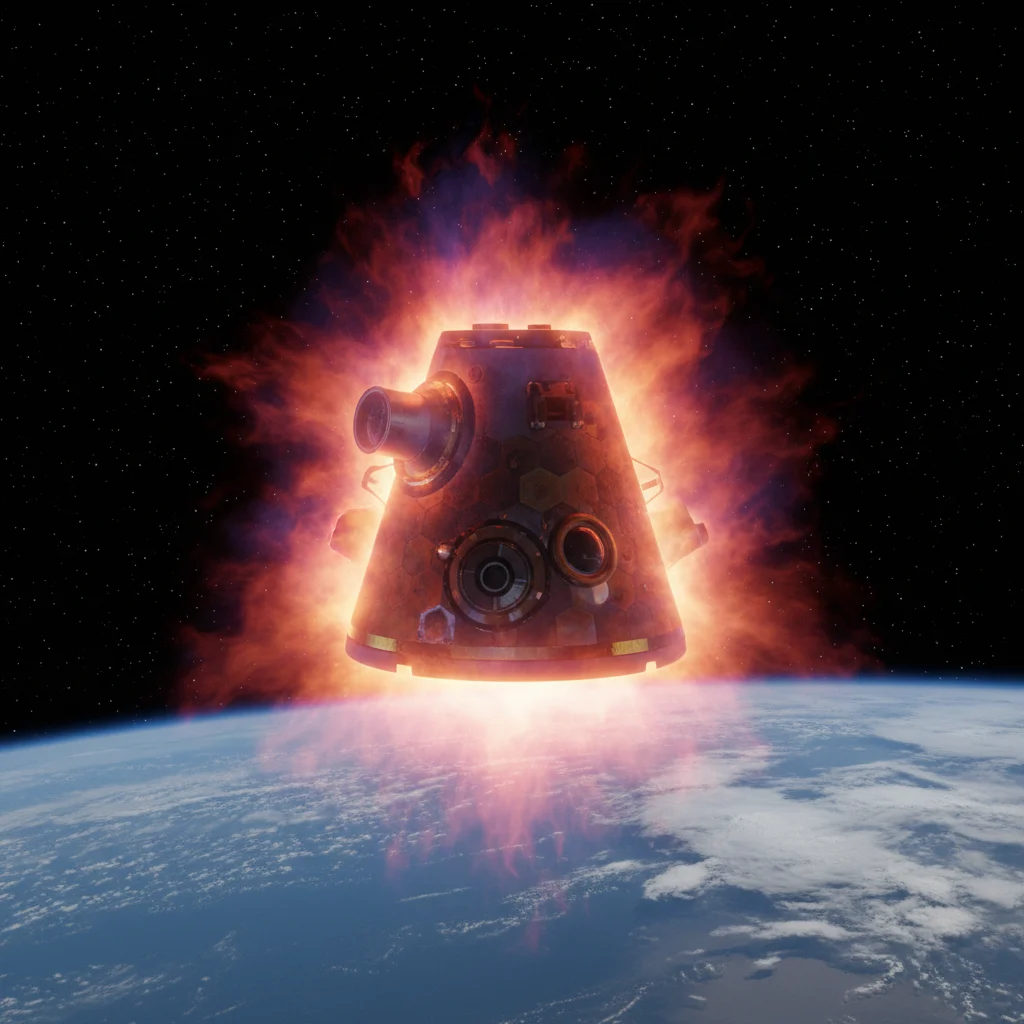
On March 30, El Segundo-based Varda Space Industries launched its sixth reentry capsule from Vandenberg Space Force Base in California, carrying critical U.S. government-funded hypersonic experiments to orbit. The mission, designated W-6, will test advanced autonomous navigation systems and next-generation heat shield materials under the extreme physical stresses of atmospheric reentry.
The capsule lifted off as part of the SpaceX Transporter-16 rideshare mission. This massive orbital deployment carried a total of 119 payloads, including satellites deployed directly from the Falcon 9 launch vehicle and hosted payloads aboard specialized orbital transfer vehicles.
Capitalizing on Extreme Reentry Profiles
Varda operates a unique fleet of spacecraft initially designed to manufacture pharmaceuticals and advanced materials in microgravity before returning them to Earth. The company’s W-Series capsules remain in orbit for weeks or months to conduct automated manufacturing processes.
However, the physical realities of returning these materials have unlocked a lucrative secondary market. To bring products home, Varda’s capsules must plunge back into the Earth’s atmosphere at speeds exceeding Mach 25.
This violent return journey exposes the spacecraft’s exterior hardware to blistering temperatures and immense aerodynamic stresses. These conditions perfectly replicate the flight environments experienced by advanced ballistic missiles and hypersonic glide vehicles.
Recognizing this overlap, the U.S. Department of Defense has increasingly turned to Varda as a commercial testing partner. The W-6 capsule represents a maturation of this dual-use business model, flying dedicated government-backed payloads focused on surviving and operating within hypersonic flight regimes.
Piercing the Plasma Blackout
A primary focus of the W-6 mission is an autonomous navigation system developed by Rhea Space Activity (RSA), funded jointly by the U.S. Space Force and the Air Force Research Laboratory.
The RSA payload addresses one of the most persistent challenges in aerospace engineering: the reentry communications blackout. When a vehicle reenters the atmosphere at hypersonic speeds, the intense friction superheats the surrounding air, stripping electrons from gas molecules.
This process forms a dense plasma sheath around the spacecraft. This ionized bubble acts as an electromagnetic barrier, effectively blocking Global Positioning System (GPS) signals and severing all radio communications between the vehicle and ground controllers.
To navigate blindly through this blackout period, RSA has developed a proprietary algorithm known as AutoNav. The system relies entirely on optical data rather than external radio frequencies.
Comprising two high-resolution cameras and a dedicated flight computer, the unit is programmed to collect continuous imagery during the hypersonic descent. The AutoNav software uses these onboard cameras to observe celestial bodies and cataloged objects in low Earth orbit.
It then cross-references these visual signatures against the U.S. Space Force’s Unified Data Library—a centralized repository tracking thousands of active satellites and pieces of orbital debris—to calculate the vehicle’s precise trajectory and position.
“The launch will allow RSA to test its proprietary algorithm, AutoNav, on a hypersonic vehicle,” Rhea Space Activity stated, noting that collecting clear imagery through the turbulent and glowing plasma sheath presents a significant technical hurdle.
Elliott Sanders, RSA’s national security coordinator, emphasized the strategic value of the technology. “Celestial navigation through the plasma sheath is a reliable way for reentry systems to navigate during GPS and radio blackout periods,” Sanders said.
Gathering Critical Thermal Data
Beyond navigation, the W-6 mission serves as a flying laboratory for advanced materials science. Mounted directly to the exterior of the Varda capsule are heavily instrumented thermal protection materials provided by Sandia National Laboratories.
Alongside the Sandia components, the spacecraft carries experimental heat shield tiles developed by NASA.
Both sets of materials are embedded with sensors designed to collect real-time performance data as the capsule decelerates through the upper atmosphere. Engineers will use this telemetry to validate ground-based wind tunnel tests and refine thermal protection systems for future crewed and uncrewed spaceflight.
The ability to physically recover these materials after the flight provides a distinct advantage over traditional destructive testing. Scientists can examine the microscopic ablation patterns and structural fatigue on the heat shields once Varda recovers the capsule on the ground.
Accelerating Hypersonic Development
The integration of these distinct experiments underscores a broader shift in how the U.S. military approaches aerospace research and development. As global competitors accelerate their own hypersonic weapons programs, the U.S. Department of Defense faces immense pressure to field reliable defensive and offensive systems.
The Air Force Research Laboratory recently awarded Varda a multi-year contract to fly government payloads on its commercial missions. This agreement allows defense agencies to rapidly test critical materials, optical sensors, and electronic components at hypersonic speeds without funding dedicated, multi-million-dollar missile launches.
Moving forward, the aerospace industry will closely monitor Varda’s ability to scale its operations. The company is actively aiming to increase the flight cadence of its W-Series vehicles in the coming years.
If successful, Varda will position its capsules as a highly repeatable, cost-effective test platform for hypersonic technologies. This commercial approach could significantly compress the development timelines for next-generation defense systems and advanced space exploration hardware.