
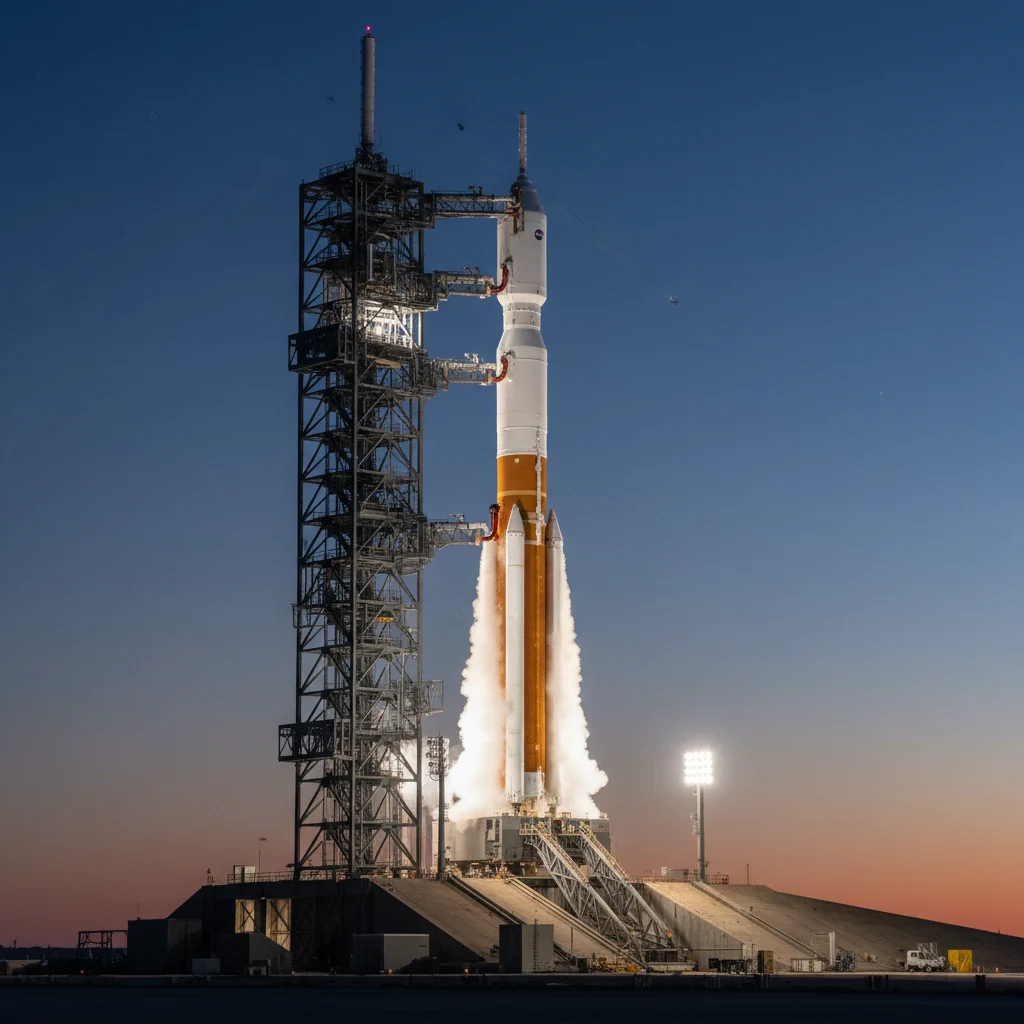
NASA officially initiated the 48-hour countdown for the Artemis 2 mission on March 30, preparing to launch the first crewed lunar voyage in 52 years. Ground controllers at Florida’s Kennedy Space Center began the terminal sequencing at Launch Pad 39B, with agency officials reporting zero major technical anomalies. The milestone signals the final operational phase before the Space Launch System (SLS) and Orion spacecraft carry four astronauts on a circumlunar trajectory.
Contextualizing the Lunar Return
Artemis 2 represents the critical transitional phase between uncrewed hardware testing and a sustained human presence on the lunar surface. The mission directly builds upon the telemetry and structural data gathered during the 2022 Artemis 1 flight. That inaugural mission validated the foundational aerodynamics and propulsion systems of the SLS architecture, but lacked the complex life support requirements of a crewed vehicle.
Unlike its predecessor, this 10-day expedition carries human occupants. NASA astronauts Reid Wiseman, Victor Glover, and Christina Koch, alongside Canadian Space Agency astronaut Jeremy Hansen, will occupy the Orion capsule. Their primary objective involves aggressively stressing the spacecraft’s Environmental Control and Life Support Systems (ECLSS) under deep space conditions.
Beyond life support, Artemis 2 serves as a vital laboratory for understanding deep space radiation exposure. The Orion capsule traverses the Van Allen radiation belts, subjecting the crew to environments far more hostile than those experienced in low Earth orbit. Dosimeters integrated into the spacecraft and the astronauts’ flight suits will provide critical data necessary for designing long-duration missions to Mars.
The crew will not touch down on the lunar surface. Instead, mission planners have programmed a free-return trajectory that utilizes lunar gravity to slingshot the spacecraft back toward Earth. This specific flight profile minimizes propulsion requirements while allowing the crew to test the manual handling characteristics of the Orion vehicle in high Earth orbit before committing to the translunar injection burn.
Technical Scrutiny and System Readiness
The initiation of the countdown marks the culmination of intense engineering scrutiny, particularly regarding the Orion spacecraft’s thermal protection system. Post-flight analysis of Artemis 1 revealed unexpected charring and localized material loss on the capsule’s ablative heat shield during its Mach 32 atmospheric reentry.
NASA engineers spent over a year analyzing the anomaly, ultimately attributing the excessive wear to the specific trajectory and atmospheric dynamics encountered during the skip-reentry maneuver. Mission managers have since adjusted the reentry profile for Artemis 2 and certified the heat shield for crewed operations, accepting a calculated, transparent level of operational risk.
The 48-hour clock is dictated by a rigid sequence of critical milestones. At the L-46 hour mark, technicians power up the Orion spacecraft and the SLS core stage to verify avionics and communication links with the Deep Space Network. By L-15 hours, the launch pad is cleared of all non-essential personnel to prepare for the hazardous cryogenic loading phase, leaving the vehicle entirely in the hands of automated ground control software.
Cryogenic propellant loading remains the most hazardous and analytically complex phase of the immediate countdown. Launch teams will soon begin loading over 700,000 gallons of super-cooled liquid hydrogen and liquid oxygen into the massive SLS core stage. Previous fueling attempts during the Artemis 1 campaign suffered from persistent hydrogen leaks, forcing NASA to redesign fueling umbilicals and implement modified loading procedures.
Current telemetry indicates these upgraded ground systems are functioning within nominal parameters. Weather officers with the U.S. Space Force’s 45th Weather Squadron currently project favorable atmospheric conditions for the launch window. However, upper-level wind shear and potential offshore precipitation remain closely monitored variables that could force a sudden hold in the countdown.
Financial Realities and Strategic Pressures
The Artemis program operates under immense financial scrutiny and evolving geopolitical pressure. A recent Government Accountability Office (GAO) report projected the total cost of the Artemis initiative will reach $93 billion by the end of 2025. The agency continues to face sharp criticism regarding the sustainability of this financial model.
Industry analysts consistently point to the $4.1 billion estimated cost per SLS launch as a fundamental weakness for long-term space exploration. Commercial alternatives, particularly the rapid iteration of SpaceX’s Starship vehicle, cast a shadow over the traditional cost-plus contracting methods that birthed the SLS and Orion systems.
Despite these fiscal criticisms, Artemis 2 serves a crucial geopolitical function for the United States. The nation is actively competing with China’s International Lunar Research Station (ILRS) initiative to establish the first permanent lunar infrastructure. A successful Artemis 2 flight demonstrates tangible American progress to international partners signed onto the Artemis Accords, reinforcing U.S. leadership in establishing space governance and operational norms.
Implications for the Aerospace Sector
The immediate success of the Artemis 2 launch sequence dictates the viability of the broader lunar exploration timeline. A flawless execution of the 48-hour countdown and subsequent launch will validate NASA’s conservative, step-by-step testing methodology. It will also provide a much-needed political victory for traditional aerospace contractors attempting to prove their continued relevance in a rapidly commercializing industry.
Conversely, any significant technical scrubs or in-flight anomalies will directly cascade into the schedule for Artemis 3, the mission tasked with physically returning humans to the lunar surface. Artemis 3 relies heavily on the data gathered during this flight, as well as the concurrent, highly complex development of commercial lunar landers and next-generation spacesuits.
Industry observers must watch the translunar injection burn and the initial 48 hours of orbital life support operations closely. If the Orion ECLSS performs optimally, NASA will secure the operational confidence required to authorize the lunar landing missions slated for the late 2020s. The global space sector now waits to see if the legacy SLS architecture can seamlessly transition from a developmental testbed to a reliable vehicle for deep space human exploration.
Leave a Reply