Washington has launched a new effort to convert the expanding Artemis Accords coalition into something more economically concrete: a channel for commercial space exports, development projects and scientific partnerships.
The U.S. Department of State launched the Space Catalyst Partnership in Lima, Peru, on 10 September. The programme is open to Artemis Accords signatories and is intended to connect foreign governments, space agencies, research organisations and companies with the American space sector.
The development was highlighted by SpaceNews as Djibouti became the 72nd country — and eighth in Africa — to sign the Accords. Djibouti’s accession matters, but the more consequential change for the space economy is the machinery being built around the diplomatic framework.
From principles to procurement
Since their creation in 2020, the Artemis Accords have primarily been a set of non-binding principles for peaceful, transparent and coordinated space exploration. The Space Catalyst Partnership adds an explicitly commercial layer.
According to the State Department, the programme will use three tools: diplomatic outreach, industry engagement and targeted foreign assistance. Proposed activities include helping partner countries obtain U.S. government financing, organising trade delegations, aligning foreign scientific capabilities with U.S.-led missions and using assistance funding to procure American space goods and services.
The first proposed project is a US$6.5 million satellite-connectivity initiative for rural schools, businesses, community centres and public institutions in southern Peru. The State Department says it is working with Congress on funding. That qualification is important: the project is planned, not yet a fully funded or awarded contract.
Independent reporting by SpacePolicyOnline also notes that the prospective American supplier has not been identified. No procurement timetable, network architecture, operator, service target or long-term operating model has been disclosed.
A broader addressable market for U.S. space companies
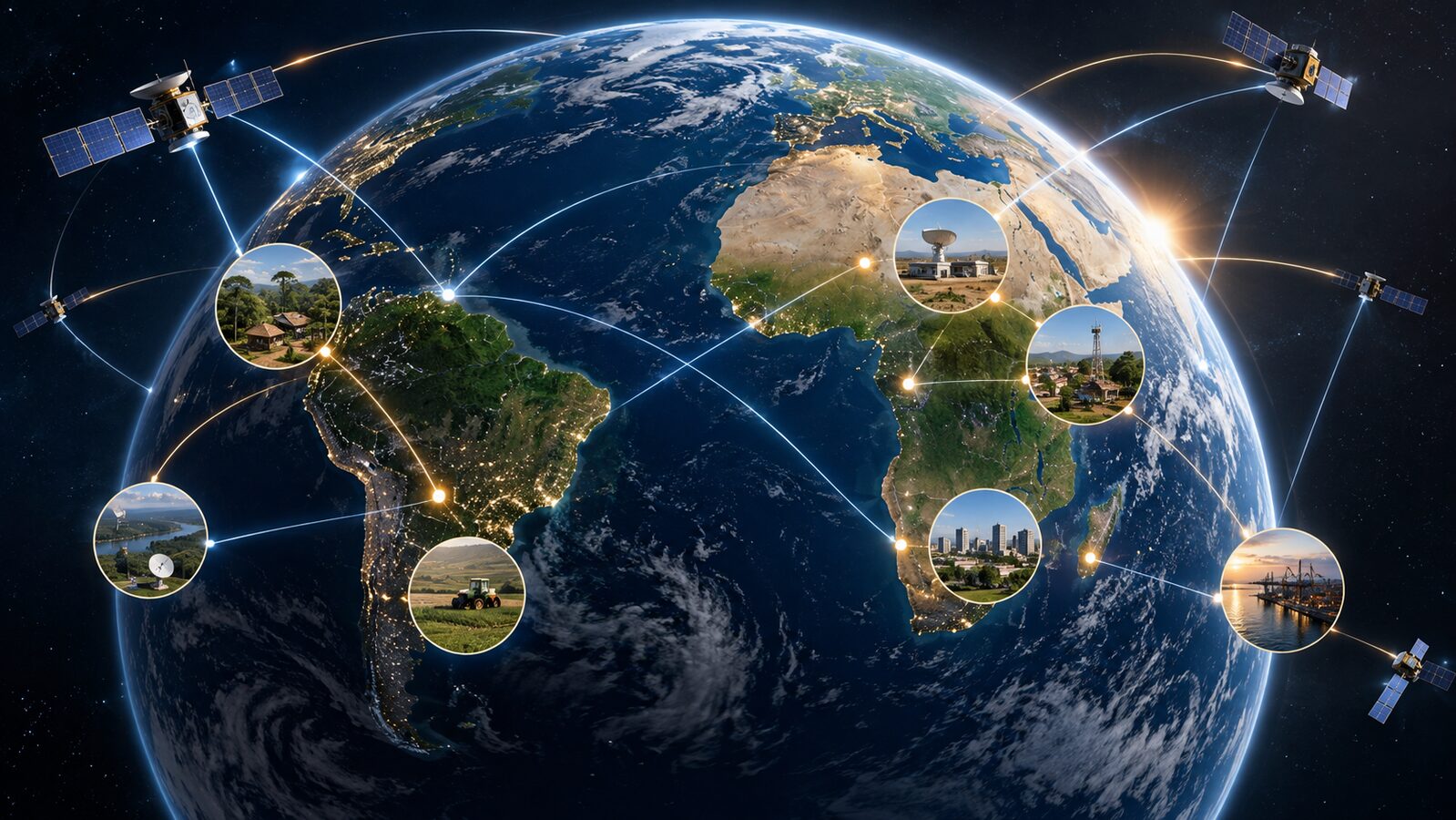
If implemented at scale, the partnership could widen the addressable market for satellite operators, spacecraft manufacturers, data providers, ground-segment companies and specialist consultancies. The State Department specifically identifies potential applications in critical minerals, agriculture, transport, communications, finance, energy and pharmaceuticals.
That breadth is commercially significant. Many emerging space markets do not begin with a launch programme or a sovereign satellite. They begin with a public-service requirement — connecting schools, monitoring crops, mapping resources or improving logistics — and with a government that needs financing, technical advice and a credible route through procurement.
The partnership is designed to reduce those barriers while steering demand towards U.S. suppliers. For companies, this could lower customer-acquisition costs and improve access to officials who control spectrum, licences, public budgets and infrastructure policy. For partner countries, it could provide a more navigable entry point into a fragmented commercial market.
However, it is not a neutral marketplace. The programme’s stated purpose is to support American commercial space leadership. Assistance tied to U.S. goods and services may accelerate deployment, but it could also narrow supplier choice and create dependence on proprietary networks, data formats or ground systems. Contract terms, local capability-building and interoperability will determine whether projects create durable domestic capacity or simply import a service.
Why Djibouti’s signature matters
NASA confirmed Djibouti’s accession at a 14 September ceremony in Washington. The country’s space programme began in 2020 and has placed Djibouti-1A and Djibouti-1B into orbit, in 2023 and 2024 respectively, on SpaceX Falcon 9 rideshare missions from California.
Djibouti’s ambassador to the United States, Mohamed Siad Douale, identified research, satellite applications, education and technical training as priorities. NASA Deputy Administrator Matt Anderson said Accords members could contribute hardware, scientific payloads, technology demonstrations and CubeSats to future missions.
Those are official ambitions, not committed mission assignments. Still, the pattern is notable. Four African countries have joined the Accords in 2026, according to Space in Africa. A coalition that can offer practical access to training, finance, missions and commercial services has a stronger value proposition than one built only around declarations.
Strategic competition moves downstream
The initiative also shows how space competition is shifting from flagship exploration programmes towards the downstream economy. Influence will increasingly be built through connectivity contracts, Earth-observation services, standards, finance and workforce development.
For the United States, the Artemis Accords network offers a ready-made group of potential partners. For signatories, Space Catalyst could make alignment more commercially useful. That creates a strategic feedback loop: projects can reinforce diplomatic relationships, while those relationships can open markets for U.S. suppliers.
The competitive effect should not be overstated yet. One conditional US$6.5 million project is small relative to global satellite investment, and the State Department has not announced a dedicated multi-year funding envelope. Other space powers and commercial operators will continue to compete on price, financing, local partnerships and technical performance.
Milestones that will determine whether it scales
The first test is whether Congress makes funds available for Peru and how the supplier is selected. The award structure will show whether Space Catalyst uses open competition, existing government vehicles or a more tightly directed assistance model.
The second test is delivery. Investors and industry should watch for disclosed coverage areas, user numbers, service levels, terminal costs and provisions for operations after grant funding ends. These details will separate a durable market-building project from a short-lived demonstration.
The third test is replication. Additional projects across Africa, Latin America and the Indo-Pacific — particularly those combining financing with local training or data infrastructure — would indicate that Space Catalyst is becoming a repeatable export platform rather than a single diplomatic announcement.
Finally, the industry should watch whether the initiative expands beyond terrestrial services into payloads, CubeSats and contributions to U.S.-led exploration missions. That would create a more direct bridge between Artemis diplomacy and the lunar economy.
For now, Space Catalyst is a framework with one conditional pilot. Its importance lies in the direction of policy: the United States is trying to make international space alignment produce visible economic benefits. If funding and execution follow, the Artemis Accords could evolve from a statement of principles into a meaningful route to market.