
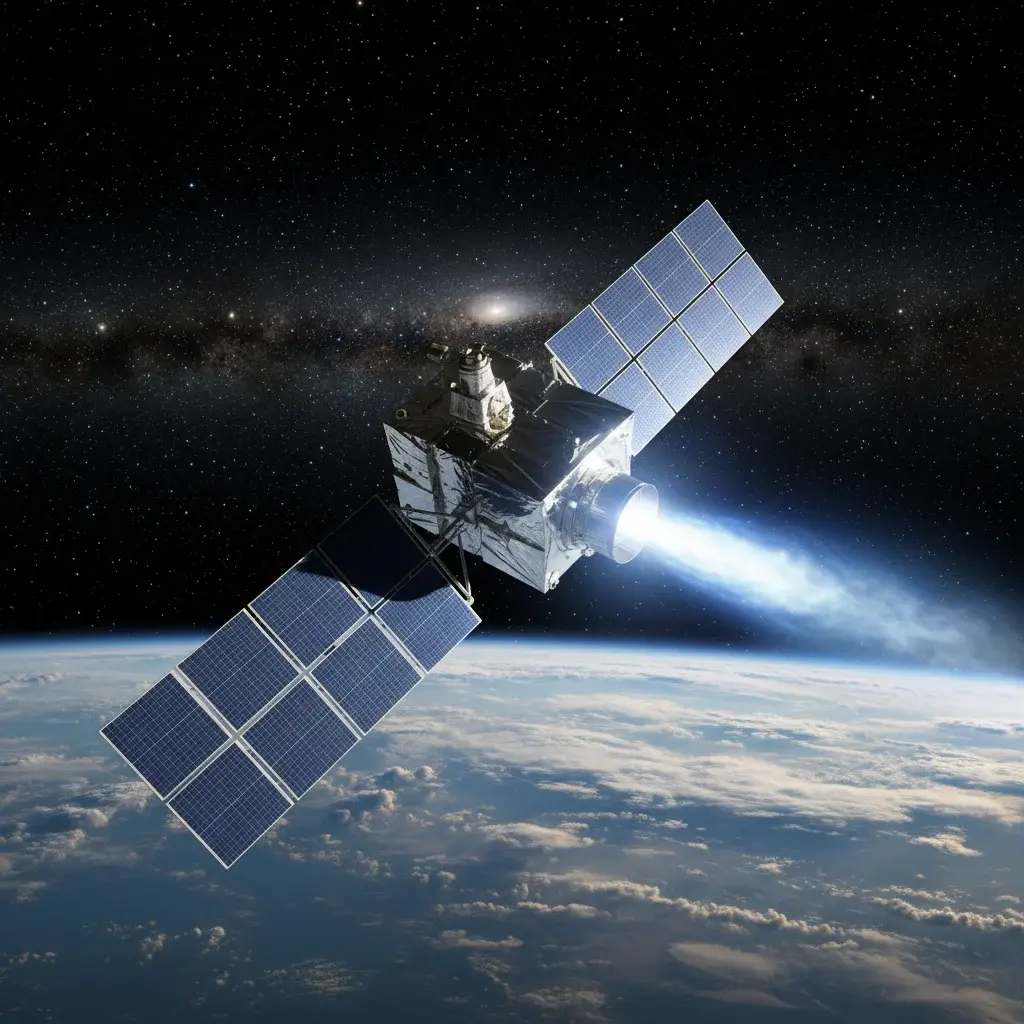
Spanish aerospace startup Arkadia Space has successfully validated its hydrogen peroxide-based DARK propulsion system in low Earth orbit, proving that safe-to-handle green propellants can deliver the high-precision thrust traditionally dominated by toxic hydrazine. Launched in March aboard SpaceX’s Transporter-13 mission via a D-Orbit ION satellite carrier, the in-space demonstration recently returned critical telemetry data. The results confirm the engine’s capability to perform precise maneuvers, marking a significant milestone for sustainable spaceflight.
The Shift Away from Toxic Propellants
For decades, the space industry has relied heavily on hydrazine for in-orbit satellite propulsion. While highly efficient, hydrazine is highly toxic, carcinogenic, and volatile.
Handling this traditional propellant requires specialized hazmat suits, rigorous safety protocols, and complex fueling infrastructure. These requirements drive up operational costs and create significant logistical bottlenecks at launch sites.
Global space agencies and commercial operators are increasingly seeking green alternatives that maintain performance without the associated environmental and human hazards. Hydrogen peroxide has emerged as a leading candidate, offering a stable, non-toxic solution that simplifies ground operations.
Rideshare missions, like SpaceX’s Transporter program, have democratized access to space but require satellites to perform their own last-mile orbital maneuvers. This demand has sparked a massive need for affordable, reliable onboard propulsion systems that do not complicate the launch manifest with hazardous materials.
Precision Performance in Orbit
Arkadia’s DARK engine demonstrated its operational viability by executing extremely short bursts of thrust during its orbital test phase. Telemetry data confirmed the system achieved impulses under 100 millinewton-seconds.
This level of micro-thrust is critical for modern satellite operators. High-precision maneuvers are essential for station-keeping, collision avoidance, and precise orbital phasing in increasingly congested orbital planes.
The successful test proves that hydrogen peroxide systems can perform as well as, if not better than, their toxic hydrazine equivalents in the vacuum of space.
Economic Drivers: Safety Translates to Savings
While environmental and worker safety are primary drivers for green propulsion, the economic advantages are proving equally compelling for commercial operators. Transitioning away from hydrazine fundamentally alters the cost structure of satellite launch preparations.
Fueling a standard satellite propulsion tank with hydrazine can cost up to €2 million ($2.3 million) due to the extensive safety and handling requirements.
In stark contrast, Arkadia completed the fueling operations for its first mission for less than €50,000 (approximately $57,000). This figure impressively includes the cost of the specialized ground equipment the company developed and shipped to the United States for the launch.