
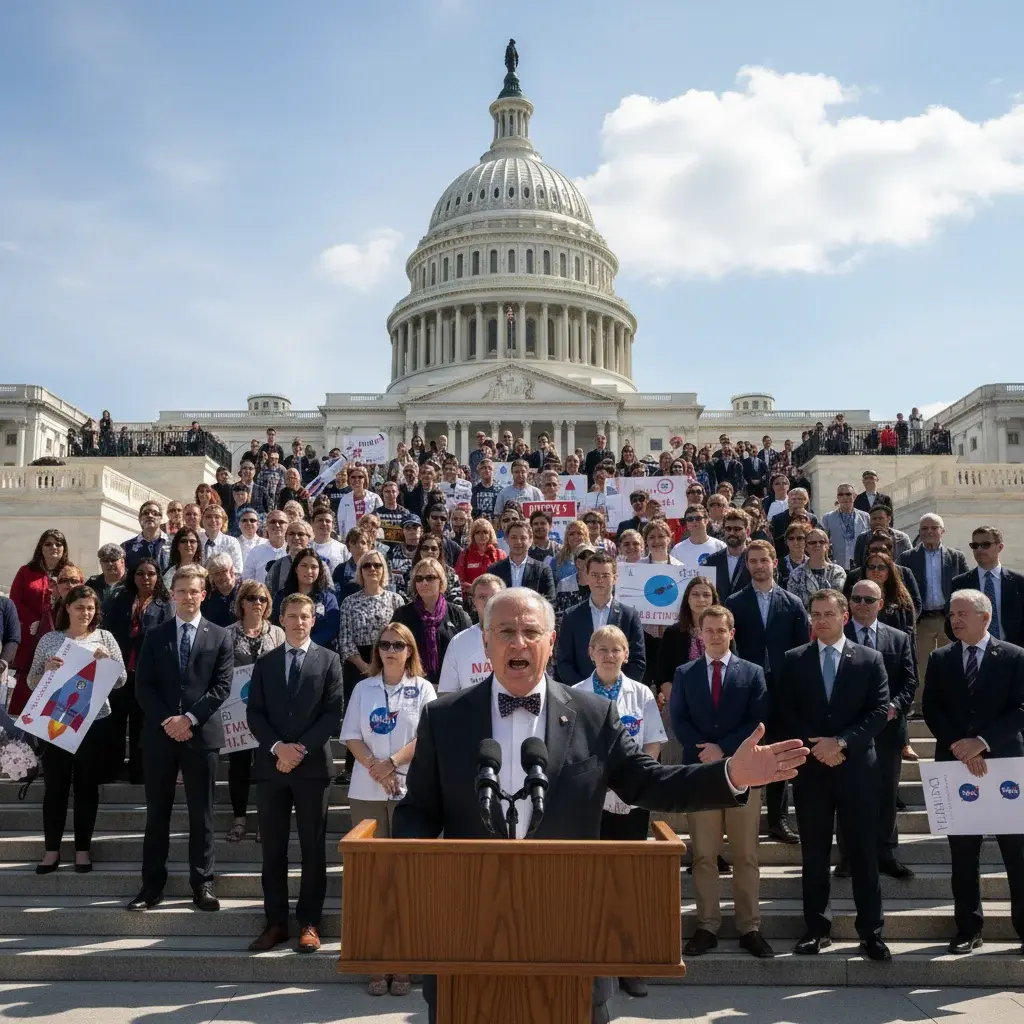
Facing unprecedented financial reductions that threaten the future of American space exploration, The Planetary Society and 20 allied space organizations converged on Capitol Hill yesterday to protest dramatic cuts to NASA’s fiscal 2026 science budget. Led by Planetary Society President Bill Nye, the coalition demanded immediate legislative action to restore funding amidst an ongoing government shutdown that has already furloughed 15,000 space agency employees.
A Budget in Deadlock
The current crisis stems from a sweeping budget proposal released by the Trump administration in May. The plan seeks to slash NASA’s top-line funding by roughly 25 percent year-over-year.
If enacted, the agency’s budget would plummet from an implemented $24.9 billion in fiscal 2025 to just $18.8 billion for the upcoming year.
Congress has failed to reach an agreement on the FY2026 budget, triggering a full government shutdown that began on October 1. The legislative stalemate has brought non-essential federal operations to a standstill, directly impacting thousands of NASA personnel and contractors nationwide.
These 15,000 furloughed civil servants include mission controllers, engineers, and principal investigators whose absence halts daily operations and delays critical mission timelines across the country.
While House and Senate appropriators have firmly rejected the administration’s steep reductions, their alternative budgets remain stalled. The House appropriations committee advanced a $24.8 billion budget for NASA, while the Senate marked up a nearly identical $24.9 billion package.
Both congressional proposals would effectively keep the agency’s funding flat year-over-year. However, neither chamber has passed these budgets, leaving the agency in financial limbo.
High-Profile Missions on the Chopping Block
The administration’s proposed cuts disproportionately target NASA’s science directorate, threatening decades of technological development and international collaboration.
Under the $18.8 billion framework, the highly anticipated Mars Sample Return mission would face complete cancellation. The flagship program, operated in conjunction with the European Space Agency, is considered the holy grail of planetary science.
Abandoning the Mars mission would not only forfeit billions of sunk costs but also cede leadership in Martian exploration to rival nations currently developing their own sample return architectures.
Deep space astrophysics would also suffer immediate casualties. The Chandra X-ray Observatory, a cornerstone of high-energy astrophysics for over two decades, would be phased out entirely. Phasing it out prematurely would blind astronomers to the high-energy universe, severely limiting the study of black holes and supernovas.
Additionally, the Nancy Grace Roman Space Telescope, poised to unravel the mysteries of dark energy and exoplanets, faces significant delays that could inflate its long-term lifecycle costs.
The Commercial vs. Science Divide
Addressing a crowd of supporters on the Capitol steps, Nye framed the budget reductions not as a temporary setback, but as an existential threat to fundamental discovery.