
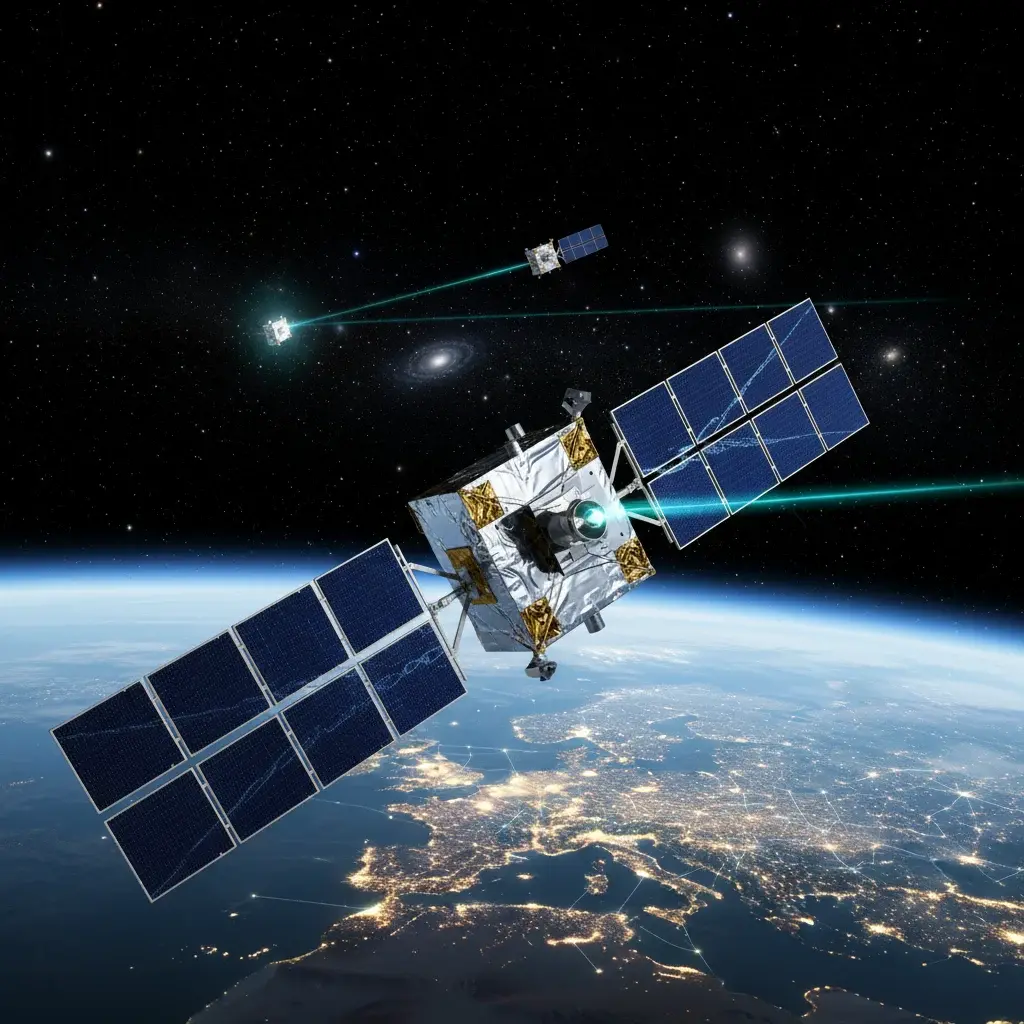
WASHINGTON — Canadian satellite operator Telesat is aggressively maneuvering to capture lucrative U.S. military contracts, modifying its upcoming Lightspeed low Earth orbit (LEO) constellation to meet rigorous defense requirements ahead of its inaugural launches this December. By integrating military-compatible Ka-band frequencies and preparing for a high-stakes laser communications demonstration in 2027, the company aims to position its 198-satellite network as a highly secure, low-latency data transport layer for the Pentagon.
The strategic pivot comes as the U.S. Department of Defense actively seeks commercial partners to bolster its resilient space architectures. Military planners are increasingly moving away from relying solely on vulnerable, massive geostationary satellites, favoring proliferated LEO networks that can withstand jamming and interception attempts.
Engineering for the Tactical Edge
To align with these shifting defense priorities, Telesat has made significant design alterations to its Lightspeed architecture. The most notable inclusion is the integration of military Ka-band frequencies.
This modification ensures the commercial constellation aligns seamlessly with the Pentagon’s existing wideband satellite communications systems. It allows military users to transition between government-owned assets and Telesat’s commercial network without requiring new ground terminal hardware.
Additionally, each of the planned 198 Lightspeed satellites will be equipped with four optical communication terminals supplied by Tesat-Spacecom. These optical inter-satellite links (OISLs) are critical for modern defense networks, utilizing lasers to transmit massive volumes of data across the vacuum of space.
Unlike traditional radio frequency transmissions, laser links are highly directional. This makes them exceptionally difficult for adversaries to intercept, spoof, or jam, providing the secure mesh network in space that military commanders demand.
Proving Ground in Orbit
The true test of Telesat’s defense capabilities will occur in 2027. Backed by a $30 million NASA contract awarded in 2022, the company will conduct a comprehensive laser communications relay demonstration.
The orbital test is designed to simulate a high-stress tactical data relay scenario. During the initial phase, one Lightspeed satellite will function as a mission spacecraft while a second acts as a relay node, passing data securely between them.
A subsequent phase will introduce a third-party commercial asset into the loop. An Earth-imaging satellite operated by Planet Labs, equipped with its own optical terminal, will transmit high-resolution imagery through the Lightspeed mesh network directly to a ground station.
Chuck Cynamon, president of Telesat Government Solutions, highlighted the upcoming demonstration as a crucial proof point during an interview at the Satellite 2026 conference. He noted that the Pentagon and U.S. Space Force are urgently seeking methods to move data rapidly across global networks.
“There’s a demand for hybrid architectures,” Cynamon said, emphasizing that commercial networks can effectively supplement government systems to close near-term capacity gaps.
Fueling the Space Data Network
Telesat’s pitch is directly targeted at the Space Force’s developing “space data network.” This ambitious initiative aims to connect disparate satellites, terrestrial sensors, and weapon systems into a unified, real-time command and control architecture.
A primary beneficiary of this network would be the Pentagon’s Golden Dome missile defense initiative. Golden Dome relies on a robust transport layer to route targeting data between early warning sensors, command centers, and kinetic interceptors in near real-time.
Program officials have publicly signaled a massive, growing demand for such orbital capacity. Gen. Michael Guetlein, who leads the Golden Dome initiative, recently confirmed that funding for the underlying space data network is seeing substantial increases.
“There’s probably no limit on how much capability is going to be needed on orbit from a space data network for the data needs of Golden Dome,” Cynamon observed. He noted that the ultimate goal is to be able to track, target, and engage threats without latency bottlenecks.
Cynamon argued that the 2027 NASA demonstration will directly validate how Lightspeed can route data under the extreme conditions required for missile defense. “This is the kind of capability with direct applicability to what perhaps Space Force might want for a more diverse space data network,” he said. “Certainly the need for moving vast quantities of data with low latency from sensors to shooters for Golden Dome.”
Flexible Procurement and Future Pressures
Beyond hardware, Telesat is innovating its business model to appeal to military procurement officers. Cynamon indicated the company plans to offer the U.S. government a “capacity pool” model.
Instead of requiring the Pentagon to purchase and operate its own satellites, the Department of Defense could access Lightspeed’s bandwidth on demand. “We could also offer a pool of optical connections on a daily, weekly, or monthly basis,” Cynamon explained.
This flexible approach reflects a broader industry shift toward hybrid architectures that seamlessly blend dedicated military infrastructure with commercial service providers.
Telesat expects to launch its first two Lightspeed satellites this December, kicking off a deployment schedule that relies on SpaceX rockets carrying batches of roughly 15 spacecraft. Commercial service is slated to begin in 2028 after the first 156 satellites are operational.
However, Telesat is entering a fiercely competitive arena. The LEO defense market is currently dominated by SpaceX’s Starlink and its military-specific Starshield variant, while Amazon’s Project Kuiper is rapidly emerging. Both heavyweights are aggressively pursuing defense contracts and deploying their own optical inter-satellite links.
Looking ahead, the demand for space-based data transport is expected to surge beyond traditional communications. Emerging concepts for orbital data centers will further pressure satellite networks to expand capacity and accelerate data transfer rates between space and ground stations.
As these next-generation architectures take shape, Telesat’s ability to successfully execute its laser communications demonstration will be critical. The results will likely determine whether the Canadian operator can secure a permanent foothold in the Pentagon’s multi-billion-dollar hybrid space network, or if it will be outpaced by its deep-pocketed commercial rivals.