
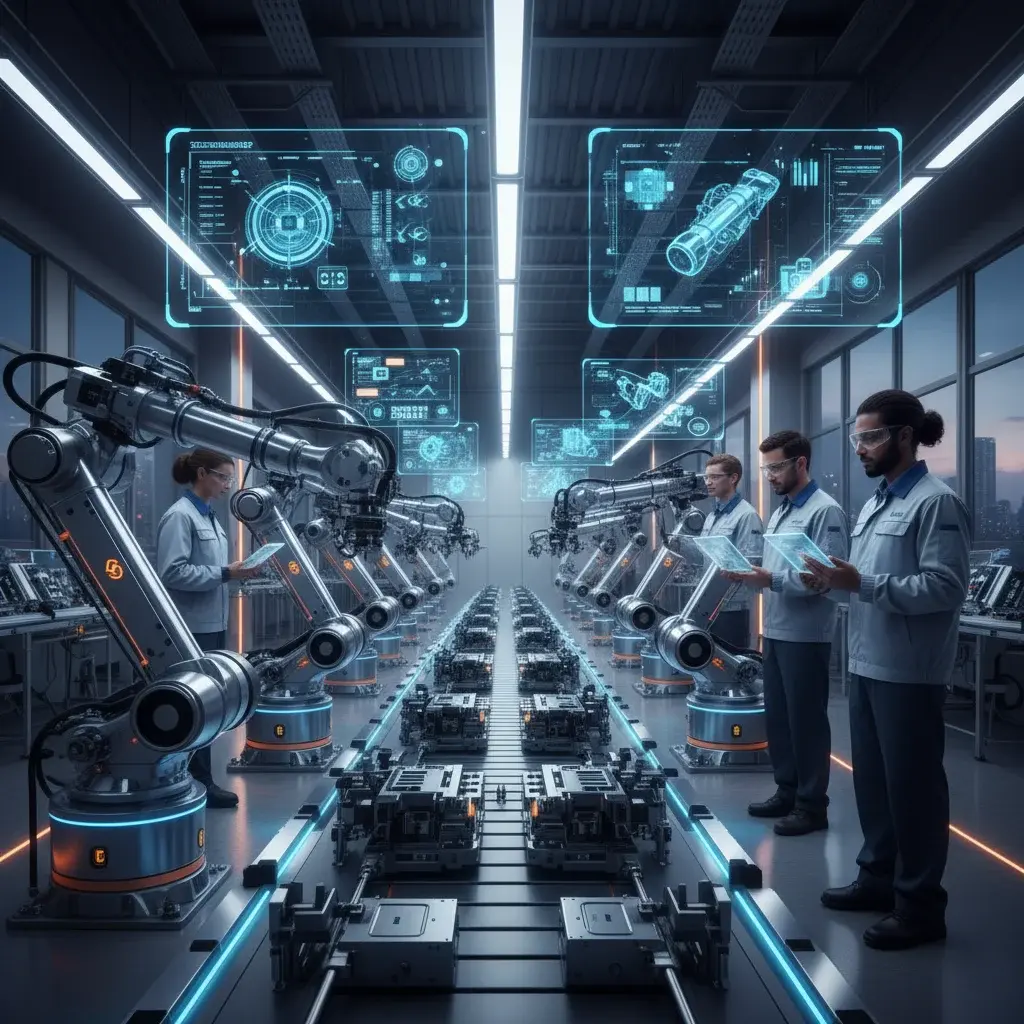
The era of default overseas manufacturing is rapidly drawing to a close as United States industrial leaders pivot toward a new paradigm: the smart factory. Driven by recent global supply chain fractures, rising international labor costs, and new federal incentives, American companies are increasingly reshoring production. However, industry experts warn that simply relocating legacy manufacturing processes back to the U.S. is insufficient to remain globally competitive. Instead, the future of domestic production relies heavily on artificial intelligence, digital twins, and empowered frontline workers to create highly adaptive, resilient operations.
The End of the Offshoring Era
For decades, the golden age of offshoring dictated global business strategies, prioritizing cheap labor over supply chain proximity. That calculus has fundamentally shifted over the past four years.
Geopolitical tensions, shipping bottlenecks, and the realization that extended supply chains carry massive hidden risks have forced a reckoning among manufacturing executives. Yet, traditional reshoring strategies are frequently falling short of expectations.
Companies attempting to simply copy-paste their overseas operations into American facilities are colliding with a severe domestic labor shortage and significantly higher operational costs. The solution, industry leaders argue, lies not in manufacturing nostalgia, but in total technological reinvention.
Reinventing the Factory Floor
To make onshore production faster and more economically viable, companies are deploying cutting-edge digital infrastructure. Smart factories leverage continuous digitization, real-time feedback loops, and advanced automation to offset the higher costs of U.S.-based production.
These advanced facilities are characterized by their unprecedented agility. By utilizing intelligent feedback systems, plant managers can drive rapid iteration, adjusting production lines in minutes rather than months.
Digital twins—virtual replicas of physical manufacturing environments—are proving particularly transformative in this space. These models ingest millions of data points from IoT sensors embedded across the factory floor.
This allows engineers to simulate production changes, predict catastrophic machine failures, and optimize complex workflows before a single physical component is altered. The result is a dramatic reduction in downtime and material waste.
Expert Perspectives on Manufacturing Agility
During a recent industry panel exploring the intersection of technology and reshoring, manufacturing executives outlined the critical role of these digital tools.
Karan Talati, CEO of First Resonance, emphasized that software and real-time data are no longer optional for modern manufacturers. Talati noted that traditional reshoring strategies fail because they attempt to solve 21st-century supply chain problems with 20th-century operational models.
By integrating AI, manufacturers can finally achieve the necessary scale without linearly increasing their headcount. According to Talati, smart feedback loops are the primary engine driving modern factory performance, allowing teams to catch defects instantly.
Robert Pakalski, VP of External Manufacturing at Hadrian, highlighted how automation fundamentally changes the economics of American production. By automating repetitive and physically demanding tasks, companies can reallocate their human workforce toward complex problem-solving and quality assurance.
Empowering the Frontline Workforce
Despite the heavy focus on artificial intelligence and robotics, the human element remains central to the smart factory model. Successful reshoring initiatives are proving that automation works best when it empowers, rather than replaces, the frontline worker.
When operators are equipped with real-time data via tablets or augmented reality headsets, they transition from manual laborers to process managers. This frontline empowerment fuels operational resilience across the entire organization.
Workers who understand the data behind their machines can make localized decisions, preventing bottlenecks before they ripple through the supply chain. This hybrid approach is becoming the gold standard for onshore facilities.
Economic and Policy Tailwinds
The transition toward smart onshoring is not happening in a vacuum. A confluence of robust economic and policy forces is actively accelerating the adoption of these technologies across the United States.
Mo Islam, CEO and Co-Founder of Arkaea, framed the discussion around these broader macroeconomic shifts. Islam pointed out that legislative tailwinds are creating a rare window of opportunity for industrial growth.
Federal initiatives are not just encouraging companies to build locally; they are specifically incentivizing the deployment of next-generation industrial technology. Tax incentives and grants are lowering the barrier to entry for mid-sized manufacturers looking to upgrade their facilities.
Furthermore, the rising cost of capital is forcing companies to seek out the rapid return on investment that predictive maintenance and AI-driven quality control can provide.
Implications for the Industry
The shift from traditional offshoring to smart domestic production represents a permanent restructuring of the global supply chain. For consumers and downstream businesses, this transition promises greater product availability, faster innovation cycles, and reduced exposure to international crises.
Furthermore, the environmental impact of localized, highly efficient production will play a crucial role in corporate sustainability goals. By reducing trans-oceanic shipping and minimizing scrap through AI-optimized manufacturing, smart factories offer a greener alternative.
Looking ahead, the integration of generative AI into manufacturing software will likely be the next major frontier. Industry observers should watch closely as artificial intelligence moves beyond predictive maintenance and begins actively designing more efficient production layouts.
Companies that fail to digitize their operations will increasingly find themselves priced out of the domestic market, unable to compete with the speed and efficiency of their tech-enabled peers. The definition of American manufacturing has permanently changed, and the race to build the smartest factory is only just beginning.



Leave a Reply