WASHINGTON — Satellite internet rivals SpaceX and Amazon are clashing before the Federal Communications Commission this week over orbital safety, with SpaceX alleging that Amazon’s recent broadband satellite deployments violate its regulatory license and create severe collision risks in Low Earth Orbit.
In a formal letter filed on April 1, SpaceX demanded immediate FCC intervention, claiming Amazon’s deployment practices forced Starlink satellites into evasive maneuvers. Amazon swiftly countered on April 2, denying any rule violations while accusing SpaceX of manufacturing the crisis by recently lowering its own constellation’s altitude.
The Race to Populate Low Earth Orbit
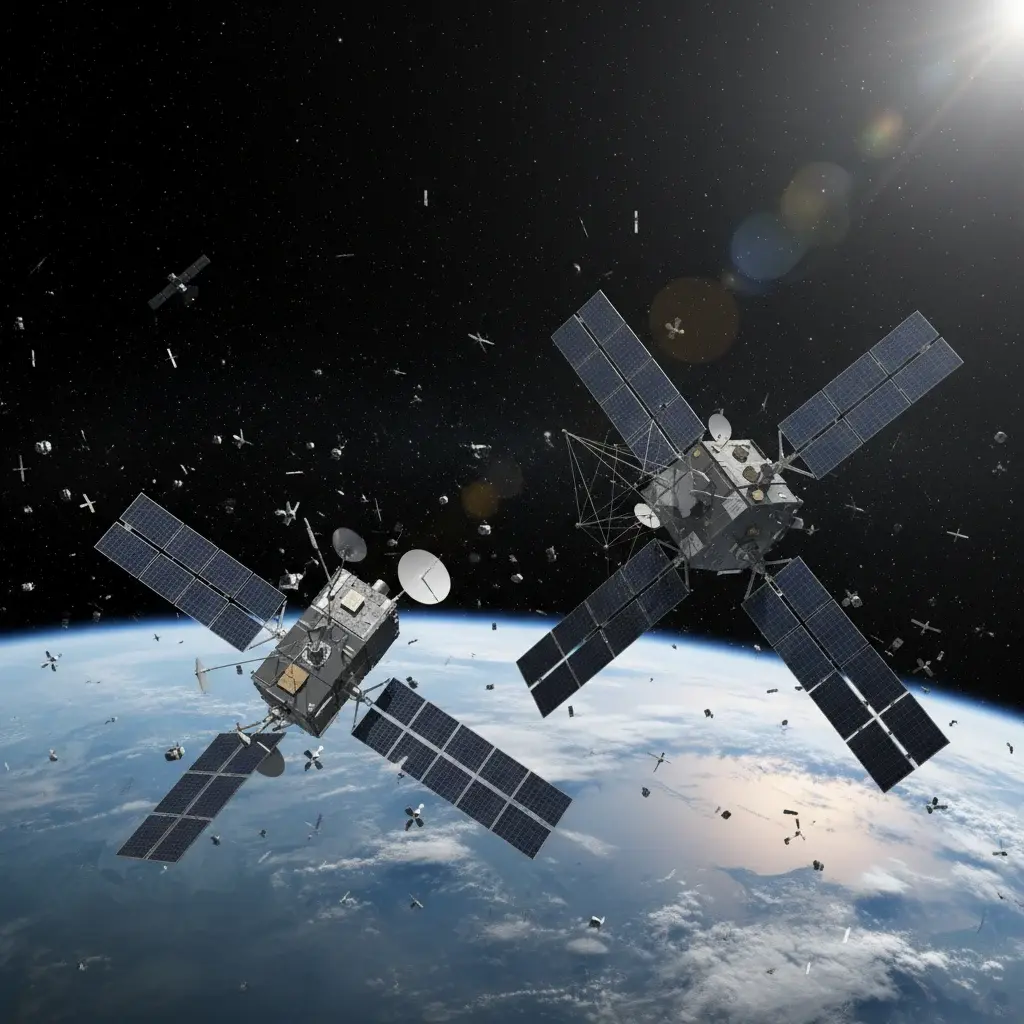
The dispute highlights growing tensions in the increasingly crowded space domain. Both companies are investing billions to build massive satellite internet constellations to provide global broadband coverage.
SpaceX currently operates a dominant fleet of several thousand Starlink satellites. Amazon is racing to deploy its competing 3,232-satellite constellation to meet looming regulatory deadlines.
To mitigate the creation of dangerous space debris, the FCC requires operators to submit detailed orbital debris mitigation plans. A standard industry practice involves deploying spacecraft into a lower insertion orbit for initial systems checkouts.
If a satellite fails upon deployment, the lower altitude ensures atmospheric drag will cause it to safely burn up within a short period. Fully functional satellites then use onboard propulsion to climb to their higher operational altitudes.
SpaceX Alleges Unmitigated Collision Risks
At the center of the conflict is the precise altitude at which Amazon releases its satellites from their launch vehicles. SpaceX claims Amazon is blatantly ignoring the conditions of its FCC license.
According to SpaceX’s April 1 filing, Amazon’s authorization requires deployments to occur “at or near” a 400-kilometer altitude. However, SpaceX alleges Amazon has been consistently deploying its spacecraft into orbits 50 to 90 kilometers higher than that baseline.
SpaceX stated this issue occurred across eight previous launches but escalated dramatically during a February 12 mission. During that launch, an Ariane 6 rocket deployed 32 Amazon satellites directly into the increasingly congested altitudes where Starlink operates.
SpaceX told the FCC that the February 12 deployments occurred at an altitude “sufficiently high that it led to unmitigable collision risks with dozens of operational spacecraft.” Furthermore, SpaceX accused Amazon of failing to update its debris mitigation plan or provide predicted maneuver plans, known as ephemerides, for the newly launched hardware.
This lack of coordination allegedly placed a heavy burden on SpaceX’s automated safety systems. SpaceX claimed that Starlink satellites had to execute 30 separate collision avoidance maneuvers within hours of the Ariane 6 deployment.
“Amazon must therefore swiftly ensure its launch plans comport with its authorization before it creates irreparable harm,” SpaceX concluded in its letter.
Amazon Cites Flexibility and Points to Starlink Shifts
Amazon fired back the following day, filing an April 2 response that forcefully rejected SpaceX’s characterization of the events. Amazon argued its FCC license does not mandate a strict 400-kilometer deployment ceiling, but rather provides “some flexibility” to accommodate complex mission requirements.
Amazon also highlighted what it views as inconsistencies in SpaceX’s safety complaints. The company noted that SpaceX raised no objections when Amazon satellites launched on three of SpaceX’s own Falcon 9 rockets earlier this year, despite those payloads being deployed at initial altitudes of 460 kilometers.
“SpaceX only began raising the issues described in its letter within the last several months, after lowering the altitude of its Starlink constellation to 475, 480, and 485 km,” Amazon stated.
Earlier this year, SpaceX announced it was migrating thousands of Starlink satellites from their original 550-kilometer orbits down to the 480-kilometer range. While SpaceX billed this massive orbital shift as a move to improve space safety and reduce latency, Amazon suggests this unilateral maneuver is the true source of the current friction.
“The issues raised by SpaceX do not involve violation of Commission rules or industry standards,” Amazon argued. “Amazon Leo’s launch and insertion parameters comply with industry standards and best practices.”
Failed Negotiations and Future Adjustments
Despite denying any regulatory violations, Amazon stated it has taken SpaceX’s risk posture seriously and attempted to negotiate mutually acceptable operational solutions.
Modifying deployment altitudes is a complex engineering challenge. Amazon noted that changing launch parameters requires up to a year of rigorous technical assessment with launch providers to ensure mission viability and safety.
“When it became clear that changing near-term Ariane launch parameters would cause multi-month delays, Amazon Leo proposed a solution that would maintain Amazon Leo’s deployment schedule while still addressing SpaceX’s concerns,” Amazon wrote. According to the filing, SpaceX declined the undisclosed proposal and failed to offer alternative solutions.
Nevertheless, Amazon is actively working to alter its future launch profiles. The company confirmed it is coordinating with Arianespace to target a lower insertion orbit beginning with the fourth Ariane 6 launch of its satellites.
Amazon is also engaging its other launch providers to evaluate if insertion altitudes can be lowered without derailing its aggressive deployment schedule. This likely includes SpaceX itself, as Amazon recently revealed in an FCC application that it purchased 10 additional Falcon 9 launches for late 2025 to help meet its regulatory deployment deadlines.
Implications for Space Traffic Management
The escalating rhetoric between two of the world’s most well-funded space enterprises underscores a critical gap in global space governance. As Low Earth Orbit transforms into a heavily commercialized zone, the lack of centralized space traffic management leaves operators to negotiate right-of-way disputes on an ad hoc basis.
The FCC is increasingly finding itself in the role of a de facto space traffic cop, forced to adjudicate complex orbital mechanics disputes through licensing conditions. How the commission responds to this specific standoff will likely set a precedent for how future mega-constellations share orbital shells.
Looking ahead, the frequency of potential close approaches will only increase. On March 23, Amazon announced plans to dramatically accelerate its constellation deployment. The company aims to execute 20 launches annually, carrying up to 48 satellites per mission.
Industry observers and regulators will be closely monitoring Amazon’s upcoming flight cadence to see how the company balances its regulatory deadlines with orbital safety. The next Amazon launch is scheduled for April 4 aboard a United Launch Alliance Atlas 5, followed closely by the second Ariane 6 mission on April 28.