
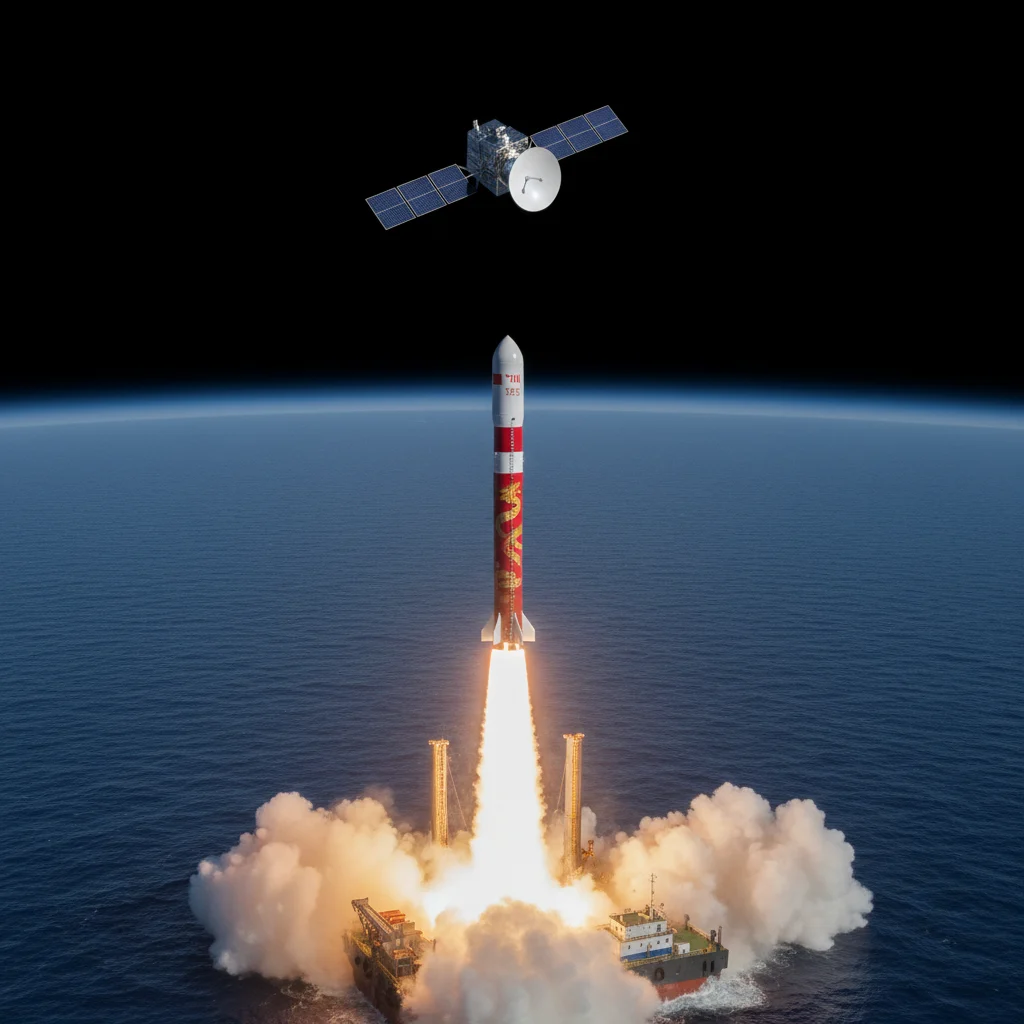
China rapidly expanded its low Earth orbit (LEO) infrastructure this week, executing a pair of successful rocket launches from land and sea to deploy advanced radar mapping and navigation augmentation satellites. The dual missions, conducted on March 22 and March 25, 2026, underscore Beijing’s aggressive push to commercialize its space sector while bolstering national Earth observation and global positioning capabilities.
Expanding the SuperView Radar Constellation
The latest mission lifted off at 6:51 p.m. Eastern on March 25. A Long March 2D hypergolic rocket departed from the Taiyuan Satellite Launch Center in northern China. Within an hour, the China Aerospace Science and Technology Corporation (CASC) confirmed the successful deployment of two synthetic aperture radar (SAR) satellites.
These payloads, designated SuperView Neo-2 (Siwei Gaojing-2) satellites 05 and 06, join an expanding commercial remote sensing network. CASC statements indicate the spacecraft will deliver all-weather, high-resolution radar imagery with a resolution better than one meter.
Unlike traditional optical sensors, synthetic aperture radar can penetrate cloud cover and operate in complete darkness. This all-weather capability ensures consistent data collection regardless of atmospheric conditions.
Sub-meter resolution further elevates this capability, allowing analysts to track millimeter-level shifts in infrastructure over time. Operators will use the imagery for the rapid production of high-precision digital elevation models (DEM), radar orthophoto products, and time-series radar interferometry.
China Siwei, a CASC subsidiary, operates the SuperView constellation, which was developed by the Shanghai Academy of Spaceflight Technology (SAST). This network operates alongside China’s national Gaofen Earth observation system, the military Yaogan series, and the commercial Jilin-1 optical constellation.
Sea Launches and GNSS Augmentation
Days prior to the Taiyuan mission, China demonstrated its flexible launch capabilities with a sea-based operation. On March 22 at 11:49 a.m. Eastern, a Jielong-3 (Smart Dragon-3) solid rocket launched from a converted barge in the Yellow Sea off the coast of Shandong province.
The payload consisted of 10 low Earth orbit navigation enhancement satellites, collectively known as the CentiSpace-2 group. CASC confirmed the successful deployment for commercial operator Future Navigation.
The U.S. Space Force subsequently tracked the 10 satellites into near-circular low Earth orbits. Spacecraft data shows an operating altitude of approximately 645 kilometers with an inclination of 55 degrees.
The CentiSpace network is designed to augment existing Global Navigation Satellite System (GNSS) signals, including China’s Beidou and the U.S. GPS. Traditional GNSS satellites operate in medium Earth orbit (MEO), roughly 20,000 kilometers above the planet.
By broadcasting supplementary signals from LEO at just 645 kilometers, the CentiSpace satellites deliver much stronger signals to ground receivers. This proximity reduces signal degradation and significantly accelerates positioning convergence times.
Future Navigation plans to scale the CentiSpace constellation to between 160 and 190 satellites operating at various altitudes and inclinations. Targeted commercial applications include autonomous driving, precision agriculture, and advanced Geographic Information Systems (GIS).
State-Backed Commercialization
While Future Navigation operates as a commercial entity, the CentiSpace project highlights the deep integration of state resources in China’s commercial space sector. The Beidou Industry Fund, a state-backed investment vehicle designed to boost China’s national GNSS ecosystem, serves as a key investor.
Furthermore, state-owned defense and electronics conglomerates are heavily involved in the hardware development. The Innovation Academy for Microsatellites of the Chinese Academy of Sciences (IAMCAS) developed the constellation’s 2018 pilot satellite.
The 29th Research Institute of China Electronics Technology Group Corporation (CETC) also provides critical technology for the navigation network. This blending of state funding and commercial operation reflects Beijing’s broader strategy to accelerate space technology deployment.
Accelerating Launch Cadence and Market Competition
The Jielong-3 mission marked the 10th flight of the four-stage solid rocket since its debut in December 2022. All ten launches have occurred from mobile sea platforms in the Yellow Sea, maintaining a 100 percent success rate.
The 31-meter-long rocket offers a payload capacity of 1,500 kilograms to a 500-kilometer sun-synchronous orbit (SSO). Capitalizing on this reliability, CASC subsidiary China Rocket is actively marketing commercial rideshare opportunities for SSO and LEO missions scheduled for late 2026 and 2027.
By advertising dedicated rideshare missions, China Rocket is directly positioning the Jielong-3 against international competitors. The ability to launch from mobile sea platforms also relieves congestion at China’s inland spaceports, providing flexible scheduling for commercial clients.
These back-to-back missions represent China’s 15th and 16th orbital launch attempts of 2026. Industry data suggests China is on track to attempt more than 100 orbital launches in a single calendar year for the first time, an increase from 92 attempts in 2025.
Looking ahead, global space industry monitors are tracking preparations at the coastal Wenchang spaceport on Hainan island. Recent social media footage indicates transporter-erector rehearsals are underway at Pad-2 for the new Long March 10B rocket.
The imminent debut of this reusable launch vehicle signals a critical shift in Chinese aerospace logistics. As China transitions toward reusable rocketry, the cost of deploying massive LEO constellations will likely plummet, intensifying global competition in commercial Earth observation and satellite navigation markets.


Leave a Reply