
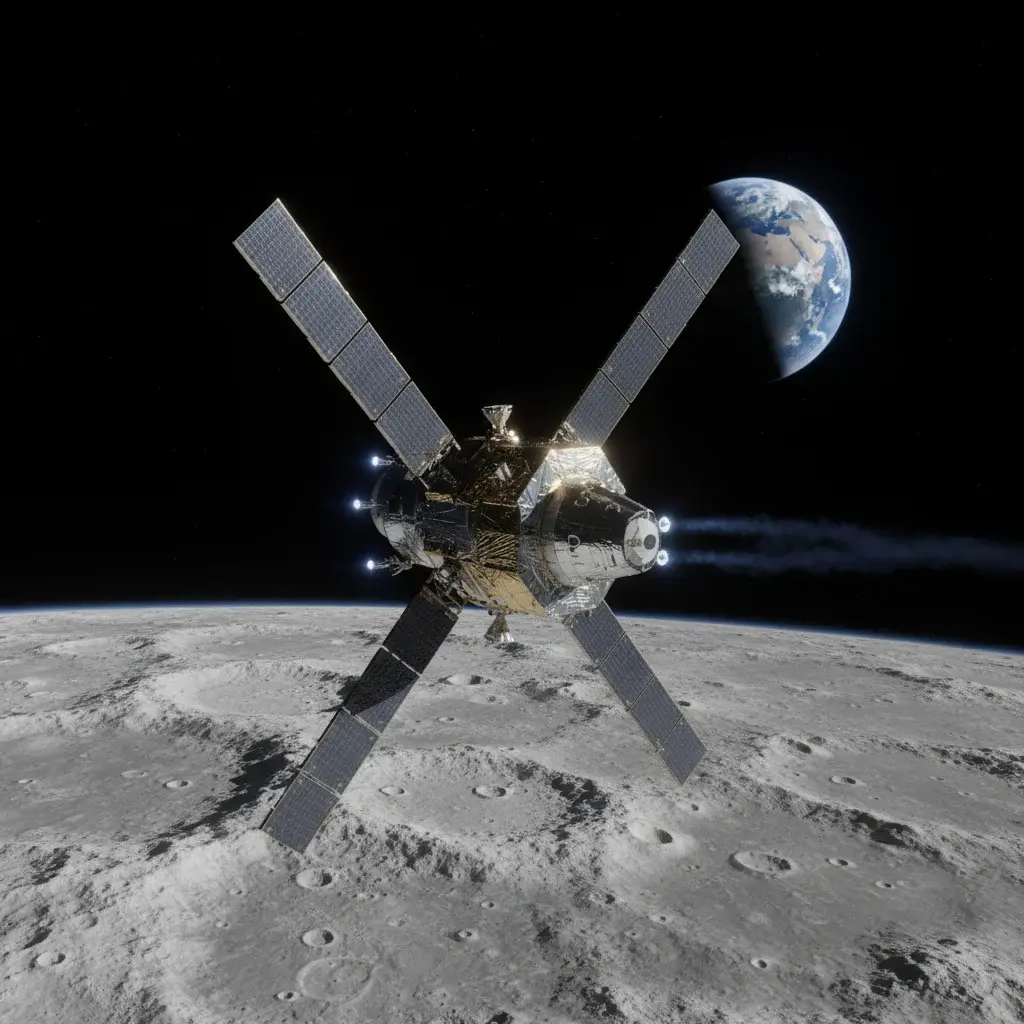
NASA will launch four astronauts from Florida’s Kennedy Space Center on the Artemis 2 mission, sending humanity back to the moon’s vicinity for the first time in more than a half-century. While the space agency advertises the historic flight of the Space Launch System (SLS) rocket and Orion spacecraft as a 10-day mission, the actual elapsed time from liftoff to splashdown will clock in at exactly nine days, one hour, and 46 minutes.
The highly anticipated flight marks the first crewed test of the Orion spacecraft. It serves as a critical stepping stone for future lunar landings, following the uncrewed Artemis 1 test flight in 2022. Mission planners designed the flight profile to rigorously test life support systems and manual piloting capabilities before committing to a deep space trajectory.
Earth Orbit and Proximity Operations
The mission begins with the massive SLS rocket lifting off from Launch Complex 39B. Two minutes and eight seconds into the flight, the twin solid rocket boosters will separate. The core stage’s four RS-25 engines will shut down six minutes later.
The Interim Cryogenic Propulsion Stage (ICPS), with the Orion spacecraft attached, will then separate into an initial orbit of 27 by 2,222 kilometers. Rather than heading immediately for the moon, Orion will spend its first 24 hours orbiting Earth.
A burn by the ICPS RL10 engine 49 minutes after launch will stabilize the orbit at 185 by 2,222 kilometers. An hour later, a second maneuver will drastically raise the apogee to 70,380 kilometers, creating a highly elliptical orbit.
Three hours and 24 minutes after liftoff, Orion will separate from the ICPS. Astronauts will spend the next 75 minutes manually maneuvering Orion around the discarded stage. They will approach within 10 meters to demonstrate proximity operations, a crucial prerequisite for future missions requiring Orion to dock with lunar landers.
“We want to make sure we understand our manual capabilities,” said Howard Hu, NASA Orion program manager. “The Artemis 2 demonstration gives the crew an opportunity to, I would say, test drive the car. They get a sense of the feedback of the system, how the spacecraft performs.”
Life Support and Translunar Injection
Following the proximity tests, the ICPS will perform a disposal burn to safely reenter over the Atlantic Ocean. Before its destruction, the stage will deploy four cubesats from Argentina, Germany, Saudi Arabia, and South Korea to conduct space weather observations.
Meanwhile, the crew will utilize their day in Earth orbit to evaluate critical Orion systems. Engineers will closely monitor the environmental control and life support systems, which flew without a crew during Artemis 1.
“The big emphasis will be on environmental control and life support systems,” noted Kirk Shireman, vice president and program manager of Orion at Lockheed Martin. The crew will also test their physical interactions with the spacecraft’s displays and flight controls.
Approximately 25.5 hours after launch, Orion’s main engine will execute the translunar injection (TLI) burn. This maneuver places the spacecraft on a free-return trajectory around the moon.
While emergency abort options exist, mission control prefers the stability of the planned route. “Once we hit TLI, from there you can abort to come home, but you get very rapidly to a point of diminishing returns where you’re not going to shave that many days off the mission,” said Emily Nelson, NASA chief flight director. “You’re almost always going to err toward the free-return trajectory because it’s a much less dynamic situation.”
Lunar Observations and Apollo Records
During the outbound journey, astronauts will conduct emergency preparedness drills, including rapid spacesuit donning. They will also finalize their lunar observation campaign.
This observation period begins four days and 22 hours into the flight and lasts approximately 24 hours. The crew will photograph and observe the lunar surface, though specific targets will require real-time adjustments depending on the exact launch date and shifting lighting conditions.
Artemis 2 may also rewrite the history books. Orion will reach its maximum distance from Earth just over five days after liftoff. If the mission launches early in the April window, it will break the distance record for a crewed spacecraft set by Apollo 13 in 1970.
However, late-window launches offer less certainty. “It’s within the error of our trajectory planning tools,” Nelson stated regarding the potential record.
Reentry Strategy and Mission Watchpoints
The homeward leg features additional system demonstrations and crew rest. At eight days and 22 hours, astronauts will begin reentry preparations and finalize vehicle checklists.
The Orion crew module will jettison its service module at the nine-day, one-hour mark, just before hitting the Earth’s atmosphere. The capsule will deploy drogue and main parachutes before splashing down in the Pacific Ocean off the coast of San Diego.
Engineers will scrutinize this reentry phase heavily. NASA delayed Artemis 2 by more than a year to investigate greater-than-expected heat shield erosion experienced during Artemis 1.
While Lockheed Martin and NASA plan a redesigned heat shield for Artemis 3, Artemis 2 retains the original design. Instead, mission planners altered the reentry flight path to significantly reduce thermal loads. NASA Administrator Jared Isaacman recently reviewed and approved this modified approach.
The successful validation of this heat shield strategy and the life support systems will dictate the timeline for Artemis 3, which aims to return humans to the lunar surface. As engineers analyze the post-splashdown data, the aerospace industry will watch closely to see if Orion’s modified reentry profile proves robust enough to keep the broader Artemis program on schedule for sustained lunar exploration.

Leave a Reply