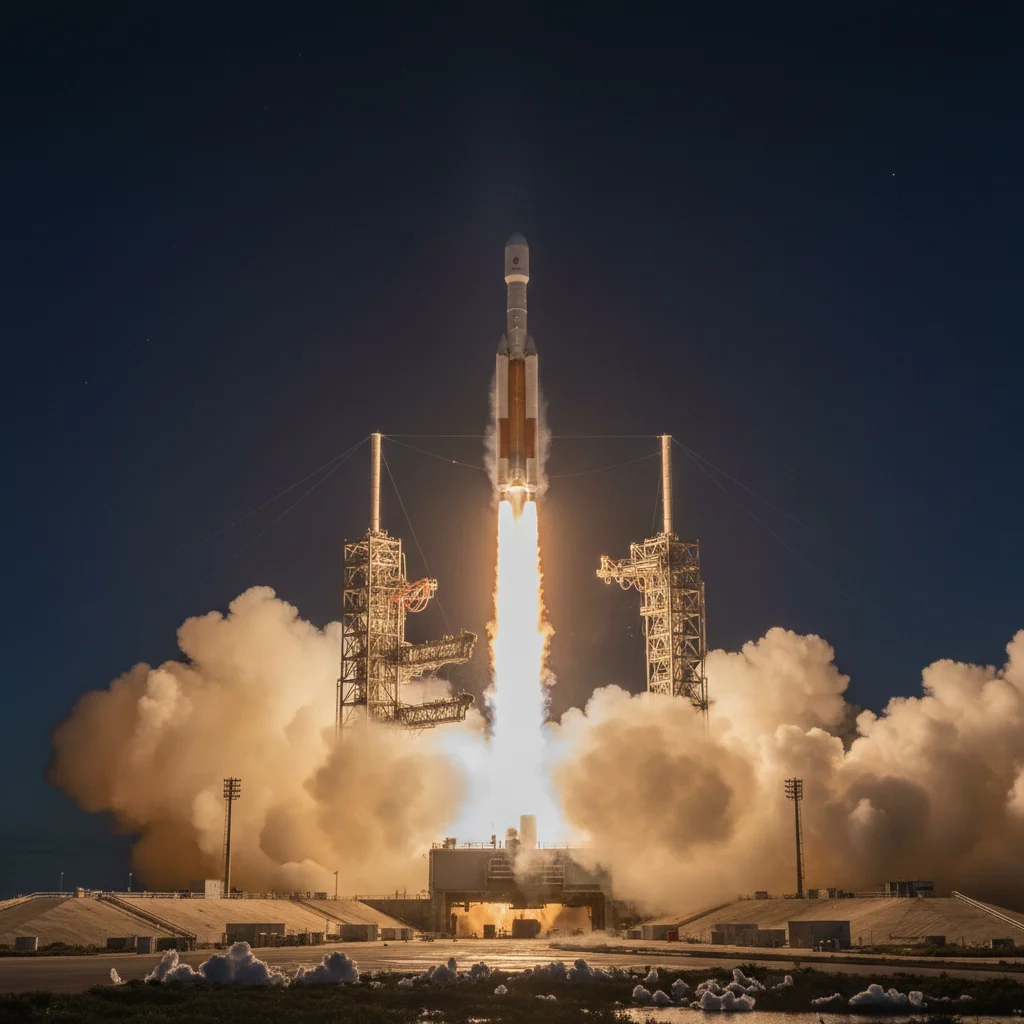
An Atlas 5 rocket successfully launched a record 29 Amazon Leo broadband satellites into low Earth orbit from Cape Canaveral Space Force Station early April 4. The mission marks a critical step for Amazon as the technology giant scrambles to accelerate the deployment of its massive internet constellation ahead of looming federal regulatory deadlines.
The Race for Orbital Real Estate
The aerospace industry is closely monitoring Amazon’s satellite deployment progress as it challenges established competitors in the low Earth orbit broadband market. The company is actively constructing a 3,232-satellite network, previously known as Project Kuiper, designed to provide low-latency global internet access. However, Amazon is operating under a strict timeline mandated by the Federal Communications Commission (FCC).
Federal licensing rules require Amazon to have exactly half of its planned constellation—1,616 satellites—operational in orbit by July. Following this latest mission, the company currently has just 241 satellites in space. This leaves a substantial deployment deficit as the critical summer deadline approaches.
Record-Breaking Atlas Mission
United Launch Alliance (ULA) executed the April 4 mission using an Atlas 5 551 rocket configuration. The vehicle lifted off at 1:46 a.m. Eastern time from the Florida spaceport. Exactly 37 and a half minutes after liftoff, the rocket successfully completed the deployment of its entire 29-satellite payload into low Earth orbit.
This flight represents the fifth operational launch of Amazon Leo satellites utilizing Atlas 5 rockets. Notably, this mission carried two more satellites than the previous four Atlas launches, which each transported 27 spacecraft.
ULA and Amazon achieved this increased capacity through targeted technical modifications. On March 23, Amazon announced that detailed engineering work allowed the integration of additional satellites into the payload fairing. This capability was further enabled by utilizing a higher-performing variant of the RL10C engine, which powers the Atlas rocket’s Centaur upper stage.
According to ULA, this mission, designated LEO 5, carried the highest number of satellites ever loaded onto an Atlas vehicle. The launch provider also confirmed it was the heaviest payload in the rocket’s history. Neither ULA nor Amazon disclosed the exact total mass of the spacecraft payload.
Regulatory Hurdles and Rocket Delays
The intense pressure to meet the FCC’s July milestone has forced Amazon to adjust its regulatory and operational strategies. In January, the company formally petitioned the FCC to either extend the deployment deadline by two years or grant a regulatory waiver. Amazon cites severe delays across the heavy-lift launch vehicle market as the primary cause for its lagging deployment schedule.
The company originally contracted the bulk of its constellation launches to three next-generation rockets. These included Arianespace’s Ariane 6, Blue Origin’s New Glenn, and ULA’s Vulcan Centaur. To date, these next-generation vehicles have not provided the necessary flight cadence to sustain Amazon’s ambitious timeline.
Amazon managed to launch its first operational satellites aboard an Ariane 6 in February. However, neither Blue Origin’s New Glenn nor ULA’s Vulcan Centaur has flown any Amazon Leo satellites yet. To bridge this critical launch gap, Amazon has relied heavily on the legacy Atlas 5 and purchased flights from competitor SpaceX.
The company noted in its recent FCC filing that it has secured an additional 10 launches on SpaceX Falcon 9 rockets. ULA currently retains three remaining Atlas 5 flights dedicated to the Amazon Leo project.
Scaling Future Launch Operations
Looking ahead, Amazon plans to aggressively ramp up its launch operations to secure its orbital network. The company stated on March 23 that it intends to double its current launch cadence, targeting more than 20 missions annually. This acceleration hinges entirely on the successful introduction and regular flight of the New Glenn and Vulcan rockets.
Once operational, these heavy-lift vehicles will significantly increase payload volume per mission. Each Vulcan launch will accommodate at least 40 satellites, while New Glenn is designed to carry 48 or more at a time. Furthermore, Amazon expects future Ariane 6 missions to carry upwards of 32 satellites once Arianespace upgrades the vehicle with more powerful solid rocket boosters.
ULA’s Vulcan Centaur Challenges
The April 4 launch also held vital significance for ULA’s broader operational tempo. It marked the launch provider’s first mission since a February 12 flight of its new Vulcan Centaur rocket for the U.S. Space Force. During that February mission, the Vulcan experienced an anomaly with one of its solid rocket boosters.
While the rocket still successfully deployed its primary payload, the incident has temporarily grounded future Vulcan flights pending an investigation. Space Force officials confirmed during a March 25 hearing that they are actively developing contingency plans. The military branch is preparing alternative launch arrangements for upcoming payloads originally assigned to Vulcan, anticipating the new rocket may remain grounded for several months.
Market Implications and Next Steps
Industry observers and regulatory bodies are now focused on the immediate launch manifest as Amazon attempts to close the gap on its FCC requirements. ULA is scheduled to execute another Atlas 5 mission for the Amazon Leo constellation no earlier than April 27. Immediately following, Arianespace is slated to launch an Ariane 6 mission carrying Amazon satellites on April 28.
The success of these rapid-fire launches will serve as a crucial indicator of Amazon’s logistical capabilities. The industry will closely watch the FCC’s pending decision on the waiver request, which will fundamentally dictate Amazon’s ability to remain a viable competitor against existing satellite internet providers.