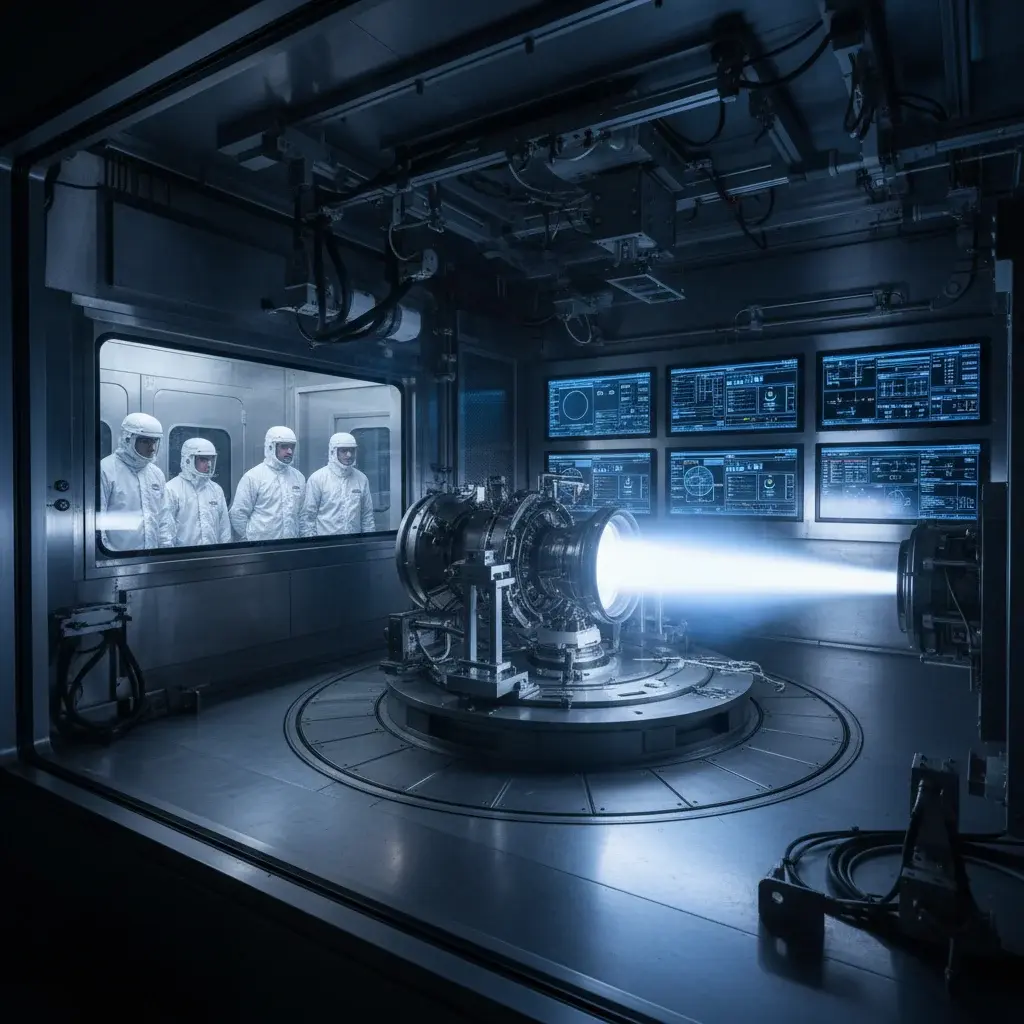
Spanish propulsion startup Arkadia Space has secured €14.5 million in new funding, anchored by the European Innovation Council (EIC), to develop an upgraded bipropellant engine for high-power orbital missions and scale its manufacturing capabilities. The financial injection provides the company with the necessary capital to transition its green propulsion technology from initial spaceflight validation to commercial mass production.
The Shift to Green Propulsion
For decades, the aerospace industry has relied heavily on hydrazine to fuel satellite and spacecraft thrusters. While highly effective as a chemical propellant, hydrazine is volatile and highly toxic.
Using legacy toxic fuels requires rigorous and expensive safety protocols during ground handling and spacecraft fueling operations. Ground crews must wear heavy protective suits, and launch pads often require complete evacuation during the fueling process, adding logistical complexity and significant costs to launch campaigns.
Satellite operators and launch providers are actively seeking alternative “green” propellants to reduce these operational costs and mitigate environmental and health risks. Arkadia Space aims to capitalize on this industry-wide shift by specializing in propulsion systems utilizing high-test hydrogen peroxide.
This safe-to-handle alternative is designed to match or exceed the performance metrics of traditional toxic equivalents, fundamentally lowering the barrier to entry for spacecraft operators on the ground.
Validating the Technology in Orbit
The company recently achieved a critical technological milestone to prove the viability of its approach. In March 2025, Arkadia successfully executed its first spaceflight demonstration aboard a D-Orbit ION satellite carrier.
During this mission, the startup validated its monopropellant engine architecture in the vacuum of space. The system successfully utilized hydrogen peroxide to generate 5 Newtons (N) of thrust.
This landmark flight demonstrated that Arkadia’s green propellant solutions could reliably operate in orbit. The successful deployment paved the way for the company to begin developing larger and more complex propulsion systems for deep space and high-mass missions.
Financial Breakdown and EIC Backing
To fund this next phase of development, Arkadia successfully navigated the highly competitive European Innovation Council funding process. The €14.5 million package is structured across multiple investment vehicles to support both immediate research and long-term infrastructure growth.
The funding includes a €2.5 million grant directly from the EIC to finance immediate research and development efforts. Additionally, the package features €12 million in equity financing, structured as €6 million from the EIC matching a €6 million investment from an undisclosed private source.
Beyond the capital injection, securing EIC backing provides strategic advantages for the growing startup. Arkadia Space CEO Francho García noted that joining the EIC ecosystem streamlines future scaling efforts.
“In principle, once you are part of the EIC Club… you’ve access to non-written, exclusive services in terms of mentoring—in terms of IOD client opportunities—but also easy access for more capital in the frame of debt or even more equity,” García stated.
Advancing to Bipropellant Architectures
With fresh capital secured, Arkadia is shifting its engineering focus from monopropellant systems to a high-power bipropellant architecture. The company plans to apply the operational data gathered from its March 2025 spaceflight to develop an engine capable of meeting much higher thrust requirements.
The new bipropellant setup will mix hydrogen peroxide with a proprietary hypergolic fuel. This chemical combination ignites spontaneously upon contact, eliminating the need for complex ignition systems and allowing for rapid, reliable engine restarts in the harsh environment of space.
According to the company, this upgraded system is designed to generate up to 500 N of thrust. This represents a massive increase from the 5 N achieved during the recent demonstration flight.
García highlighted the specific advantages of this chemical approach for complex orbital operations.
“The unique characteristic, because of the hypergolicity, you can have very high pulsing capability,” García said. “You can push extremely, extremely fast and to do precise maneuvers for docking or land on the Moon… There’s no other green fuel that you can hypergolize.”
Meeting Market Demand and Scaling Production
The European commercial space sector is already showing strong demand for Arkadia’s green-engine architecture. Launch vehicle manufacturers and satellite operators are eager to integrate non-toxic propulsion systems into their next-generation spacecraft to streamline launch cadences.
Last year, Arkadia secured a significant commercial agreement with MaiaSpace, a prominent European launch vehicle developer. Under this contract, Arkadia will supply a 250-N version of its bipropellant engine for MaiaSpace’s launch vehicles. García indicated that additional commercial contracts are currently in the pipeline.
To meet this rising market demand, Arkadia is designating a significant portion of its new funding for infrastructure expansion. The company is preparing for a dedicated building year as it transitions from prototype development to serial production.
Management plans to construct a larger manufacturing facility capable of producing engine systems at scale. Furthermore, Arkadia intends to invest directly in its own fuel-production capabilities to ensure the supply of its proprietary hypergolic fuel keeps pace with its increased engine output.
Industry Implications and Next Steps
The successful capitalization of Arkadia Space signals a broader maturation of the European green propulsion supply chain. As the company ramps up its manufacturing footprint and fuel-production capacity, it is positioning itself as a primary propulsion provider for both orbital maneuvering vehicles and future lunar landers.
Industry observers should watch for the upcoming ground tests of the 500-N bipropellant engine and further contract announcements from European launch providers. If Arkadia can successfully deliver its 250-N engines to MaiaSpace on schedule, it could trigger a wider industry pivot away from legacy hydrazine systems, significantly lowering the barrier to entry and ground operation costs for the next generation of spaceflight missions.