
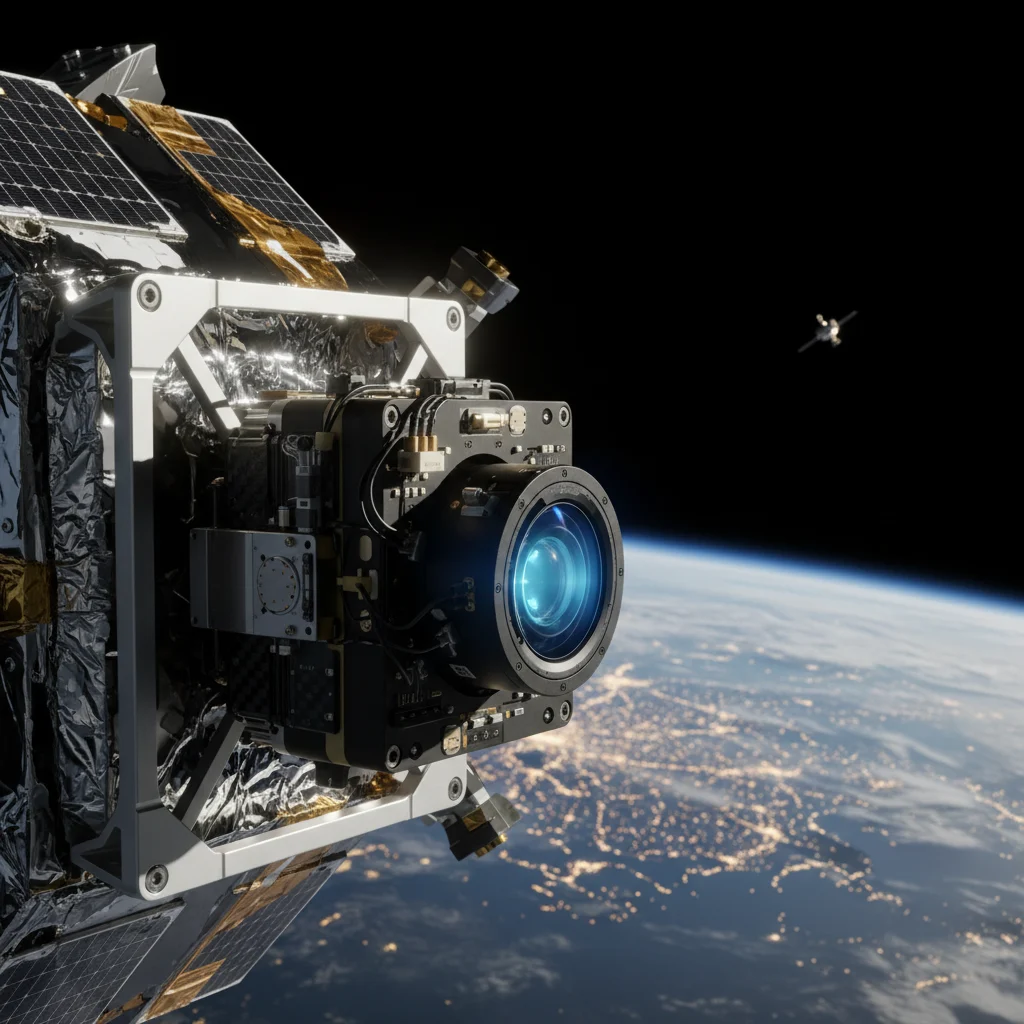
Canberra, Australia — Infinity Avionics, a premier provider of smart vision systems for the global NewSpace economy, announced the full commercial availability of its Aquila imaging system today. Following a standout debut at the International Astronautical Congress (IAC) in Sydney, the high-performance, flight-ready camera targets the rapidly expanding Space Situational Awareness (SSA) sector. It also serves as a primary visual sensor for the $14 billion In-Space Servicing, Assembly, and Manufacturing (ISAM) market, alongside the Rendezvous, Proximity Operations, and Docking (RPOD) market.
The global orbital ecosystem is undergoing a fundamental shift toward highly complex, interactive operations. Satellites are no longer static assets; modern missions frequently involve autonomous docking, satellite life-extension services, and active space debris removal.
Furthermore, the concept of In-Space Manufacturing (ISM) is moving from theoretical research to practical application. As these dynamic operations scale, the demand for high-fidelity, real-time visual data has never been greater.
Historically, space operators faced a difficult compromise when selecting visual sensors. Legacy imaging systems often proved too bulky, heavy, and power-intensive for modern small satellite architectures. Conversely, smaller, low-fidelity inspection cameras failed to deliver the resolution and frame rates required for delicate, high-stakes orbital maneuvers.
High-fidelity optical telemetry is now a non-negotiable requirement for mission success. Aquila enters the commercial market as a versatile, customizable solution designed specifically to bridge the technological gap between legacy optics and basic inspection sensors.
Addressing Size, Weight, and Power Constraints
Space hardware engineering requires strict adherence to Size, Weight, and Power (SWaP) limitations. Infinity Avionics engineered Aquila to deliver Full High Definition (FHD) capabilities while remaining strictly within the SWaP constraints typical of agile small satellite platforms.
The system supports both standard High Definition (HD) and FHD image capture, backed by robust onboard data storage. Crucially for dynamic orbital operations, Aquila enables seamless video streaming at up to 30 frames per second (FPS).
This high frame rate ensures that mission operators receive smooth, actionable visual telemetry rather than disjointed still frames. Low-latency video is absolutely essential when executing maneuvers where distances close at rapid orbital velocities, such as docking or debris capture.
To accommodate a diverse range of mission profiles, Infinity Avionics designed the system with modularity in mind, offering multiple lens configurations. Satellite designers can tightly tailor the field of view and focal length to specific operational requirements.
Lens options range from wide-angle configurations necessary for capturing broad deployment sequences to narrow field-of-view lenses designed for millimeter-precise close-up inspections. Furthermore, Aquila is available in three distinct product tiers, allowing operators to scale their imaging solutions based on specific budget constraints and mission criticality levels.
Enabling Autonomy Through Smart Vision and Edge AI
While Aquila functions effectively as a standalone imaging tool, its underlying architecture is optimized for integration into broader autonomous ecosystems. The camera pairs seamlessly with Infinity Avionics’ proprietary BRAIN smart edge processor.
Deep space and orbital communications frequently suffer from limited downlink bandwidth and inherent signal latency. These communication bottlenecks make real-time, ground-based decision-making exceptionally difficult during critical proximity operations.
The combination of Aquila’s high-speed data throughput and the BRAIN processor’s artificial intelligence capabilities addresses this bandwidth limitation directly. Operators can deploy these paired technologies as comprehensive Smart Vision Systems capable of processing visual data in-situ.
By analyzing high-resolution images onboard the spacecraft, the system drastically reduces the volume of raw data that must be transmitted back to Earth. This edge-computing capability is foundational for future autonomous missions, enabling spacecraft to make split-second navigational or operational decisions without waiting for ground control telemetry loops.
Versatile Applications for the New Frontier
Infinity Avionics has identified four critical operational domains where the Aquila system will serve as a primary enabling technology.
For space asset monitoring and engineering, the camera provides high-resolution visual confirmation of critical mechanical events. This includes verifying complex antenna deployments, monitoring solar array orientations, and assessing overall structural integrity after the violent stresses of launch.
In the RPOD and debris removal sector, Aquila delivers the low-latency video required for precision autonomous docking. This visual feedback is equally vital for emerging satellite refueling services and the robotic capture mechanisms utilized in active debris removal missions.
The system also targets the nascent In-Space Manufacturing industry. Aquila allows operators to monitor delicate fabrication processes in microgravity, where real-time visual feedback serves as the primary mechanism for quality control and autonomous error correction.
Finally, the camera supports advanced orbital and planetary navigation. Detailed, low-latency imagery enables smart obstacle avoidance algorithms to function effectively in unpredictable space environments.
Industry Implications and Orbital Outlook
“The launch of Aquila represents a significant milestone in our mission to be ‘Your Eyes in Space’ for the next generation of the space economy,” said Igor Dimitrijevic, CEO of Infinity Avionics.
Dimitrijevic emphasized that offering FHD streaming and onboard storage in a highly compact package gives mission designers the tools required to execute high-stakes maneuvers, like RPOD and in-space manufacturing, with absolute confidence.
The commercial availability of specialized hardware like Aquila signals a broader industry transition from passive orbital observation to active, autonomous decision-making. As the $14 billion ISAM market continues to mature, the reliance on sovereign, high-performance optical hardware will accelerate rapidly.
Moving forward, the aerospace sector will closely watch the integration of these smart vision systems into upcoming commercial and government missions across Australia, Europe, and Asia. Ultimately, the success of next-generation orbital logistics, satellite servicing, and space manufacturing will depend heavily on the ability of autonomous spacecraft to accurately see, process, and react to their immediate surroundings in real time.


Leave a Reply