
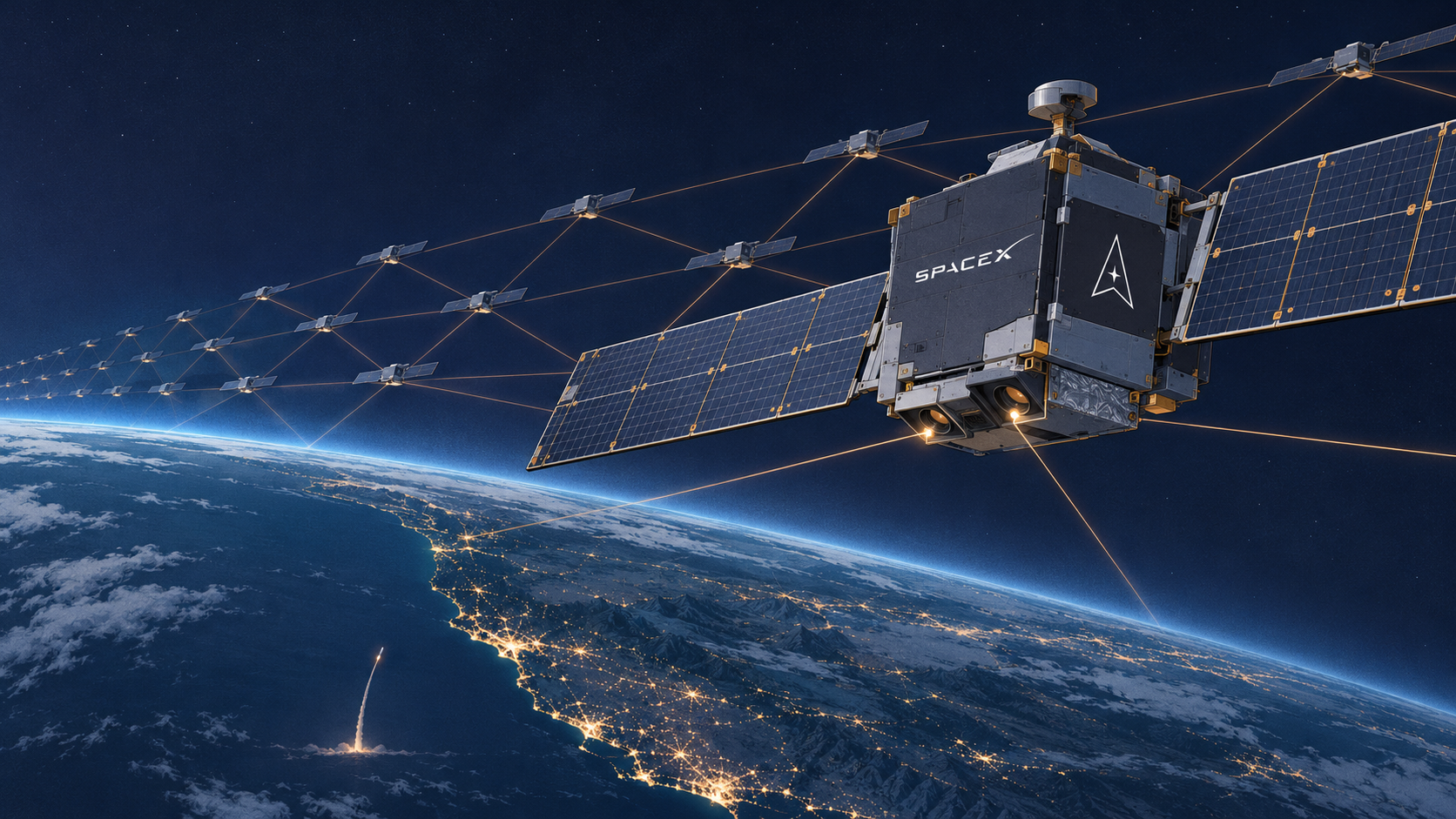
The United States Space Force has moved its Space Data Network Backbone from a large procurement into a rapid deployment campaign. After three successful launches in two weeks, the Department of the Air Force says the government-owned network is on track to provide regional capability before the end of 2026 and global support in 2027.
That timetable matters because the network is intended to move targeting, missile-warning and command data between sensors, decision-makers and weapons systems. The value is not in another communications constellation by itself; it is in creating a low-latency transport layer that can connect otherwise separate military and commercial systems.
SpaceNews identified the three-launch surge and the programme’s growing dependence on SpaceX. The new evidence is significant, but it also needs qualification: launch success does not prove that the satellites have been commissioned, that optical links work as a resilient mesh, or that users can move operational data through the system at the promised scale.
A classified campaign becomes visible
The latest mission, USSF-317, launched from Vandenberg Space Force Base at 04:20 UTC on 21 November. It followed USSF-432 on 7 November and USSF-627 on 12 November, completing the three missions cited by the Department of the Air Force.
Those flights form part of a six-launch “R” series that began on 16 August, with further missions on 10 and 26 September. Public orbital catalogues associated 23 satellites with each of the first five launches. Third-party launch databases list another 23 for USSF-317, implying roughly 138 spacecraft across the campaign.
That total is an open-source inference, not an official disclosure. The Space Force has confirmed the accelerated Backbone deployment, while withholding spacecraft quantities, design details and most mission data. Independent launch reporting has linked the satellites to SpaceX’s Starshield-derived platform, but the government has not publicly confirmed the bus configuration.
This distinction matters commercially. The confirmed development is a six-flight deployment programme under the Space Data Network architecture. Specific claims about payload design, sensing functions or satellite performance remain unverified.
Launch tempo is not operational capability
In May, Space Systems Command awarded SpaceX a US$2.29 billion firm-fixed-price Other Transaction Authority delivery order for the Backbone. The contract requires a fully operational prototype by the end of 2027. The latest government statement sets an earlier progression—regional capability in 2026 and worldwide support in 2027—but does not define the service levels behind those labels.
The network still has to complete orbit raising, spacecraft checkout, optical crosslink activation, routing tests, cyber accreditation and integration with ground and command systems. It must also demonstrate that traffic can pass reliably between different security domains and across systems supplied by multiple vendors.
A regional service declaration could therefore represent a limited operational slice rather than a mature global network. Investors and suppliers should separate the number of objects in orbit from accepted capacity, availability, latency and resilience under realistic military conditions.
SpaceX gains an infrastructure position
The deployment demonstrates why SpaceX is difficult to displace in proliferated national-security constellations. It can combine serial spacecraft manufacturing, a high-cadence launch system and an established low-Earth-orbit operating model inside one contractor. Three missions in two weeks compress a schedule that would challenge a supply chain split among several traditional primes.
That vertical integration can reduce interface delays and speed the arrival of useful capacity. It also gives SpaceX a strategic position extending beyond launch services. If the Backbone becomes the default transport fabric for sensors, missile defence and coalition command systems, the company will sit underneath a growing share of the military-space economy.
The government describes the system as government-owned and controlled, which limits the operational autonomy of the contractor. Ownership, however, does not remove dependence on SpaceX for replenishment, upgrades, technical support and production knowledge. Resilience must be assessed across the supply chain as well as in orbit.
Competition becomes the policy fault line
That concentration is already drawing scrutiny. The Senate Appropriations Committee’s fiscal 2027 defence proposal criticised recent Space Force and National Reconnaissance Office sole-source acquisitions and directed the service to maintain multiple vendors as it awards further Space Data Network work. The committee proposed US$3.3 billion for the programme, showing that concern about competition is not the same as opposition to deployment.
The Space Force is building alternative connection points around the SpaceX core. In August it awarded Amazon LEO for Government, Lockheed Martin, Northrop Grumman, Rocket Lab and York Space Systems US$12 million each for optical-network demonstrations and Space Exchange Point development. Space Insight previously analysed York’s role as an on-ramp rather than a production order.
Viasat has also received a contract worth up to US$450 million, including an initial US$115 million task order, to design and scale the Backbone’s mission operations centre. These awards spread integration and operating work, but they do not yet create a second supplier capable of matching SpaceX’s deployed satellite layer.
The competitive test is whether open interfaces allow other spacecraft and commercial networks to carry meaningful traffic, not simply whether several companies receive development contracts. A network can be multi-vendor at its edges while remaining structurally dependent on one backbone provider.
The Backbone must work with, not duplicate, SDA
The Space Data Network Backbone is intended to operate alongside the Space Development Agency’s Transport Layer. SDA’s Tranche 1 had 84 transport satellites in orbit after its fourth plane launched in October, with initial warfighting capability targeted for 2027.
The two systems have overlapping language—proliferated low-Earth orbit, optical links and low-latency data transport—but different acquisition histories and network roles. The Backbone is positioned as high-throughput backhaul, while SDA’s architecture links tactical users, missile-tracking sensors and other nodes through successive competed tranches.
Integration could create a larger, more resilient mesh. Poor coordination could create incompatible routing, duplicated capacity or competing ground systems. As Space Insight noted after SDA’s fourth Transport Layer launch, the decisive outcome is whether data can cross organisational and vendor boundaries without bespoke gateways that erase the speed and cost advantages of proliferation.
Milestones that determine the network’s real value
The first milestone is a defined regional-capability declaration: where service is available, which users are connected, and what performance has been accepted. The second is evidence of stable optical crosslinks, dynamic routing and end-to-end operational traffic rather than spacecraft counts alone.
Next, watch Viasat’s mission operations centre and the five-vendor interoperability demonstrations. Successful connection of non-SpaceX satellites would reduce lock-in; continued reliance on the core provider for every critical function would deepen it.
Congressional funding and procurement conditions will shape the industrial outcome. A funded second satellite supplier or competed replenishment order would be more consequential than additional study contracts. The end-of-2027 operational-prototype deadline remains the programme’s clearest contractual test.
The launch surge proves that the United States can place a military data constellation into orbit at commercial tempo. It has not yet proved that the resulting network is interoperable, resilient or competitively sustainable. Those are the tests that will determine whether the Space Data Network becomes shared infrastructure for the wider space economy—or another fast-deployed system whose speed was purchased with long-term concentration risk.