
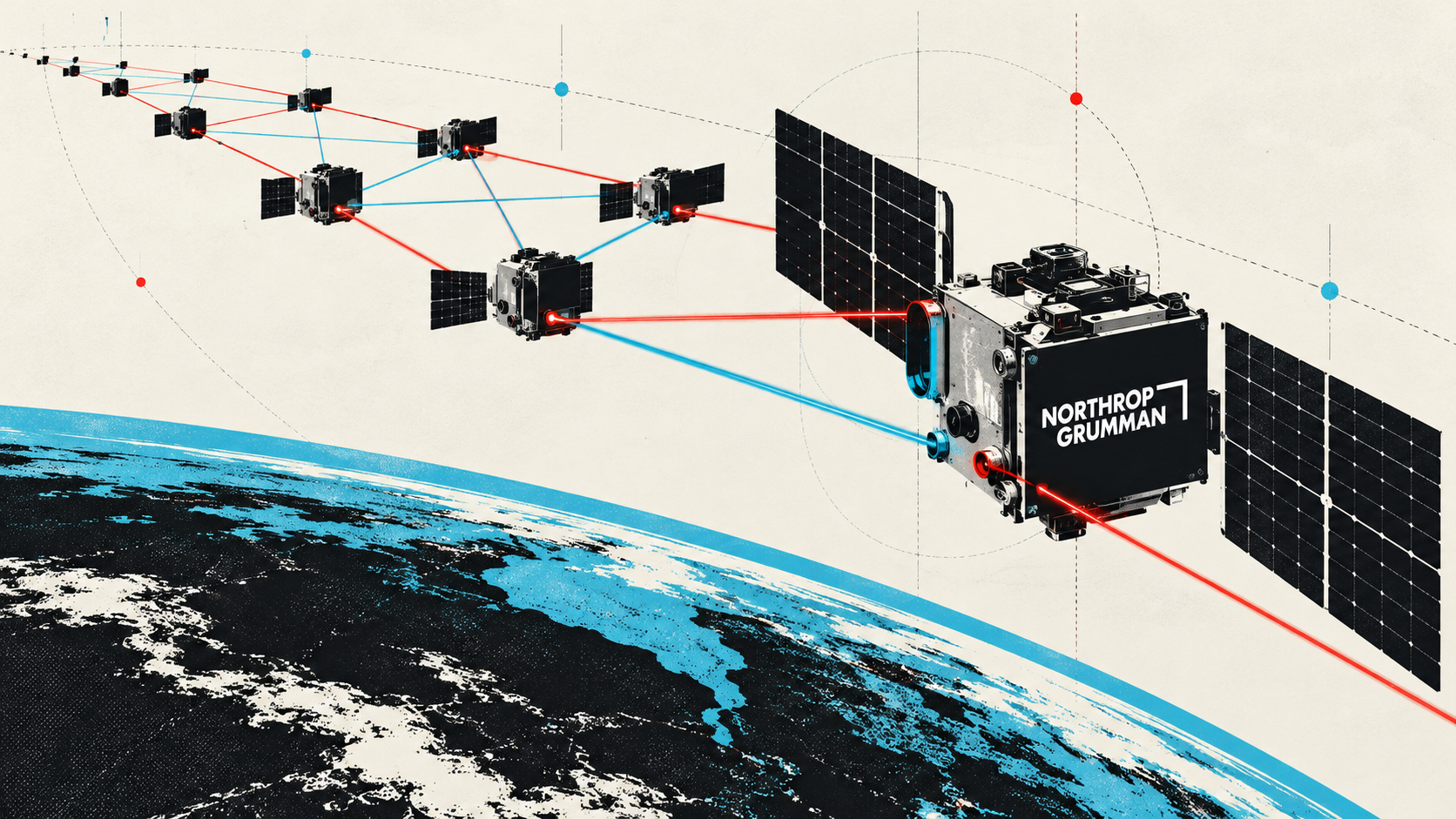
A SpaceX Falcon 9 has placed 21 Northrop Grumman-built satellites into low Earth orbit, bringing the Space Development Agency’s Tranche 1 Transport Layer to 84 spacecraft across four orbital planes. The launch matters less as a Falcon 9 mission than as a test of whether the Pentagon can turn a multi-vendor satellite production programme into one interoperable operational network.
SpaceNews identified the 10 October mission as Northrop Grumman’s first operational plane for the Transport Layer. The SDA’s own launch statement confirms that the satellites were launched from Vandenberg Space Force Base and that Tranche 1 is still targeting initial warfighting capability in 2027. That distinction is important: 84 spacecraft are now in orbit, but “on orbit” does not yet mean commissioned, interconnected or available to military users.
Scale has arrived before full operational proof
Tranche 1 is designed around 126 Transport Layer satellites: six near-polar planes of 21 spacecraft. York Space Systems, Lockheed Martin and Northrop Grumman each received responsibility for two planes, or 42 satellites.
The SDA awarded the three prototype agreements in February 2022 with a combined potential value of approximately US$1.8 billion. York’s award was about US$382 million, Lockheed Martin’s US$700 million and Northrop Grumman’s US$692 million. All three fleets are supposed to carry optical communications terminals, Link 16 and Ka-band payloads, plus onboard battle-management, command, control and communications processing.
That architecture is deliberately different from a traditional military communications programme built around a small number of highly capable satellites. It distributes capacity across many smaller spacecraft, shortens technology-refresh cycles and uses competition to preserve several production lines.
Four of the six Transport Layer planes are now in orbit. York-built planes launched in September 2025 and July 2026, while Lockheed Martin’s first plane launched in October 2025. Northrop Grumman’s arrival adds a third spacecraft design to the deployed system and raises the operational value of common interfaces from a procurement principle to a technical necessity.
Vendor diversity is both the advantage and the risk
The commercial lesson is that SDA is creating a recurring defence-space market rather than choosing one dominant prime. Separate awards allow the agency to compare cost, schedule and performance while sustaining more than one supplier. They also create demand for optical terminals, radios, processors, ground systems and launch services across successive tranches.
Northrop Grumman says it is building approximately 150 spacecraft for SDA across Tranches 1, 2 and 3. That is a company statement about contracted production, not evidence that all spacecraft have been delivered or accepted. The 21 satellites launched on 10 October are the first half of Northrop’s 42-satellite Tranche 1 Transport Layer award; the company says its second plane will follow, with further SDA launches over the next six months.
The model can widen the industrial base, but multi-vendor procurement transfers risk into systems engineering. Spacecraft from different manufacturers must exchange data through optical links, route traffic under common network rules, connect to ground infrastructure and present useful information to military platforms. A fleet of compatible satellites is economically and militarily more valuable than several parallel vendor networks. Proving that compatibility is now the central test.
The network still has unresolved technical dependencies
SDA describes its Transport Layer as the low-latency backbone linking sensors, command systems and weapons. Its long-term plan envisages 300 to more than 500 satellites at altitudes of roughly 750 to 1,200 kilometres, using optical inter-satellite links and Ka-band communications. Tranche 1 is intended to provide the first operational regional coverage rather than the final global system.
The launch count can therefore overstate progress. Satellites must raise themselves into their assigned plane, complete checkout and establish reliable links. The original 2022 agreements allowed three months after launch for each plane to reach its operational orbit and complete on-orbit verification.
That process has already exposed constraints. Breaking Defense reported in July that SDA paused launches after hardware and software problems appeared in the first 42 Transport Layer satellites. Officials cited thermal-model issues and electric-propulsion difficulties, while acknowledging that the agency had not yet demonstrated the planned optical mesh. Link 16 testing over the continental United States also remained dependent on regulatory approval.
Those issues do not negate the significance of four deployed planes. They explain why the next milestones are functional rather than numerical. The programme needs repeatable orbit raising, stable thermal performance, cross-vendor optical links, dynamic routing, ground connectivity and authorised tactical-data-link demonstrations.
A strategic template with wider market consequences
If SDA succeeds, the result will be more than a US military communications constellation. The programme would validate a procurement model based on fixed-price competition, serial satellite manufacturing and planned technology replacement every two years. That could influence allied defence architectures and other government constellations, creating a larger market for standardised spacecraft buses, optical terminals and network software.
It would also shift competitive advantage. Manufacturers that can deliver batches on time and interoperate with third-party hardware may win repeat work even without owning the entire system. Conversely, suppliers that depend on proprietary interfaces or bespoke production could struggle as governments demand faster refreshes and common standards.
Strategically, a proliferated network is intended to be harder to disable than a small set of exquisite satellites. It can distribute communications and missile-tracking data across many nodes, while losses can be replenished more quickly. Yet proliferation also expands the cyber, ground-segment and space-traffic-management burden. Resilience depends on network behaviour under attack, not simply the number of satellites available.
The architecture is also becoming more closely connected to Golden Dome and the Space Force’s broader Space Data Network. That raises the stakes for reliable optical routing: warning and tracking sensors only create operational value when their data can reach decision-makers and interceptors quickly enough.
What investors and industry should watch
The first milestone is commissioning of the new Northrop plane. The SDA has confirmed launch, while Northrop Grumman has confirmed deployment and described intended capabilities; neither has yet announced completed on-orbit acceptance or cross-vendor networking.
The second is the remaining Tranche 1 launch campaign. A second Northrop plane and Lockheed Martin’s second plane would complete the 126-satellite Transport Layer, but schedule alone will not establish initial warfighting capability.
The third is evidence of an operational optical mesh and Link 16 use. Demonstrations that move data across spacecraft from different manufacturers, through ground systems and to tactical users would materially reduce integration risk.
Finally, watch the 2027 initial-capability declaration and the criteria behind it. A narrowly defined regional service is different from persistent global coverage, and investors should distinguish a programme milestone from a fully mature network.
The fourth Transport Layer launch changes the balance of the SDA programme. Production scale is no longer hypothetical, and Northrop Grumman has joined York and Lockheed Martin on orbit. The next phase will show whether that industrial diversity becomes resilient network capacity—or whether the programme’s hardest problems have simply moved from factories to interfaces.