
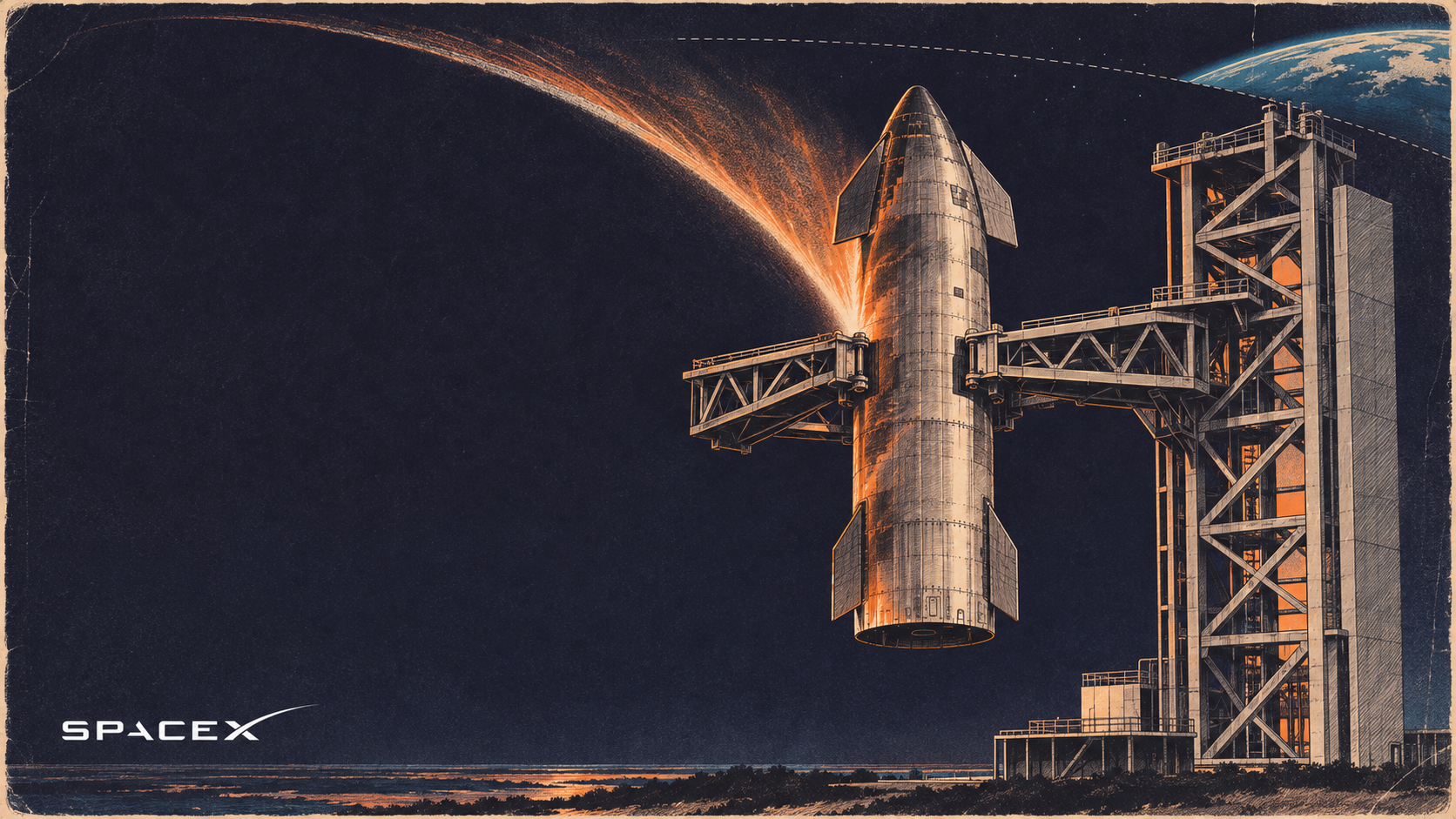
SpaceX has caught a Starship upper stage returning from orbit for the first time, converting one of the most visually ambitious elements of the vehicle’s design into a demonstrated flight capability.
The milestone, identified for this analysis through SpaceNews, does not yet prove rapid or economical reuse. It does remove a major uncertainty: whether a 52-metre spacecraft can survive orbital re-entry, navigate back to Starbase and place itself accurately between the launch tower’s mechanical arms.
That changes the industry question. Starship’s upper-stage recovery is no longer mainly a problem of flight geometry. It is becoming an operations, refurbishment and regulatory problem—and those are the tests that will determine whether the vehicle reshapes launch economics.
A payload mission and a recovery test
Flight 15 lifted off from Starbase, Texas, on 13 November and returned the ship roughly 22.5 hours later on 14 November. According to SpaceX’s mission plan, the spacecraft completed about 14 Earth orbits before its deorbit burn, atmospheric entry, landing flip and tower catch.
The mission also deployed 26 Starlink V3 satellites. SpaceX says each can add one terabit per second of network capacity and that the batch was equivalent to about ten Falcon 9 launches carrying V2 Mini satellites. Those are company estimates, but the deployment itself was confirmed. The combination matters: SpaceX did not conduct an isolated recovery demonstration; it paired the catch with a revenue-supporting constellation mission.
The flight was not a clean demonstration of full-system recovery. Super Heavy’s boostback ended early after a low-propellant-mass alarm. Guidance determined that the booster was outside the correct return corridor, diverted it towards the Gulf of Mexico and activated the flight-termination system before splashdown. SpaceX is still investigating the root cause.
That autonomous divert protected the launch site, but it also prevents SpaceX from claiming the intended double catch. The achievement is specifically the first recovery of a Starship upper stage after orbital flight—not proof that both stages can yet be recovered together with routine reliability.
Recovery is necessary; reuse is the economic test
Falcon 9 transformed launch economics by returning and reflighting its first stage, but its upper stage is discarded. Starship is intended to close that remaining gap. Recovering the ship avoids throwing away its six Raptor engines, avionics, tanks, thermal-protection system and payload section after every mission.
However, a caught vehicle has value only if it can fly again without extensive labour or component replacement. SpaceX now needs to inspect the heat shield, flaps, engine section and primary structure; quantify damage; define refurbishment work; and demonstrate another launch. Turnaround time, technician hours and replacement-part cost will matter more to customers and competitors than the spectacle of the catch.
This is why the result advances, rather than completes, the argument made after Starship’s first orbital flight. Orbit established basic transportation capability. Recovery now establishes a route back to the launch site. Reflight will be the first meaningful evidence that the hardware can support the low marginal costs and high cadence central to SpaceX’s commercial thesis.
Starlink gives SpaceX a demand advantage
Starship’s commercial advantage is not simply payload capacity. It is SpaceX’s ability to generate internal demand through Starlink while the vehicle matures. The 26-satellite deployment gives each test flight an operational purpose and lets SpaceX learn at a tempo that launch providers dependent solely on external customers would struggle to finance.
If upper-stage reflight becomes routine, SpaceX could spread hardware and launch-site costs over many missions, accelerate Starlink V3 deployment and reserve Falcon 9 for missions better suited to its mature architecture. Competitors would face pressure on both price and available market volume.
Lower internal cost does not guarantee proportionately lower customer prices. SpaceX may initially retain savings to recover development and infrastructure investment, particularly where alternatives are limited. The competitive impact will therefore depend on published pricing, demonstrated reliability and how quickly customers accept Starship—not on engineering cost alone.
Artemis needs cadence and propellant transfer
The catch is strategically important to NASA because the Starship Human Landing System depends on repeated launches. Under NASA’s revised 2026 lunar architecture, tanker Starships will aggregate cryogenic propellant in low Earth orbit before fuelling the lunar lander. SpaceX must demonstrate that transfer approach during an uncrewed mission before carrying astronauts to the Moon.
Upper-stage recovery supports the economics of that launch campaign, but it does not validate cryogenic storage, rendezvous, docking or vehicle-to-vehicle transfer. Nor does it certify the crewed lander. NASA has not assigned either SpaceX or Blue Origin to a specific lunar landing under the realigned contracts, and both providers must complete uncrewed demonstrations before crewed missions.
The catch therefore improves Starship’s position without resolving Artemis’s critical path. The decisive lunar milestone remains propellant aggregation at operational scale.
The tower becomes both asset and constraint
Tower recovery removes the mass and complexity of landing legs and avoids downrange recovery vessels. It also concentrates launch and recovery around a costly piece of ground infrastructure. A failed approach can damage the tower needed for the next launch, creating a single-site cadence risk that Falcon 9’s distributed drone-ship model does not share.
Scale will also require regulatory approval and additional sites. The US Federal Aviation Administration is conducting a programmatic environmental review of expanded Starbase operations, including more launch, landing and expenditure locations, with public comments open until 7 December 2026. SpaceX is also preparing Starship infrastructure in Florida. As Space Insight has previously analysed, technical reusability and permission to operate at industrial cadence are separate problems.
Milestones that now matter
The most important evidence will come from the caught ship itself: inspection findings, refurbishment scope and whether the same vehicle flies again. A short, transparent turnaround would give investors and customers a basis for modelling reusable-stage economics.
Next come a successful dual recovery of the current vehicle generation, repeated catches without pad damage, orbital propellant-transfer demonstrations and regular Starlink V3 deployments. Regulators’ decisions on Starbase expansion and the pace of Florida construction will show whether infrastructure can match flight hardware.
Flight 15 has moved Starship across an important threshold. The upper stage has returned from orbit to the hardware intended to launch it again. The global launch market should now take full reusability more seriously—but price disruption, lunar logistics and rapid cadence still depend on what happens after the catch.