
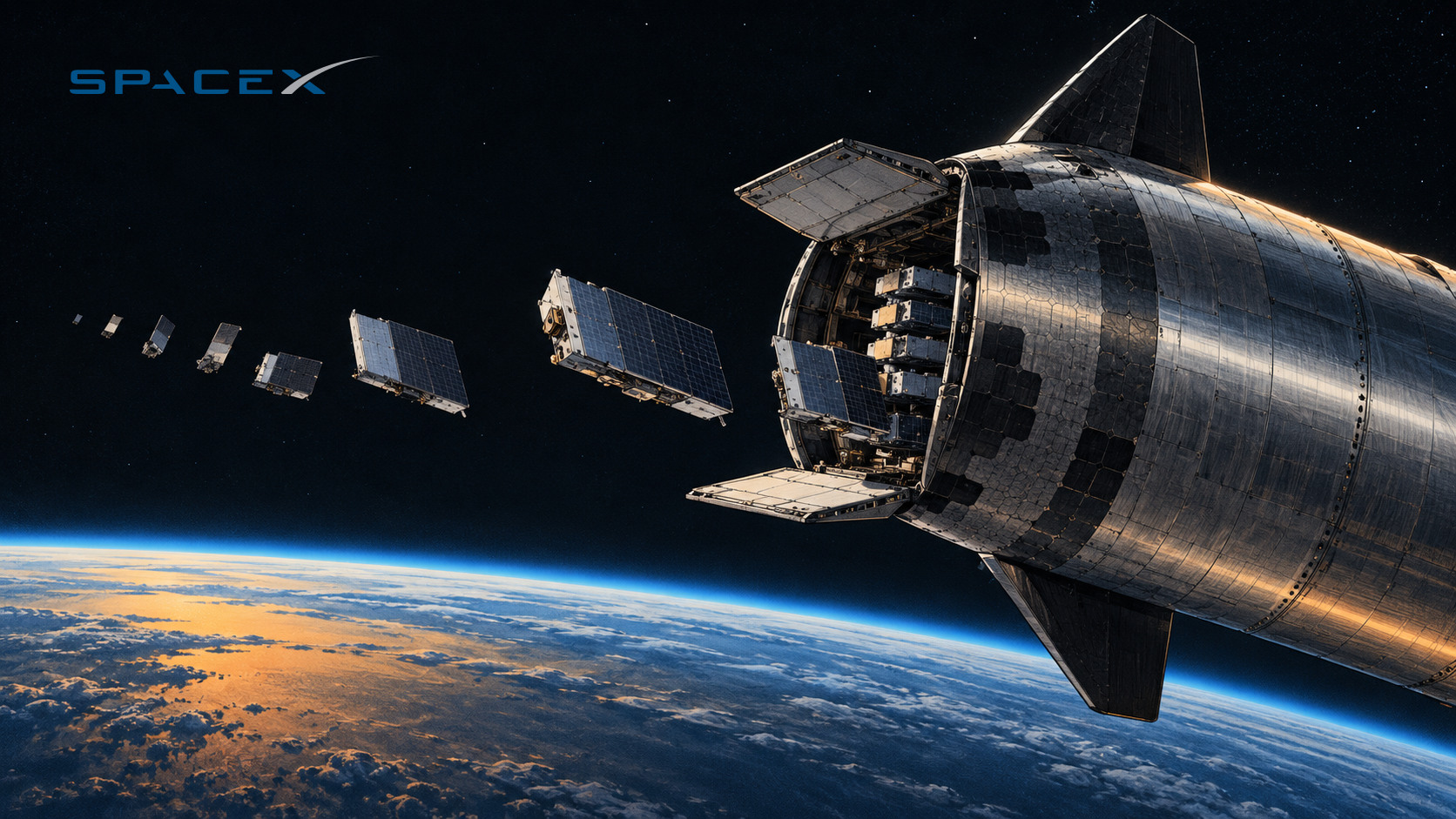
SpaceX has crossed the line that matters most to launch customers: Starship has reached orbit carrying operational payloads, rather than flying another suborbital development profile. The development was first reported by SpaceNews after Flight 14 lifted off from Starbase, Texas, on 28 September.
The mission deployed 26 Starlink V3 satellites at roughly 269 kilometres altitude. SpaceX said all 26 were operating nominally, a company claim that will require time in orbit to substantiate fully. The result nevertheless changes Starship’s status: it is now an orbital launch system that has delivered a revenue-generating payload, although it is not yet a reusable or routine one.
An operational success with development-flight caveats
SpaceX’s mission record confirms Flight 14 as the programme’s first attempt to go to orbit. Independent reporting by Reuters found that the planned ten-hour mission was shortened to about three hours after one of Starship’s three sea-level Raptor engines shut down prematurely following stage separation.
Engineers used other engines to complete the orbital insertion. That demonstrated useful fault tolerance, but it should not be confused with clean execution. SpaceX also reported that some Super Heavy engines stopped operating during the booster’s descent. The booster made a controlled Gulf splashdown; the ship later descended into the Pacific and was not intended for recovery.
The distinction is important. Reaching orbit and deploying satellites validates the basic transport function. It does not yet validate the economic premise of recovering both stages, turning them around rapidly and repeating flights at high cadence. Those are the capabilities that would convert Starship’s exceptional scale into lower unit costs.
Starlink becomes the anchor customer
Flight 14 also made Starlink the mechanism by which SpaceX can learn while earning. The company says each V3 satellite can handle ten times as much data as a V2 Mini, while a routine Starship mission is ultimately intended to carry up to 60 V3 spacecraft. Those are SpaceX performance targets, not independently verified service outcomes.
Even so, deploying 26 V3 satellites creates a real operational feedback loop. SpaceX can exercise payload integration, release mechanisms, constellation operations and customer-capacity growth on the same flights used to mature the launch vehicle. That vertical integration is a competitive advantage few launch providers can reproduce: the internal payload can absorb early flights that third-party customers may regard as too risky.
For the broader launch market, the immediate effect is more limited than the headline might suggest. Falcon 9 remains the dependable workhorse, and commercial customers cannot plan around Starship until SpaceX shows repeatable orbital delivery, a stable licensing pathway and predictable manifests. But each successful Starlink flight can release some Falcon 9 capacity and accelerate V3 deployment, strengthening the broadband business that finances further Starship development.
The competitive clock has started
Rival launch companies now face less uncertainty about whether Starship can perform the first half of its job. The remaining uncertainty concerns when it can do so reliably and cheaply. That matters to heavy-lift systems under development, prospective orbital infrastructure and satellite manufacturers whose business cases assume much larger payload volumes.
A rapidly reusable Starship could pressure launch prices, encourage heavier spacecraft and make bulk deployment of fuel, habitats and industrial hardware more credible. A Starship that reaches orbit only occasionally, with substantial refurbishment and variable payload performance, would be strategically important but economically less disruptive.
Regulation remains part of the cadence equation. The US Federal Aviation Administration’s Part 450 regime covers launch and re-entry licensing, including safety analysis and public-risk criteria. A successful flight gives SpaceX better evidence for future approvals, but vehicle changes, anomaly findings and environmental constraints can still affect the pace of authorisations.
Orbit is necessary for Artemis, not sufficient
The strategic significance extends beyond commercial launch. NASA has contracted SpaceX to develop Starship human landing systems for Artemis III and IV. Flight 14 therefore removes one foundational risk: the V3-class architecture can achieve orbit with a useful payload.
It leaves the harder lunar chain unproven. NASA’s architecture requires a propellant-storage Starship in low-Earth orbit, repeated tanker flights, cryogenic transfer, a human-rated lander and an uncrewed lunar demonstration. NASA’s published HLS concept explicitly depends on the orbital storage-and-tanker sequence.
The agency’s Aerospace Safety Advisory Panel has cautioned that V3 performance will determine the number of refuelling missions and highlighted fuel transfer, boil-off, landing stability and the uncrewed demonstration as major unresolved issues. Flight 14 improves the starting point; it does not close those risks.
Milestones that will determine the economics
The next evidence should be judged less by spectacle than by repetition. Investors and customers should watch for a second clean orbital mission, larger V3 batches, successful recovery or catch attempts for both stages, and credible turnaround intervals. A third-party commercial payload would show that external customers accept the risk, rather than relying on SpaceX’s internal demand.
For NASA, the decisive milestones are an orbital cryogenic-propellant transfer, the tanker cadence needed to fill a depot, and the uncrewed lunar-landing demonstration. For regulators and local stakeholders, the test will be whether growing flight frequency can be licensed without compromising public safety or expanding disruption beyond accepted limits.
Flight 14 is therefore more consequential than another successful test, but less conclusive than an entry into routine service. Starship has demonstrated orbital utility and begun carrying the payloads that can finance its maturation. The launch economy’s central question has shifted from whether the system can reach orbit to how quickly SpaceX can turn that capability into reliable reuse.