
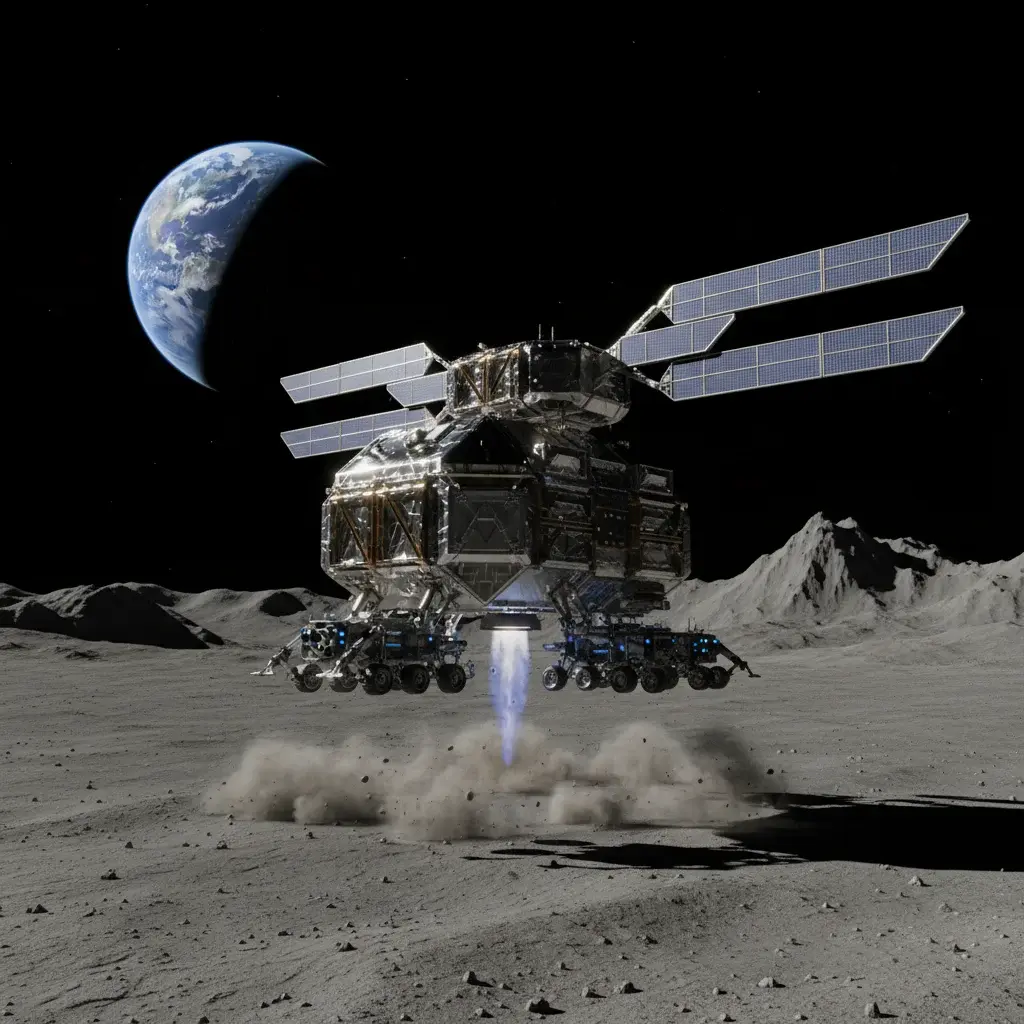
NASA unveiled a sweeping draft Request for Proposals (RFP) on March 24 in Washington, D.C., detailing a $6 billion plan to establish and sustain a lunar base through monthly uncrewed commercial landings. This second phase of the Commercial Lunar Payload Services (CLPS) program, launching as soon as next year, has ignited intense enthusiasm among commercial spaceflight providers tasked with making the agency’s permanent lunar ambitions a reality.
The CLPS initiative represents a fundamental paradigm shift in how the United States explores the Moon. Instead of designing, building, and operating its own bespoke spacecraft, NASA acts as a customer purchasing delivery services from private aerospace companies. The newly announced CLPS 2.0 draft RFP outlines a comprehensive 10-year ordering period designed to dramatically increase the cadence of lunar missions.
Scaling Up Lunar Logistics
Under the new framework, NASA mandates the development of larger landers and rovers capable of transporting significantly heavier payloads to the lunar surface. The agency is also increasing its direct, hands-on support, deploying its own subject matter experts to assist commercial partners in navigating the immense technical hurdles of deep space operations.
The technical requirements for CLPS 2.0 represent a massive step up from initial commercial lunar missions. NASA is aggressively pushing the commercial sector to develop spacecraft capable of surviving the brutal two-week lunar night, where temperatures can plummet to minus 250 degrees Fahrenheit, routinely destroying standard batteries and avionics.
To combat these extreme conditions, the draft RFP specifically asks companies to outline their readiness to integrate radioactive heating and power sources into their lander designs. Furthermore, the agency is laying the critical groundwork for a two-way lunar supply chain, requesting detailed proposals on what it would take to successfully launch from the Moon and return two kilograms of lunar material to Earth.
Industry Embraces the ‘Opportunity Bomb’
Commercial space executives are overwhelmingly positive about the program’s evolution and the aggressive new timeline. Tim Crain, Chief Technology Officer at Intuitive Machines, described the revised phase as an “opportunity bomb” for the burgeoning commercial space industry.
Crain commended NASA for exhibiting what he called “Apollo practicality.” He noted the agency’s rare willingness to pivot and restructure long-standing procurement programs that fail to yield optimal results.
“The overarching message is, we want partners who deliver,” Crain said. “That came through loud and clear. And nothing is off-limits that they won’t change.”
Firefly Aerospace is similarly positioned to capitalize on the accelerated mission cadence outlined in the draft RFP. The company recently expanded its clean room facilities specifically to accommodate the simultaneous manufacturing of multiple lunar landers.
“We’re pumped about it, because it’s a recognition that the things we were already doing at Firefly are on the right track,” Firefly CEO Jason Kim stated. The ability to produce multiple landers annually aligns directly with NASA’s vision for monthly supply drops to a future lunar outpost.
Consolidating a Fragmented Market
For Astrobotic Technology, the revised structure of CLPS 2.0 brings necessary market consolidation. The first phase of the program featured up to 13 potential vendors, creating a highly fragmented landscape where not all companies secured actual spaceflight contracts.
Astrobotic CEO John Thornton characterized the bloated initial vendor pool as a “distraction” and praised NASA for narrowing the competitive field to proven operators.
“Imagine if there were 15 launch vehicle companies trying to go for a small market. It doesn’t pencil out,” Thornton explained. “That is how you get costs to come down further—a small group that can be more vertically integrated.”
The Broader Artemis Ecosystem
This commercial payload push runs parallel to NASA’s broader Artemis campaign, which serves as the crewed counterpart to the uncrewed CLPS logistics network. The Artemis II mission is already advancing, with NASA astronauts Reid Wiseman, Victor Glover, Christina Koch, and Canadian Space Agency astronaut Jeremy Hansen preparing for a historic circumlunar flight.
Political momentum for building out this lunar infrastructure remains robust in Washington. Top lawmakers increasingly view the establishment of a sustained lunar base as a mandatory stepping stone for future deep space exploration.
“Once we establish a base there…that might be the best place to launch to Mars,” one top space lawmaker noted, reflecting a growing bipartisan consensus on Capitol Hill.
To fund these overlapping initiatives, the White House recently requested an $18.8 billion fiscal 2027 budget for NASA. While this matches the top-line request from fiscal 2026 and includes some strategic cuts to NASA’s science and STEM missions, the financial commitment to establishing permanent lunar infrastructure remains heavily prioritized.
Looking Ahead
As the commercial space industry digests the extensive CLPS 2.0 draft RFP, the focus now shifts entirely to the formal bidding process. Companies will spend the coming months finalizing advanced lander designs capable of handling radioactive power sources and executing complex sample return logistics.
If NASA successfully executes this 10-year, $6 billion blueprint, the Earth-Moon corridor will soon host the highest volume of space traffic in human history. Industry observers should watch closely for the final RFP release and subsequent contract awards, which will effectively crown the primary corporate architects of America’s permanent commercial lunar supply chain.


Leave a Reply