
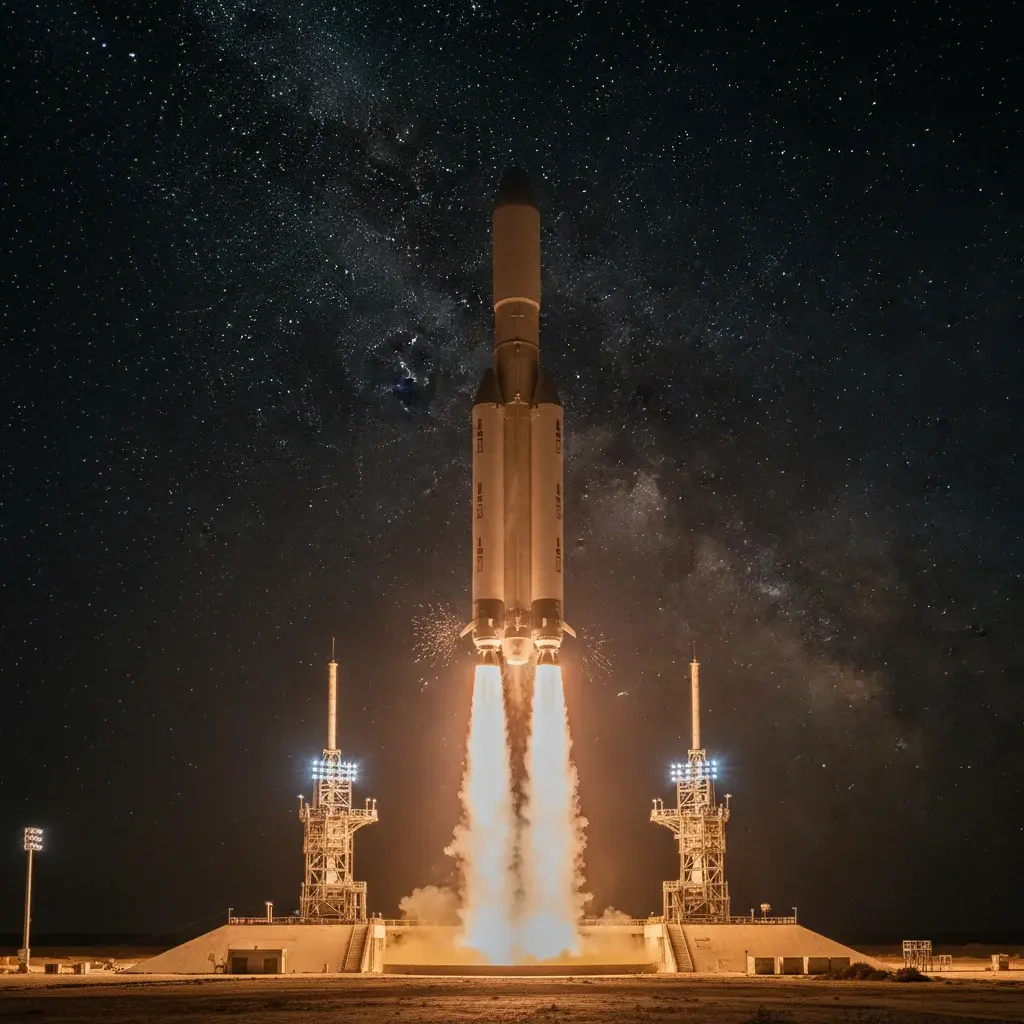
The inaugural flight of the Tianlong-3 rocket, developed by Chinese commercial aerospace firm Space Pioneer, ended in failure early Friday after suffering a critical anomaly during its ascent. The heavy-lift vehicle lifted off at 12:17 a.m. Eastern (0417 UTC) on April 3 from the Dongfeng Commercial Aerospace Innovation Test Zone at the Jiuquan Satellite Launch Center, marking a significant setback for China’s rapidly expanding private space sector.
State media outlet Xinhua confirmed the loss of the vehicle in a brief statement hours after liftoff. Engineers and regulatory bodies are currently analyzing telemetry data to determine the exact cause of the malfunction.
Amateur footage circulating on Chinese social media platforms captured the sequence of events. The video clearly illustrates a sudden, small explosion originating in the engine bay approximately 33 seconds into the flight. Following the visible rupture, the vehicle lost thrust and deviated from its planned trajectory, resulting in the loss of the mission.
The Falcon 9 Competitor
The Tianlong-3 represents a cornerstone of China’s push to develop a robust, reusable launch architecture. Measuring 72 meters in length and 3.8 meters in diameter, the two-stage rocket utilizes a kerosene-liquid oxygen (kerolox) propellant mix. Space Pioneer designed the vehicle to directly compete with SpaceX’s Falcon 9, focusing on first-stage reusability to drastically lower operational launch costs.
The rocket boasts substantial payload capabilities, engineered to carry between 17,000 and 22,000 kilograms to low Earth orbit. For sun-synchronous orbits at an altitude of 500 kilometers, the vehicle can deliver up to 17,000 kilograms. Nine Tianhuo-12 variable thrust engines power the first stage, providing the complex throttle control necessary for eventual propulsive landings.
This heavy-lift capacity is critically needed to support China’s state-backed mega-constellation projects. These satellite internet initiatives require the rapid, cost-effective deployment of thousands of spacecraft over the next decade, a demand that state-owned rockets alone cannot currently meet.
Space Pioneer issued a public apology following the failure, addressing partners and supporters of commercial spaceflight. The company pledged to work closely with investigators to ensure the complete success of subsequent launch missions. However, Space Pioneer did not disclose whether the doomed flight carried any customer payloads, leaving the immediate material impact of the lost hardware unclear.
A Troubled Development History
Friday’s launch failure reopens wounds from a highly publicized testing accident nearly two years prior. In June 2024, a static fire test of the Tianlong-3 first stage went awry when the vehicle unintentionally escaped its test stand clamps. The rogue booster flew a short distance before crashing into a nearby hillside and exploding.
That 2024 incident sent shockwaves through the Chinese commercial space industry. It prompted regulatory bodies to mandate a comprehensive review of safety protocols across the commercial launch sector. Space Pioneer was forced to execute a major redesign of the first stage, significantly delaying the rocket’s highly anticipated debut.
The company appeared to have recovered by July 2025. Space Pioneer completed the construction of its dedicated launch pad at the Dongfeng site and successfully executed a static fire of the redesigned first stage. This milestone positioned the Tianlong-3 alongside other emerging reusable rockets, such as the Zhuque-3 and Long March 12A, which both reached orbit in late 2025 despite failing their respective first-stage recovery attempts.
Financial Stakes and Market Position
The financial implications of the Tianlong-3 failure are substantial. Space Pioneer secured approximately $350 million in a major funding round in October 2025. Investors poured capital into the firm to accelerate the development of the Tianlong-3, alongside next-generation launch vehicles and advanced engine technologies.
Prior to Friday’s anomaly, Space Pioneer held a promising track record. The company successfully launched its smaller Tianlong-2 kerolox rocket into orbit during its solitary flight in April 2023. This earlier success had bolstered investor confidence in the firm’s ability to scale up to medium- and heavy-lift vehicles.
China’s Ambitious 2026 Launch Schedule
The Tianlong-3 anomaly marks China’s 19th orbital launch attempt of 2026 and its third failure of the year. It arrives just days after CAS Space successfully debuted its Kinetica-2 kerolox rocket on March 30, which carried a prototype cargo spacecraft into orbit.
Earlier in the year, the Chinese space sector experienced two other notable setbacks. A Ceres-2 solid rocket was lost during a mid-January launch, while a state-operated Long March 3B rocket suffered a third-stage anomaly shortly after. Despite these hurdles, the national launch cadence remains exceptionally high.
Industry executives indicate China is targeting around 140 orbital launches in 2026. This aggressive schedule aims to support numerous constellation deployments and critical tests for China’s crewed lunar program. Upcoming operations also include vital human spaceflight missions to the Tiangong space station and the Chang’e-7 lunar landing mission.
Moving forward, regulatory agencies will likely heavily scrutinize Space Pioneer’s manufacturing and quality assurance processes before clearing the Tianlong-3 for a return to flight. Industry observers will closely monitor the forthcoming accident investigation report, which could dictate new regulatory hurdles for commercial launch providers. The speed at which Space Pioneer can implement corrective measures and return the Tianlong-3 to the pad will serve as a critical indicator for the resilience and future trajectory of China’s commercial space economy.

Leave a Reply