

NASA Administrator Jared Isaacman announced a sweeping overhaul of the Artemis program this week, effectively pausing the planned lunar Gateway station and leaving European space partners with hundreds of millions of euros in stranded investments.
The sudden redirection shifts the U.S. space agency’s focus toward a direct lunar surface base, abandoning the orbital outpost that has long served as a cornerstone of international cooperation for humanity’s return to the Moon.
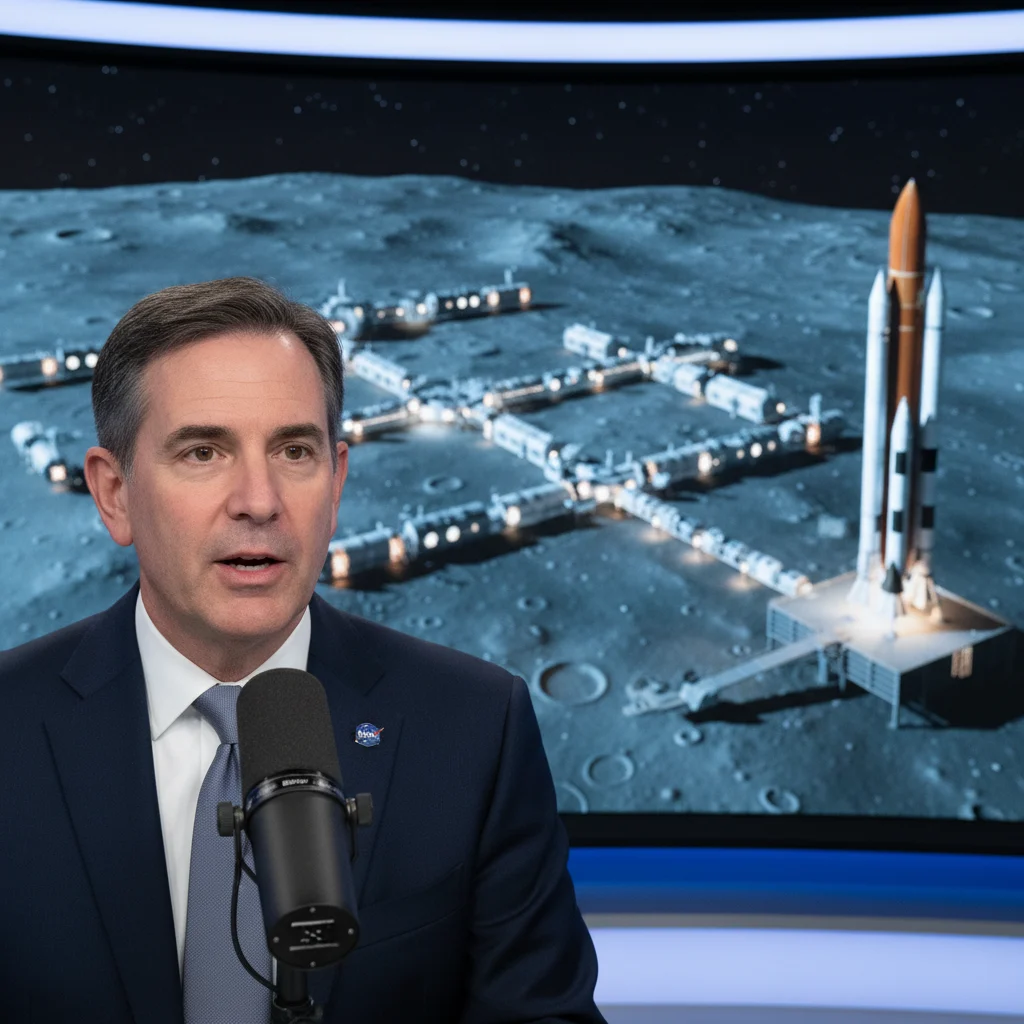
NASA’s newly unveiled vision relies on building and supplying a lunar surface base through monthly uncrewed landings, utilizing Commercial Lunar Payload Services (CLPS) companies as soon as next year. However, this pivot leaves international partners scrambling to determine how their existing orbital hardware fits into a surface-first architecture.
A Sudden Shift in the Lunar Roadmap
For years, the European Space Agency (ESA) and major European aerospace primes have operated under the assumption that the Gateway station would serve as the critical staging point for lunar operations.
Under this framework, Europe committed heavy financial and industrial resources to develop key components of the planned lunar orbiting station.
These contributions included the Lunar I-Hab, one of two primary habitation modules designed to house future Artemis crew members during their orbital stays.
European contractors were also building the Lunar View module, intended to provide refueling capabilities for the station’s power and propulsion element, cargo logistics, and viewing ports for astronauts.
Additionally, the Lunar Link telecommunications element was under European development to ensure robust communication links between the Gateway station, lunar surface hardware, and personnel.
Collectively, these Gateway-specific projects cost Europe hundreds of millions of euros, with lucrative contracts awarded to major industry players including Thales Alenia Space, Airbus, Redwire, and Beyond Gravity.
While ESA is still contributing the European Service Module for the Orion spacecraft—which will successfully fly astronauts Reid Wiseman, Christina Koch, Victor Glover, and Jeremy Hansen on the upcoming Artemis II mission—the broader architecture for subsequent missions has been completely upended.
Caught Off Guard
Despite Isaacman’s remarks during the press announcement that the pause of Gateway in its current form “should not really surprise anyone,” the European space sector was largely caught unawares.
Airbus, which was supplying the European Service Module as well as the power management and distribution system for Gateway’s HALO module, only formally learned about the proposed pause during NASA’s presentation this week, according to a company spokesperson.
A spokesperson for TTTech, the firm supplying network electronics for Gateway alongside Beyond Gravity, stated that the company expects to “understand more about the next steps in NASA’s redirection and its plans for the Moon base in the coming weeks and months.”
The timing of NASA’s unilateral announcement coincides with a period of declining European trust in U.S. space policy.
Consequently, Europe has increasingly focused its strategic efforts on building sovereign space capabilities, such as backing regional startups like Arkadia Space, to reduce reliance on American-led architectures.
Hoping for a Congressional Lifeline
While the executive branch has signaled the end of Gateway, international suppliers are closely monitoring the U.S. legislative process for a potential reversal.
The Trump administration previously telegraphed this cancellation last year when it proposed cutting Gateway loose in its fiscal year 2026 budget request.
However, the orbital station was ultimately saved by U.S. lawmakers, who appropriated $2.6 billion in Gateway funds in the final spending bill.
Now that the Gateway is once again on the chopping block, many European suppliers are keeping their fingers crossed for a second round of Congressional redemption.
While several European Gateway suppliers declined to comment immediately following the announcement, those who did speak are not giving up hope entirely.
“Congressional approval is still required for this,” a spokesperson for Beyond Gravity stated. “We will therefore have to wait and see what the final decision looks like.”
Salvaging Hardware for New Horizons
If the cancellation plan proceeds, Isaacman proposed that many Gateway elements could be repurposed for other spaceflight initiatives, including the newly prioritized lunar surface base.
However, this strategy will inevitably create winners and losers among the contractor base, as some hardware is significantly easier to adapt for other missions.
NASA has already unveiled plans to utilize the power and propulsion module of the Gateway to support the SR-1 Freedom mission, an ambitious initiative aiming to send a nuclear-powered spacecraft to Mars in 2028.
Redwire, the company that developed the roll-out solar arrays for Gateway, is holding out hope that its technology can still be utilized on this upcoming Mars mission.
Mike Gold, Redwire’s president of civil and international space, noted that the company is also developing the international berthing and docking mechanism for the I-Hab module.
According to Gold, there is a viable chance that this docking hardware could be repurposed for operations in low Earth orbit (LEO).
“We can certainly leverage these capabilities for LEO missions as well, if ESA chooses to pivot from the I-Hab to LEO activities,” Gold said. “Again, I’ve had less than 48 hours to digest this, so it’s still unclear.”
The Path Forward for International Partnerships
Given the abrupt nature of the announcement, ESA is currently evaluating how it plans to navigate the shifting Artemis architecture.
The primary challenge remains finding secondary applications for the remainder of the Gateway hardware currently in production.
NASA has publicly stated it will “repurpose applicable equipment and leverage international partner commitments” to support a future lunar base.
Yet, for several European elements specifically designed for free-flying microgravity environments, transitioning to a lunar surface application remains a functional nonstarter.
Moving forward, the international space community will closely watch how the U.S. Congress responds to NASA’s proposed budget realignments in the coming legislative session.
If lawmakers approve the Gateway cancellation, ESA and its commercial partners will be forced to urgently pivot their stranded assets toward sovereign LEO stations or entirely new deep space architectures.
Ultimately, this unilateral pivot by NASA risks permanently altering the dynamics of global space cooperation, potentially accelerating Europe’s drive toward total aerospace independence in the decade to come.


Leave a Reply