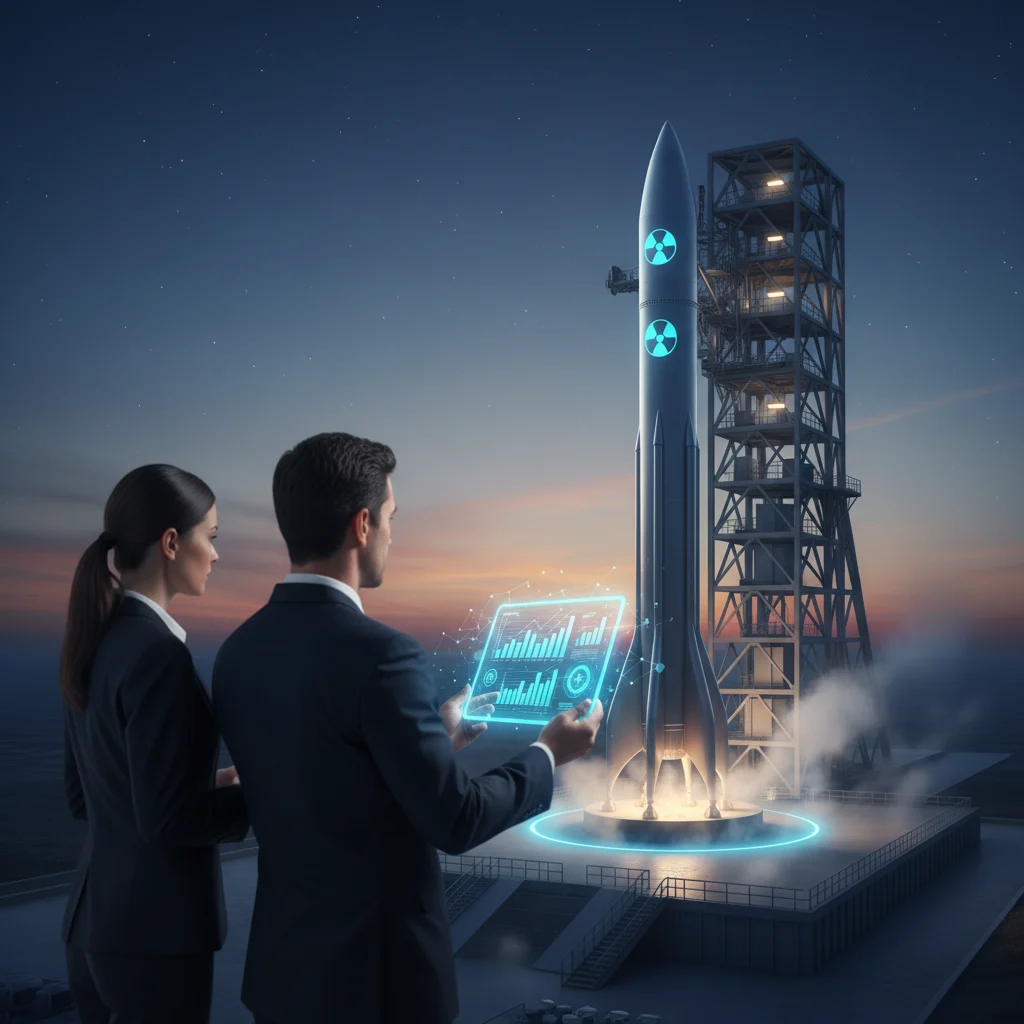
Aerospace executives and policy experts gathering in Washington, D.C., on Thursday delivered a stark warning for the future of off-Earth energy: the biggest hurdle to launching commercial nuclear reactors into space is not engineering, but securing insurance. Speaking at the Nuclear Launch Seminar, hosted jointly by the Association of Commercial Space Professionals and the Nuclear Energy Institute, industry insiders labeled risk underwriting as the sole “show stopper” for upcoming atomic space missions.
The Lunar Power Imperative
As the commercial space industry targets ambitious lunar bases and deep-space exploration, traditional solar arrays are no longer sufficient. A single lunar night lasts for 14 Earth days, plunging solar-reliant habitats into freezing darkness. To maintain life support systems and scientific equipment, companies are developing compact fission reactors to power these next-generation outposts.
However, while entrepreneurs express immense confidence in their ability to safely deliver radioactive materials into orbit, the insurance sector remains deeply hesitant. Underwriters are balking at the mere mention of the word “nuclear.”
Despite decades of technological advancement, financial institutions continue to associate atomic power with catastrophic terrestrial failures. “Insurance is a fundamentally conservative and reactionary industry,” Stewart Forbes, an energy attorney with Hogan Lovells, told seminar attendees. “People still think Chernobyl or Fukushima or Three Mile Island, but that’s not the world we live in anymore.”
Engineering Safety vs. Actuarial Uncertainty
To alleviate these fears, aerospace engineers emphasize the stringent safety protocols inherent in modern space reactor design. These nuclear systems are engineered to remain completely inert during the violent forces of launch.
Control mechanisms are permanently engaged to prevent the radioactive material from going critical while inside Earth’s atmosphere. According to technical presentations at the seminar, the reactors only initiate fission once they reach a stable, designated orbit.
The primary—albeit statistically minute—risk involves an activated reactor suffering an orbital decay and surviving atmospheric re-entry, potentially scattering radioactive debris. Because a commercial nuclear space launch has never occurred, the insurance industry lacks the actuarial data necessary to accurately price this specific risk.
Without historical datasets to model probabilities and potential financial liabilities, commercial underwriters simply cannot draft policies. This data vacuum forces the nascent industry to look toward the federal government for a financial safety net.
Government Indemnification as the Launchpad
Experts at the seminar outlined that federal agencies must indemnify the first generation of space nuclear launches. By absorbing the financial risk of these pioneering flights, the government would allow the creation of baseline datasets that commercial insurers could subsequently use to shape their future premium structures.
Industry leaders identified two primary administrative pathways to achieve this federal backing. The first option involves the Department of Energy (DOE) taking legal ownership of the nuclear devices during the launch phase, thereby absorbing the liability under existing federal frameworks.
The second option relies on NASA officially declaring space nuclear power as an absolute necessity for its lunar base program. By elevating the technology to a national security priority, the space agency could justify extending exceptional indemnification to its commercial partners.
Implementing these strategies does not necessarily require Congress to pass complex new legislation. “This does not require new statutes,” explained Harsh Desai, chief commercialization officer at Zeno Power. “It requires the agencies to interpret existing laws a certain way and get them to work with each other in the right way.”
Shifting NASA Priorities and Industry Consolidation
This push for regulatory clarity arrives at a critical juncture for U.S. space policy. NASA Administrator Jared Isaacman recently marked his first 100 days in office with an aggressive mandate to accelerate lunar surface operations. His straightforward directive—”Get in, we’re going to the Moon”—places immense pressure on the agency’s infrastructure pipeline, which heavily relies on sustained surface power.
Simultaneously, the White House has submitted an $18.8 billion fiscal year 2027 budget request for NASA. While this proposal maintains the top-line funding from the fiscal 2026 request, it necessitates strict prioritization of mission-critical technologies over certain science and STEM initiatives.
In the broader commercial ecosystem, companies are rapidly consolidating the supply chain required for these extreme environments. Phantom Space recently acquired Thermal Management Technologies to build advanced satellite thermal components for in-space applications, highlighting the industry’s preparation for high-heat, high-power missions.
Meanwhile, lawmakers are already questioning NASA’s shifting vision for Commercial LEO Destinations (CLDs), further complicating the regulatory landscape as Administrator Isaacman proposes new plans for America’s human presence in low Earth orbit.
Navigating the Regulatory Horizon
The immediate future of commercial space nuclear power now hinges on legislative action currently navigating Capitol Hill. Lawmakers are actively debating versions of the NASA Reauthorization Act of 2026, which includes specific provisions pushing the space agency to clarify and formalize an indemnification process for space nuclear payloads.
As these negotiations proceed, the commercial space sector will be watching closely to see whether NASA or the DOE steps forward to bridge the insurance gap. If the federal government fails to establish a clear liability framework, the ambitious timelines for continuous human presence on the Moon may face indefinite delays, grounded not by a lack of thrust, but by a lack of coverage.