
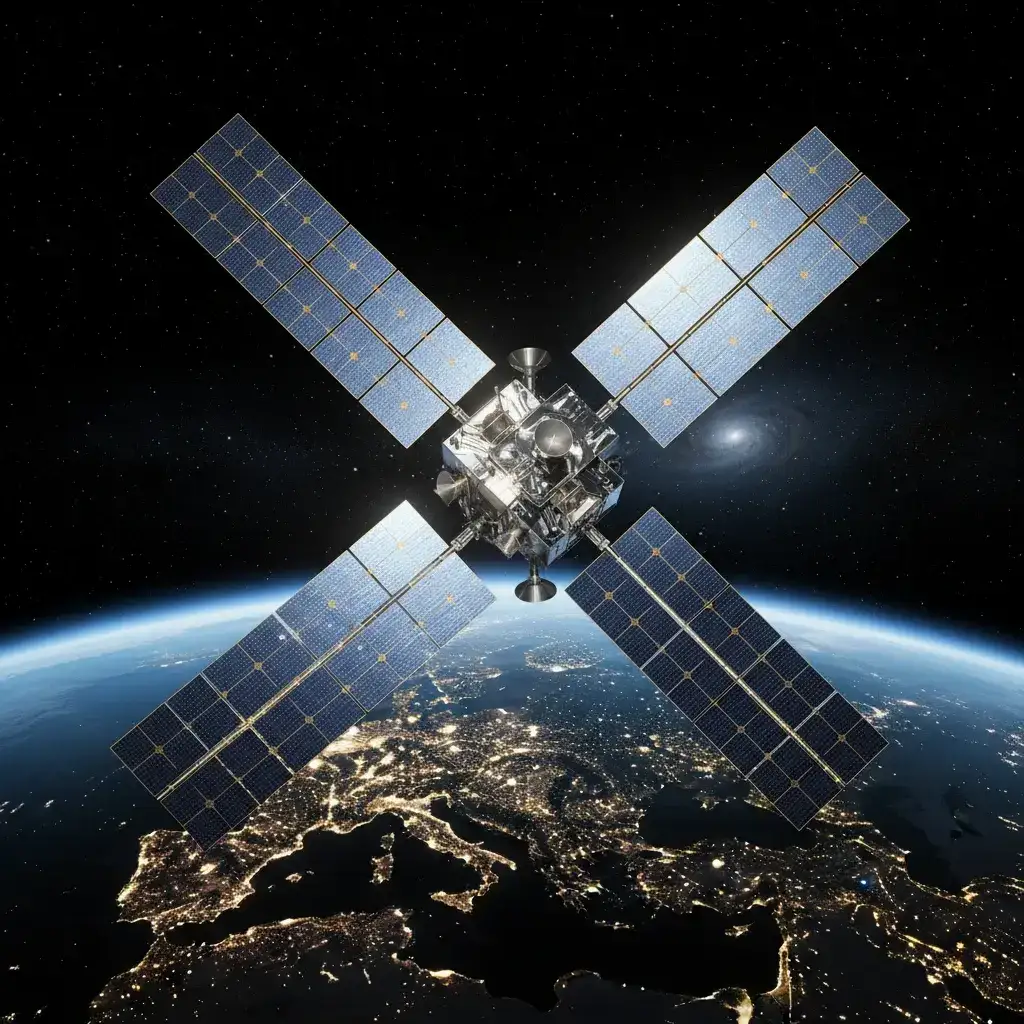
The European Union is poised to seize control of the continent’s space priorities as Brussels aggressively reorients its multi-billion-dollar satellite programs toward military and security applications. According to a new report from The Aerospace Corporation, a proposed fivefold increase in defense and space spending could soon position the EU as the dominant political and financial driver of European space policy, fundamentally altering its relationship with the historically civilian-focused European Space Agency (ESA).
A Geopolitical Awakening in Orbit
For decades, Europe’s space ecosystem has operated under a delicate balance of power distributed across three distinct pillars. The EU handled broad political and regulatory frameworks, intergovernmental organizations like ESA and EUMETSAT provided technical engineering and scientific research, and individual member states retained strict control over sovereign military space capabilities.
However, a rapidly shifting geopolitical landscape is upending this traditional division of labor. The report, titled “A Geopolitical Awakening: The European Union and Space,” argues that massive financial injections are accelerating Europe’s long-standing quest for “strategic autonomy” in orbit.
Authored by Michael Gleason, an analyst at The Aerospace Corporation’s Center for Space Policy and Strategy, the report outlines how the EU is evolving into the central engine of European space. While ESA remains the technical backbone, the EU’s unique ability to pool resources from its 27 member states is reshaping the hierarchy of orbital operations.
Financial Leverage and the Future of ESA
The primary catalyst for this power shift is unprecedented funding. In July, the European Commission unveiled a sweeping budget proposal for the 2028–2034 cycle. The plan seeks to surge defense and space spending to approximately $150 billion over seven years.
This massive influx of capital represents a critical lever of control over the broader European space architecture. Currently, the EU supplies roughly one-quarter of ESA’s budget. Gleason projects that under the new spending proposals, the EU’s contribution could eclipse the 50% mark within just a few years.
“I’m predicting, based on my analysis, that the EU could be providing over 50% of the European Space Agency’s budget,” Gleason stated. “If that happens, that would give the EU a lot more weight on European Space Agency priorities.”
Such a dramatic shift in funding sources threatens to pull ESA away from its founding mandate of purely civil and scientific exploration. As Brussels holds the purse strings, the historically peaceful agency may be drafted further into the development of hard security and defense capabilities for the bloc.
Expanding Security and Defense Infrastructure
The EU already commands a formidable portfolio of critical space infrastructure that underpins daily life and economic activity across the continent. Brussels owns and oversees major systems that drive global navigation, Earth observation, and secure communications.
The Galileo satellite navigation system and the Copernicus Earth observation program serve as the crown jewels of this portfolio. They are supported by EGNOS, a system designed to refine and enhance navigation signals for the aviation sector.
Beyond civilian applications, the bloc is aggressively expanding its security-focused architecture. The GOVSATCOM initiative aims to pool secure satellite communications for government and military users across member states. Meanwhile, the EU is advancing IRIS², a highly anticipated broadband megaconstellation designed to guarantee secure connectivity and eliminate European reliance on foreign commercial providers.
A significant portion of the newly proposed budget will target asset protection. Gleason highlights that European policymakers are increasingly focused on defending these vital orbital networks from emerging threats, including anti-satellite weapons, cyberattacks, and electronic signal interference.
To support these defensive postures, the bloc currently operates a dedicated space surveillance network. It also maintains an intelligence hub tasked with processing classified satellite imagery for top policymakers.
National Ambitions Threaten Bloc Unity
Despite Brussels’ push for centralization and resource pooling, the transition is sparking friction with national capitals. As the EU attempts to achieve economies of scale, individual national governments are simultaneously expanding their sovereign military space ambitions.
This dual-track expansion raises the immediate risk of costly duplication and strategic fragmentation. Germany, for example, recently outlined plans to deploy its own $12 billion, 100-satellite communications constellation. This sovereign network would operate parallel to the EU’s planned IRIS² system.
Defense officials and aerospace analysts worry that such overlapping efforts could severely undercut the bloc’s broader goal of unified strategic autonomy. The situation sets up a potential structural tension between collective European programs and national desires to maintain independent, sovereign capabilities.
Navigating the New Orbital Landscape
The result is an increasingly complex orbital landscape where Brussels wields unprecedented financial influence but lacks absolute political control over individual member states’ defense priorities.
“Many Americans are not aware that the European Union is heavily involved in space activity,” Gleason noted, emphasizing a global blind spot regarding Europe’s shifting defense posture.
As the European Parliament and member states debate the proposed $150 billion budget leading up to 2028, the aerospace industry will be watching closely to see how effectively the EU translates its financial pledges into a cohesive defense architecture. The key indicator to monitor will be whether Brussels can successfully integrate national military space programs into a unified European framework, or if sovereign interests will ultimately fragment the continent’s geopolitical awakening in space.


Leave a Reply