
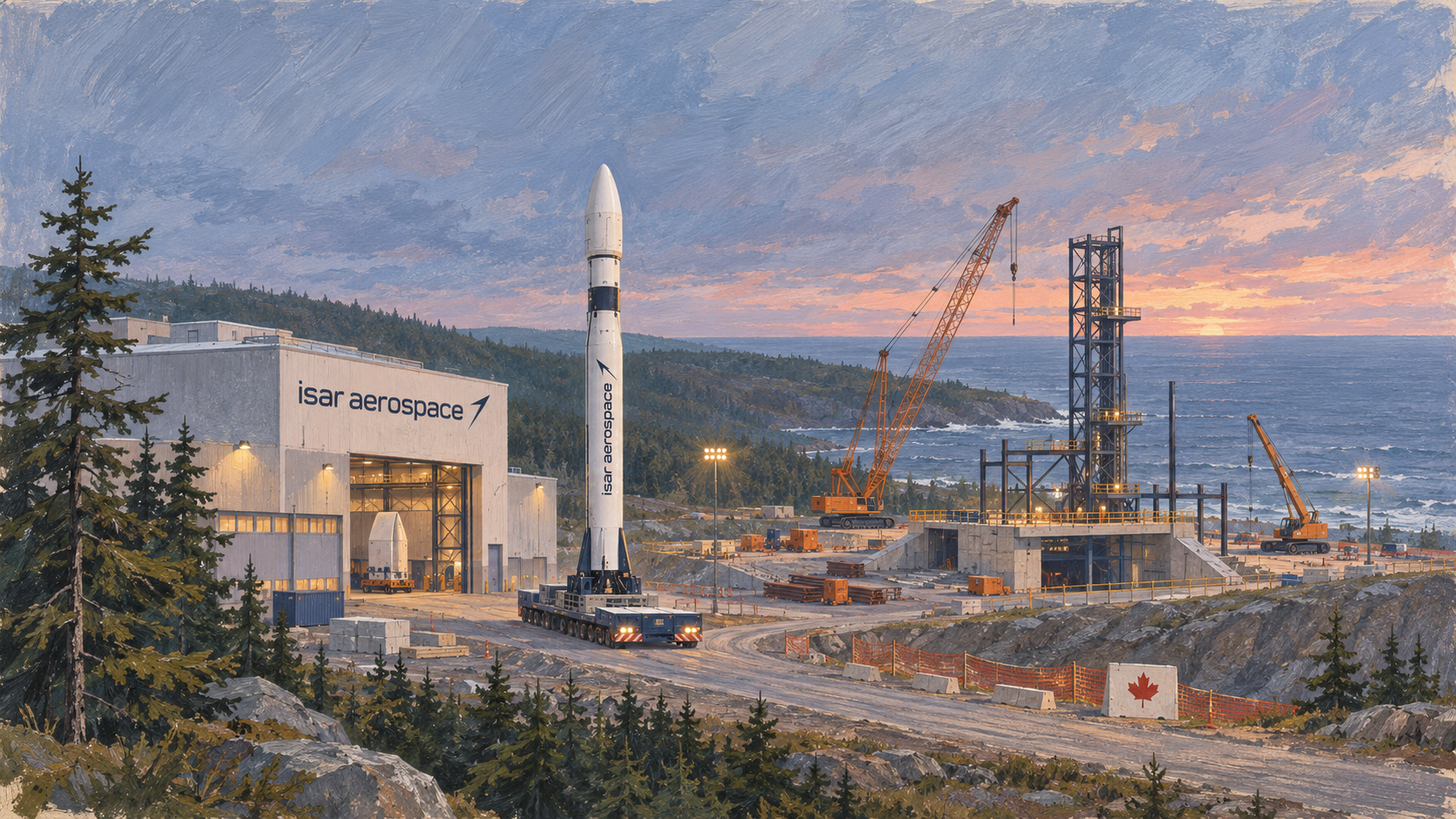
Isar Aerospace has moved its Canadian launch plan from contract language to physical execution, taking operational control of a dedicated site at Spaceport Nova Scotia and beginning construction of the infrastructure needed to fly its Spectrum rocket from North America.
SpaceNews reported the milestone on 28 November. The development is consequential because it links three trends that have largely advanced in parallel: Europe’s emergence of privately developed orbital launchers, Canada’s attempt to establish sovereign launch capability, and NATO’s effort to make allied access to orbit more distributed and responsive.
The handover is real, but it is not an operational launch capability. The site still requires construction, each launch will need Canadian authorisation, and the first Spectrum flight from Nova Scotia remains a company target for 2028.
A site handover changes the programme’s status
Isar and Maritime Launch Services signed a facilities-use agreement in July, then finalised the statement of work and programme milestones in September. On 21 November, the companies announced the transfer of the designated complex, giving Isar responsibility for developing, building and operating its own pad, final-assembly line and payload-preparation facility near Canso.
That sequence matters. Letters of intent and access agreements are common in launch, while completed infrastructure is not. The handover gives Isar direct control over a second launch location after its pad at Andøya Spaceport in Norway, and starts the work that must be completed before the service can produce revenue.
The commercial terms also make the commitment more substantial than a marketing partnership. Maritime Launch says the agreement has a 10-year base term with two optional five-year extensions. It provides for quarterly payments of US$3.75 million, except for a 30-month waiver period beginning after the first year, plus cost-based fees for certain launch services. Maritime’s financial filings record receipt of the first US$3.75 million payment in August.
Flight heritage makes expansion credible—not assured
Isar is no longer proposing to build a launch network around an unflown vehicle. Spectrum reached orbit on its second mission in September and deployed five small satellites plus a technology demonstration from Andøya. Reuters independently described it as the first commercial rocket to reach orbit from continental Europe.
One successful orbital mission nevertheless provides limited evidence for cadence, reliability or economics. Isar says its Munich-area factory could produce as many as 40 vehicles annually, while the Nova Scotia partners have promoted the possibility of up to 40 launches a year from 2029. Those are capacity ambitions, not demonstrated rates. They require repeatable production, a deep customer manifest, trained range personnel and a regulatory system able to process frequent missions.
The company’s €270 million Series D in June provides capital for industrialisation and international expansion. It does not eliminate the financing burden of running two launch sites while Spectrum moves from qualification into commercial operations.
Canada gains infrastructure before it gains sovereignty
Canada has framed domestic launch as economic and strategic infrastructure. The federal government has committed C$182.6 million over three years to establish sovereign capability and signed a separate 10-year, C$200 million agreement for a dedicated government pad at Spaceport Nova Scotia. Defence funding is also supporting Canadian light-launch developers through the Launch the North programme.
Isar adds a flight-proven allied vehicle to that domestic ecosystem. It could provide Canadian satellite builders and government missions with an alternative to shipping payloads abroad, while attracting integration, range, logistics and specialised engineering work to Atlantic Canada.
But a German-operated rocket from Canadian soil is not the same as an entirely Canadian launch supply chain. Engines, vehicle production, key intellectual property and programme control remain centred in Europe. The arrangement strengthens assured access among allies; it does not remove dependence on foreign industrial capacity.
The regulatory foundation is still being built
The companies describe Spaceport Nova Scotia as Canada’s first licensed commercial orbital launch site. Canada’s official framework is more precise: Transport Canada says it does not license spaceports. Under the interim programme, the Minister of Transport authorises individual launches after reviews covering aviation, marine traffic, environmental law, national security and public interest.
A permanent regime is progressing but incomplete. The Canadian Space Launch Act, Bill C-28, passed second reading on 26 November and was referred to the House transport committee. Regulations are expected later. That legislative progress reduces policy uncertainty, yet operators still face detailed safety cases, liability rules and coordination across federal agencies.
Construction timing is another constraint. The July agreement called for additional spaceport infrastructure to be completed by 31 December 2027. Maritime has said it expects readiness for orbital launch by the end of March 2028. The site handover occurred after the original 1 November condition, demonstrating that even early milestones can move.
A transatlantic node in a wider launch network
Nova Scotia’s Atlantic position supports over-ocean trajectories to mid- and high-inclination or polar orbits, which are useful for Earth observation, communications and defence spacecraft. It also gives Isar geographic diversification. A customer could potentially choose between European and North American integration paths without changing launch vehicle.
The strategic value extends beyond the two companies. NATO’s STARLIFT initiative is intended to pool military launch demand, reserve commercial capacity and connect spaceports across participating nations. Canada and Germany are among the funders. An operational Isar pad in Nova Scotia would be a tangible node in that architecture rather than another national facility operating in isolation.
Commercially, the model tests whether launch providers can sell not just a rocket flight but a distributed end-to-end service: production, pad operations, payload integration and assured slots across allied territory. Success could encourage other launch companies to pursue multi-spaceport networks. Failure would reinforce the industry’s history of underused sites built ahead of sustainable demand.
Milestones that will decide the outcome
The next evidence should be physical and regulatory: completion of the pad and assembly facilities, a submitted Canadian launch application, environmental and range approvals, and a named first mission. Spectrum must also demonstrate repeat launches from Andøya while Isar builds its Canadian workforce and supply chain.
After that, watch the size and quality of the manifest, integration with STARLIFT procurement, and whether Maritime’s government and commercial pads share infrastructure efficiently. The decisive metric will not be theoretical annual capacity, but launches conducted safely and repeatedly from 2028 onward.
Isar’s site handover does not solve the allied launch bottleneck. It does something more concrete than most spaceport announcements: it assigns an operational site to a vehicle that has already reached orbit and puts construction against a defined schedule. The next two years will show whether that combination becomes resilient infrastructure or another ambitious launch plan waiting for demand.