
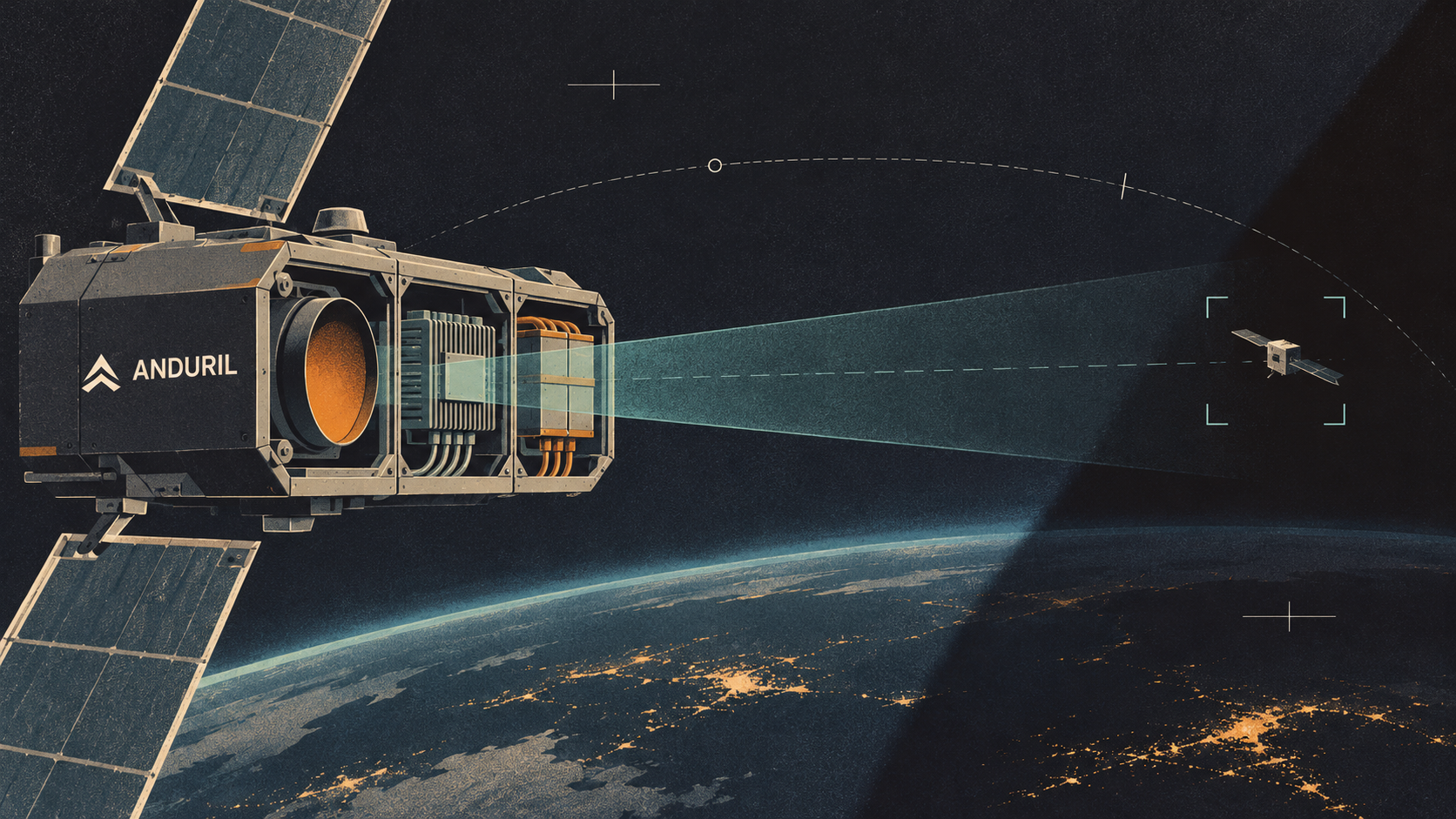
Anduril has put three proprietary space payload systems through an orbital demonstration, moving its space ambitions beyond software and ground prototypes into flight hardware. The important development is not simply another sensor in orbit. It is the company’s attempt to turn space-domain awareness into a modular payload business that can ride on different spacecraft buses and process more data at the edge.
SpaceNews first highlighted the disclosure on 10 November. The company-funded ANDURIL-216 mission, internally called Lectronimo, launched on 7 July 2026 aboard SpaceX’s Transporter-17 rideshare mission. Independent reporting by Aviation Week and Via Satellite confirms the spacecraft is operating in low Earth orbit.
Three systems, five payloads
The payload count needs careful separation. ANDURIL-216 carries three imaging payloads: one Anduril-built long-wave infrared sensor and two electro-optical sensors supplied by third parties. It also hosts Anduril’s Mission Compute Module and Dynamic Payload Power Module. In other words, the mission is validating three proprietary modular systems—the infrared sensor, computer and power unit—alongside two outside imagers.
Anduril says it has commissioned the bus, power hardware and edge processor, received calibrated images from all three imagers, and used its Lattice software to command and task a spacecraft exclusively for the first time. Those are company claims, not government acceptance results. No customer, production order, unit price, detection range or independently measured tracking performance has been disclosed.
The most strategically relevant element is the long-wave infrared sensor. Conventional visible-light tracking depends on reflected sunlight, so custody can be interrupted when a target crosses Earth’s shadow. Thermal infrared sensing is intended to detect emitted heat during eclipse. Anduril executives told reporters that eclipse can occupy roughly one-third of an orbit and that the sensor is designed to reduce this gap. The disclosure does not establish continuous custody under operational conditions, but it identifies a genuine weakness in optical surveillance.
A payload strategy, not a satellite franchise
Anduril’s economic proposition is portability. The power module conditions different spacecraft power outputs for payload use, while the mission computer provides onboard processing, storage and a card-based architecture for third-party software. The company says the components are designed to work with multiple buses rather than bind customers to a single spacecraft platform.
That approach could shorten integration cycles and separate the value of a surveillance mission from the company building the bus. ANDURIL-216 uses an Apex Aries bus, continuing a partnership in which an earlier Apex mission carried an Anduril edge-processing payload. Anduril also lists planned demonstrations with Impulse Space in geostationary orbit and Argo Space in a high-energy orbit on its space programme page.
If the interfaces prove repeatable, bus manufacturers gain another flight-proven payload option and Anduril gains routes to market without financing a proprietary constellation. The trade-off is dependence on host spacecraft schedules, power and thermal margins, communications links and security accreditation. “Bus-agnostic” is an engineering objective; every real mission still requires qualification and integration.
A market is forming around persistent custody
The timing is favourable. The U.S. Space Force’s 2040 Objective Force Design describes space-based sensors, terrestrial sensors and a processing-and-fusion layer as the three core elements of space-domain awareness. It expects more manoeuvrable and harder-to-detect spacecraft, shifting the mission from safety-of-flight cataloguing towards faster military custody, warning and targeting support.
Procurement is also becoming more competitive. In April, Space Systems Command awarded 14 companies places on the Andromeda contract vehicle for proliferated geostationary surveillance, with a ceiling reported at US$1.8 billion over ten years. On 10 November, Scout Space separately announced a US$60 million SpaceWERX STRATFI award for space-domain awareness sensors, onboard processing and a hardware-agnostic software testbed. Flight heritage matters, but Anduril is entering an active field rather than creating an uncontested category.
The competitive boundary spans traditional prime contractors, newer spacecraft builders and specialist sensor firms. It also crosses ground and space architectures. The Space Force is upgrading ground-based optical systems, developing the allied DARC radar network and operating spacecraft such as GSSAP and Silent Barker. An infrared payload in low Earth orbit will complement, not replace, those systems.
Edge processing is the larger prize
The mission computer may ultimately matter as much as the imager. Sending raw sensor data to the ground creates bandwidth and latency constraints. Processing and fusing observations on orbit could allow a spacecraft to identify an event, retask itself or pass a compact alert to another system more quickly. That is particularly valuable when manoeuvring objects create short decision windows.
However, autonomy adds verification risk. Algorithms must distinguish a meaningful manoeuvre from sensor noise, thermal variation or an incorrect association. National-security users will require cyber assurance, explainable behaviour, reliable time and position data, and a clear path for human control. The orbital test demonstrates that hardware survived launch and can produce imagery; it does not yet prove operationally trusted autonomous custody.
Commercial adoption also depends on data rights and access. An August 2026 U.S. Government Accountability Office review found that licensing costs, perceived restrictions and concerns about long-term access were already discouraging some defence users from purchasing commercial space data. A technically capable sensor is only one part of a usable service.
What to watch next
The next milestones should be measurable: repeated tracking of known targets through eclipse; disclosed detection and custody performance; operation of onboard models; successful transfer of observations into government catalogues or battle-management systems; and evidence that the payloads can move to a second bus without extensive redesign.
Commercial evidence matters just as much. A government task order, a production quantity, an allied customer or a funded follow-on mission would show that the demonstration is converting into demand. The planned Impulse and Argo missions will also test whether Anduril’s modular claim survives different orbital regimes and partner architectures.
For now, ANDURIL-216 is best understood as a credible entry ticket. It gives Anduril orbital heritage across sensing, computing, power integration and command software, but not an operational surveillance franchise. If the company can turn those flight results into repeatable interfaces and trusted data, space-domain awareness may become less a contest between complete satellite programmes and more a market for interchangeable sensors, processors and software.