
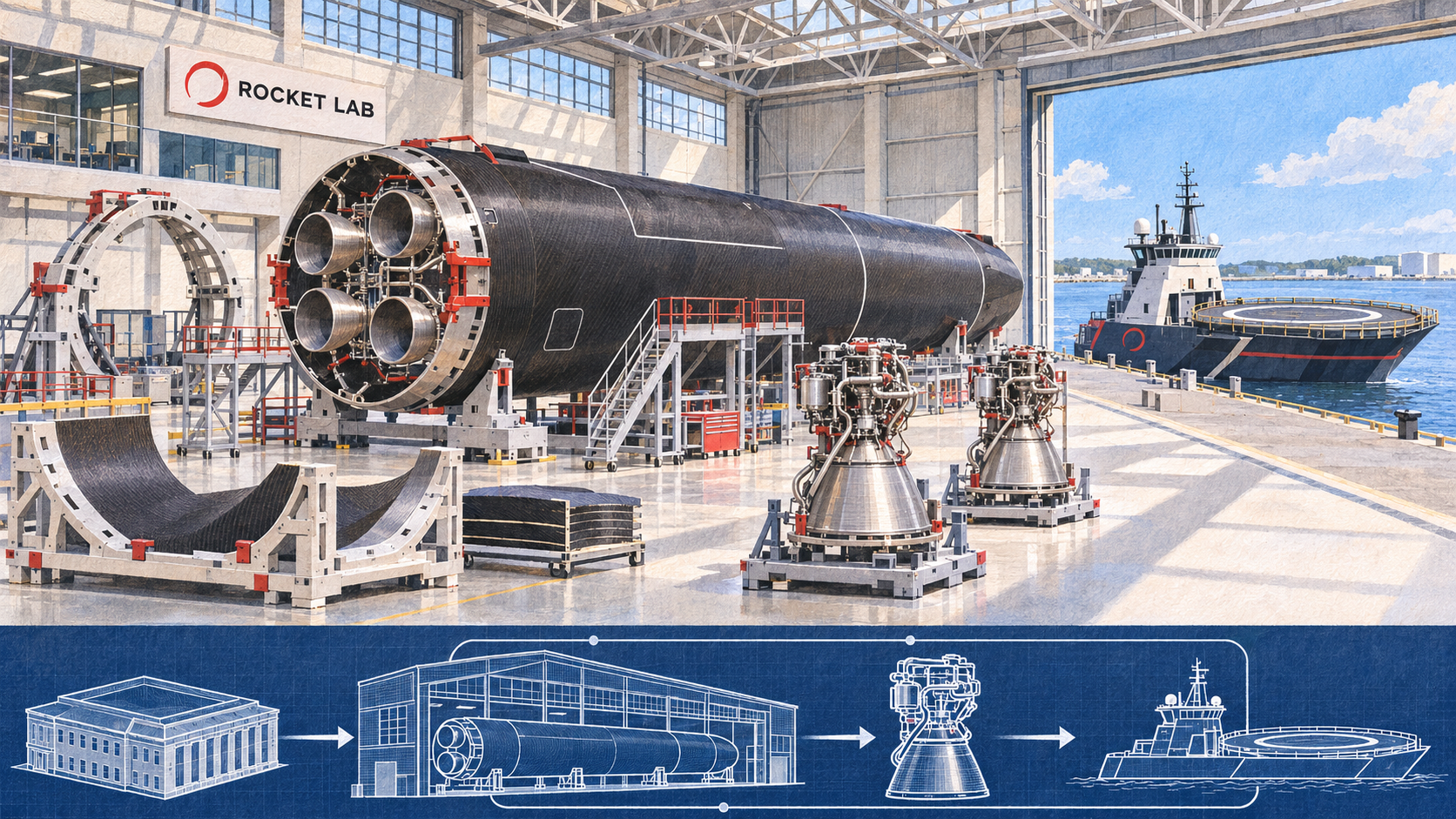
The Pentagon is preparing to finance the industrial system around Rocket Lab’s Neutron rocket before the vehicle has reached orbit. Its Office of Strategic Capital has made a US$150 million conditional loan commitment intended to expand production, launch processing and maritime recovery capacity for the reusable medium-lift vehicle.
The development, first identified for this analysis through SpaceNews, is more consequential than its size suggests. It shows the US government treating launch cadence as industrial infrastructure: not simply buying missions, but using public credit to help create the factories, engines, vessels and turnaround system required to supply them.
That is a strategic endorsement of the capacity the Pentagon wants Neutron to provide. It is not an endorsement of flight readiness. Neutron’s inaugural launch remains targeted for 2027, and the programme must still clear first-stage manufacturing, qualification and recovery milestones.
A conditional loan, not cash already delivered
The Office of Strategic Capital, or OSC, said the proposed loan would support faster vehicle delivery and processing, additional maritime equipment for booster recovery and transport, higher production of composite structures and engines, and infrastructure designed to reduce time between launches.
The commitment is conditional. Rocket Lab must satisfy financial, legal, technical, investment and due-diligence requirements before financial close. The Pentagon’s public announcement did not disclose a maturity date, security package, disbursement schedule or final interest rate. Until those conditions are met, US$150 million is a prospective credit facility rather than funded capital.
This is also not emergency liquidity. Rocket Lab’s quarterly filing reported US$4.45 billion in cash and US$256 million in marketable securities at 30 September, following capital raised to fund its pending Iridium acquisition. The company recorded US$267.8 million of quarterly revenue and a US$79.7 million net loss.
The loan’s value is therefore chiefly strategic and project-specific. It could provide relatively low-cost, non-dilutive financing for assets the government wants built while reserving Rocket Lab’s larger cash pool for the Iridium transaction, development work and other corporate needs.
Demand is forming ahead of technical proof
Rocket Lab says it signed more than US$515 million of Neutron launch contracts during the third quarter: eight missions for five constellation operators. The announced customers include ICEYE and Muon Space, with missions stretching from late 2028 into 2030. Neutron’s manifest now covers 16 missions, and several were sold at a stated base price of US$70 million.
Those contracts are evidence of customer demand, but their payment schedules, termination rights and launch-delay protections are not public. They should not be confused with recognised revenue or a proven flight rate. Rocket Lab’s claimed 13,000-kilogram low-Earth-orbit performance and reusable operating model remain design objectives until demonstrated.
The backlog nevertheless explains why financing post-debut capacity now matters. If the first flight succeeds but production remains slow, customers still face scarce launch slots and Rocket Lab cannot spread fixed costs across a useful cadence. Funding engines, composite tooling and recovery vessels in parallel can shorten the gap between technical success and commercial service.
Public credit is becoming a launch-policy instrument
Traditional launch support has centred on research grants, infrastructure spending and service contracts. OSC is applying a different instrument: repayable debt intended to crowd capital into manufacturing capacity linked to national security.
That can be more disciplined than a grant because the borrower must repay, while still offering terms private lenders may not provide for an unflown rocket. It also shifts some risk towards the public balance sheet and makes due diligence important. The government is financing a production thesis whose central asset has not yet completed an orbital mission.
The strategic aim is clear. A reusable medium-lift launcher operating from Wallops Island would give US military and commercial customers another domestic option in a market where high-cadence capability remains concentrated. It would also add geographic diversity and could eventually compete for National Security Space Launch work after Neutron meets the required flight criteria.
For competitors, the loan is a signal that price and technical merit will not be the only determinants of future launch supply. Governments are increasingly prepared to shape industrial capacity directly. Similar credit tools could become relevant to propulsion, space-domain awareness, critical materials and other bottlenecks where strategically useful demand exists but private financing alone does not deliver the desired scale or timing.
The critical path still runs through manufacturing
Public financing cannot remove Neutron’s immediate technical constraint. Rocket Lab disclosed in October that voids had been found in portions of a composite first-stage propellant-tank dome. Process changes produced encouraging results, according to the company, but a replacement forward dome, full tank assembly and hydrostatic and cryogenic testing still lie ahead.
As Space Insight previously assessed, “2027” is a window rather than a firm launch date. The new loan does not alter that distinction. It is aimed at the infrastructure needed beyond flight one, not at certifying that the first vehicle is ready.
Execution risk then moves from development into operations. Rocket Lab must manufacture consistent composite structures, raise Archimedes engine output, qualify ground systems, recover a booster at sea and establish refurbishment requirements. Additional vessels and equipment create capacity only if the recovery design works and the returned stage can be processed economically.
Milestones that will test the industrial thesis
The first financial milestone is closing the OSC loan, including disclosure of final terms, conditions and the assets it will fund. Investors should then watch the timing of disbursements and whether Rocket Lab commits matching capital to specific production and recovery projects.
The technical sequence is more decisive: acceptance of the replacement dome, completed first-stage tank tests, integrated static fire, vehicle delivery to Launch Complex 3 and a successful inaugural flight. After that, booster recovery, the interval to a second mission and evidence of repeatable engine and composite production will determine whether the loan is financing genuine cadence rather than idle capacity.
Commercially, firm mission dates for ICEYE, Muon Space and other customers will reveal whether backlog converts into a workable manifest. Strategically, qualification for national-security task orders would show that public credit has helped create another usable launch provider rather than merely another developmental programme.
The Pentagon’s commitment does not de-risk Neutron’s first flight. It changes what happens if that flight succeeds. By financing the factory-and-recovery system in advance, the US government is trying to turn a new rocket into repeatable capacity faster—and making industrial scale, not just orbital performance, the next measure of launch competition.