
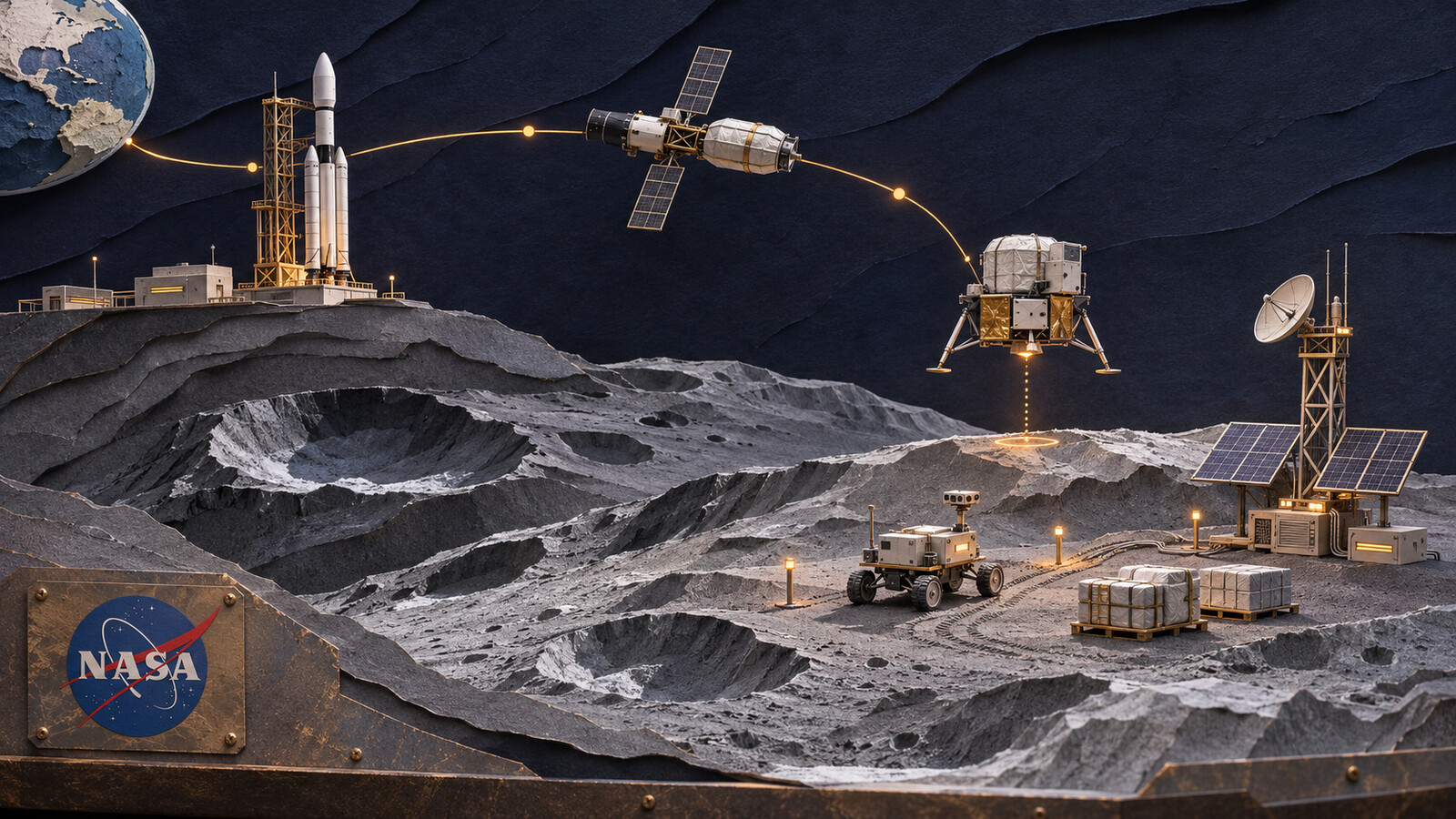
NASA has moved a meaningful part of its lunar architecture from planning charts into commercial orders. The agency awarded six launch and in-space transportation task orders worth approximately US$1.3 billion, opened a new cargo-lander supplier pool and booked delivery of a nuclear-powered rover to the lunar south pole.
The package, first identified for this analysis through SpaceNews, matters less for its largest headline—US$10 billion—than for the way NASA is assembling an end-to-end logistics market. Launch vehicles, orbital-transfer spacecraft, landers, communications assets and surface power are being procured as connected services rather than isolated demonstrations.
That gives several young systems their first substantial cislunar demand signal. It also concentrates schedule risk in a chain containing vehicles that have not yet flown.
A US$10 billion ceiling is not a US$10 billion award
NASA selected Blue Origin, Firefly Aerospace, Intuitive Machines, ispace-U.S., Lockheed Martin, Northrop Grumman, SpaceX and Voyager Technologies for Commercial Lunar Payload Services 2, or CLPS 2.
The 10-year, multiple-award contract has a combined maximum value of US$10 billion. That number defines how much NASA may order across the supplier pool; it is not money already obligated and does not guarantee revenue to any participant. Companies must still compete for firm-fixed-price task orders.
This distinction is central for investors. Selection establishes eligibility and strategic relevance, but backlog begins only when a priced mission is awarded. The contract nevertheless widens the field beyond the five providers that have received delivery orders under the current CLPS programme and creates a procurement route extending into the mid-2030s.
NASA also raised the existing CLPS 1 ceiling from US$2.6 billion to US$4.2 billion. That framework remains available for initial Moon Base work through November 2028, with time to complete awarded deliveries extending to November 2033.
The transport orders create the immediate market
The firmer commercial signal is the approximately US$1.3 billion attached to six task orders under NASA’s Venture-Class Acquisition of Dedicated and Rideshare contract. Arrow Science and Technology, Blue Origin and Impulse Space will lead missions integrating launch, orbital transfer and—in some cases—lunar descent.
NASA says the package will use Falcon 9, New Glenn and Terran R launch vehicles, with transfer spacecraft supplied by Blue Origin, Firefly, Impulse and Quantum Space. The missions are intended to move communications, navigation, reconnaissance and technology payloads through several cislunar orbits from 2028.
Impulse Space says its two firm-fixed-price orders cover one mission launched by SpaceX and another using Relativity Space’s Terran R. The latter would combine Impulse’s Helios kick stage and a new lander. Those are contracted roles, but mission schedules and technical performance remain targets: neither Terran R nor Impulse’s lunar lander has flown.
Quantum Space separately says it expects about 25% of Arrow’s US$185 million task order, with terms still being finalised. That is a company disclosure rather than a NASA-published subcontract value.
NASA also selected SpaceX under an existing lunar-logistics contract to deploy cislunar communications satellites on Starship in 2028. The agency did not disclose that task order’s value in its announcement.
Procurement is shifting from rockets to routes
Commercial launch contracts traditionally end when a payload reaches its deployment orbit. These orders buy a longer chain: launch, transfer across cislunar space, delivery into a specified orbit and, for some missions, a descent demonstration.
That change could expand the addressable market for orbital-transfer companies. A small launch provider may no longer need to build a Moon-capable upper stage, while a lander developer can buy part of the journey from a specialist. Standard interfaces and repeat missions could eventually turn bespoke trajectories into a logistics network.
Falcon 9, New Glenn and Terran R appear in the same procurement, while Firefly can participate through in-space transportation without supplying the launch. NASA is spreading work across overlapping teams rather than choosing one vertically integrated route.
For established launch companies, this creates demand but also new dependencies. A successful mission now requires the launch vehicle, transfer stage, payload and ground segment to clear their own reviews on the same schedule. One late component can strand the rest of the stack.
The Moon Base needs cargo before crews
The package includes a US$94 million base award to Blue Origin to deliver NASA’s PROMISE rover, plus a performance-dependent option worth another US$140 million. NASA plans to build the six-wheeled rover from spare flight components and engineering models associated with the Curiosity and Perseverance Mars programmes.
PROMISE is targeted for late 2028 and an 18-month mission. It would drill about one metre below the lunar surface, assess potential resources and test autonomous systems near the south pole. Blue Origin is expected to use its Mark 1 cargo lander.
NASA also awarded component work for a small communications-and-solar tower to Honeybee Robotics, Redwire and Yank Technologies. These initial orders cover elements rather than a fully integrated surface utility. A separate solicitation for complete power systems is expected in early 2027.
Together, the awards show NASA’s economic sequence: robotic reconnaissance, cargo delivery, communications and power before sustained crew operations. That can create customers before a crewed landing, but most demand still originates with one government agency.
Fixed prices transfer risk, not physics
NASA’s commercial model gives suppliers design freedom and places more cost risk on contractors. It does not remove the engineering difficulty of lunar delivery.
The NASA Office of Inspector General found that earlier CLPS task orders had accumulated US$208.2 million in cost growth and averaged at least 14 months of delay. The expected award-to-launch period expanded from 30 months to about 44 months. Auditors also warned that firm-fixed-price work had imposed financial strain on relatively small suppliers.
CLPS has produced valuable flight experience, but commercial lunar landings remain uneven. That makes the new supplier pool a portfolio strategy: NASA can tolerate some failures only if it maintains enough parallel routes and protects missions whose payloads are no longer low-cost experiments.
The programme relies on schedule assumptions across New Glenn, Terran R, Starship, new transfer stages and landers. Awards prove demand; they do not prove those vehicles will be ready together in 2028.
Milestones that will show whether the market is real
The next evidence will come from task-order detail and hardware rather than contract ceilings.
Investors should watch for NASA’s first competed CLPS 2 delivery order, disclosed values for the six VADR missions, and firm launch dates. New Glenn’s return to flight, Terran R’s debut and Starship’s progress towards operational cislunar missions are direct schedule gates.
Impulse must demonstrate Helios at mission scale and mature its lander; Quantum Space must convert its planned role into final subcontract terms. Blue Origin must fly Mark 1 before PROMISE can become a surface asset. NASA’s early-2027 power-system solicitation will indicate whether the agency is ready to move from component purchases to integrated infrastructure.
The award package does not yet constitute a self-sustaining lunar economy. It does something more concrete than another roadmap: it creates paid routes for several competing transport systems and establishes a framework for repeated surface delivery. The commercial opportunity is now visible. Whether it becomes infrastructure will depend on flight cadence, interface discipline and NASA’s willingness to keep ordering after the first demonstrations.