
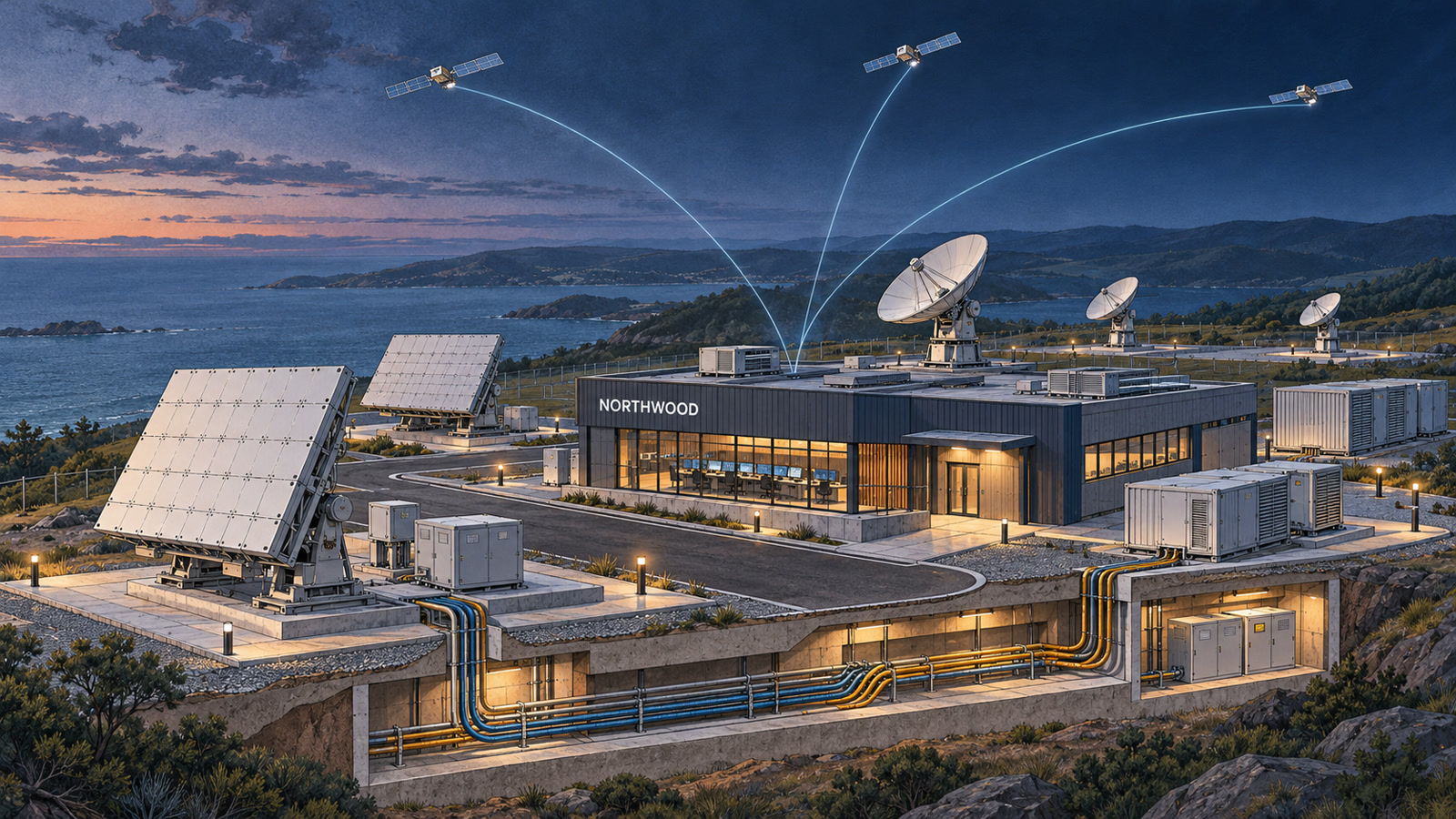
Northwood Space has raised US$375 million to turn satellite ground infrastructure from a collection of bespoke installations into something closer to a shared, globally distributed utility.
The Series C, first identified for this analysis through SpaceNews, was announced on 2 November. Andreessen Horowitz and DFJ Growth co-led the round, with participation from Washington Harbour Partners, Alpine Space Ventures, Stepstone, In-Q-Tel and others. SpaceNews and other independent reports put Northwood’s post-money valuation at US$2 billion.
The sum is consequential because it targets one of the space economy’s least glamorous constraints: every satellite still needs terrestrial antennas, spectrum, fibre, power and secure operations. Launch and spacecraft production have industrialised faster than much of the ground segment. Northwood’s wager is that standardised hardware and a software-defined network can close that gap.
Capital moves to the other end of the link
Northwood says the new equity will accelerate contracts, hiring and deployment of a global network serving commercial, US government and allied missions. It also secured a separate, multi-year credit facility from HSBC Innovation Banking. The debt facility’s size was not disclosed.
The company’s own announcement says it has deployed six multi-orbit sites across two continents, demonstrated geostationary-orbit command from a commercial phased array and opened a 185,000-square-foot (17,200-square-metre) headquarters and factory in Torrance, California. These are company-reported milestones, not an independently audited measure of network availability or revenue.
Independent trade publication Via Satellite reported that Northwood produced 29 antenna units over the past year and plans to move to hundreds annually. The company currently employs about 140 people and intends to add roughly 400 over three years.
That makes this less a conventional network-financing story than an industrial-scale test. The capital must convert a young company’s early deployments into repeatable factory output, licensed sites and service-level performance.
A cloud model for the ground segment
Northwood’s architecture combines two antenna families. Portal is a multi-beam phased array intended for telemetry, tracking and command across low Earth orbit through geostationary orbit. Prism is a modular 2.4-metre parabolic system aimed at higher-throughput S-, X- and Ka-band links.
The economic proposition is shared capacity. Instead of every operator financing, licensing and maintaining its own worldwide sites, customers would buy access to common infrastructure through a software layer. Higher utilisation could spread fixed costs across more missions, shorten the path from spacecraft completion to operations and make additional geographic redundancy affordable.
That could be particularly valuable for smaller constellations, Earth-observation companies and missions with variable contact needs. It also creates a different competitive arena. Established providers such as KSAT, SSC, Viasat, AWS Ground Station, Leaf Space and Atlas Space Operations already sell network access or ground services. Northwood is attempting to differentiate through antenna manufacturing, rapid site deployment and ownership of the stack from hardware to scheduling software.
If that integration works, ground access becomes more like cloud infrastructure: capacity can be added in standard units and allocated across customers. If it does not, Northwood will carry the capital intensity of hardware, real estate and global operations without achieving the utilisation needed to support a US$2 billion valuation.
Defence demand validates the bottleneck, not the solution
National-security demand gives the thesis strategic weight. Earlier in 2026, Northwood announced a US$49.8 million US Space Force contract to add capacity to the Satellite Control Network, which supports launch, routine command and emergency spacecraft operations. In-Q-Tel’s participation in the Series C adds another signal of government interest.
The need is well documented. A US Government Accountability Office review found that the Satellite Control Network’s 19 globally distributed antennas averaged 75% utilisation over the decade to fiscal 2021, above the 70% level cited by Space Force officials as the industry threshold for adding capacity. Annual launches supported by the network had tripled since 2012.
That evidence confirms a capacity problem; it does not prove that Northwood will solve it. Military command links require assurance, cyber security, frequency compatibility and continuity under disruption. Commercially derived equipment must also integrate with government mission systems and satisfy security and data-sovereignty rules across allied territories.
Success would nevertheless have broader consequences. A resilient commercial layer could reduce the time and cost of expanding government networks, create alternative paths during outages and give allied operators access to common infrastructure. It could also place pricing and delivery pressure on traditional bespoke antenna programmes.
The hard part is global execution
Antennas are only one component of a ground network. Each site needs favourable geography, landing rights, spectrum coordination, high-capacity backhaul, power, physical security and reliable local operations. Ka-band performance can be affected by rain, while multi-band government work adds certification and interference-management demands.
Nor is announced throughput the same as usable customer capacity. Northwood has said it aims to provide at least 10 gigabits per second at more than a dozen sites by the end of 2026, to deploy 100-plus-gigabit-per-second sites in high-demand regions by the end of 2027, and to exceed 20 terabits per second of aggregate capacity in 2028. Those are targets. Investors should look for measured performance, contracted demand and sustained availability rather than aggregate headline bandwidth.
The competitive response matters too. Incumbents possess established sites, licences, customer relationships and operational records. Cloud providers can bundle ground access with computing and storage. Satellite manufacturers and operators may also retain strategic links in-house, limiting the pool of traffic available to a shared network.
Milestones that will test the valuation
The next 18 months should show whether Northwood’s financing creates durable infrastructure or simply a well-capitalised build-out. The clearest indicators will be factory output measured in working units; the number and geographic diversity of operational sites; independently demonstrated throughput and uptime; delivery against the Space Force contract; and recurring commercial revenue from customers using multiple locations.
Two company targets deserve particular attention: 100-plus-gigabit sites by the end of 2027 and a credible path towards the 2028 aggregate-capacity goal. Progress on spectrum approvals and allied deployments will be as important as antenna production.
Northwood’s round does not remove the ground bottleneck. It changes who may finance and operate the remedy. If shared, mass-produced ground systems can meet demanding commercial and defence service levels, the terrestrial side of the space economy could finally begin scaling at the pace of the constellations above it.