
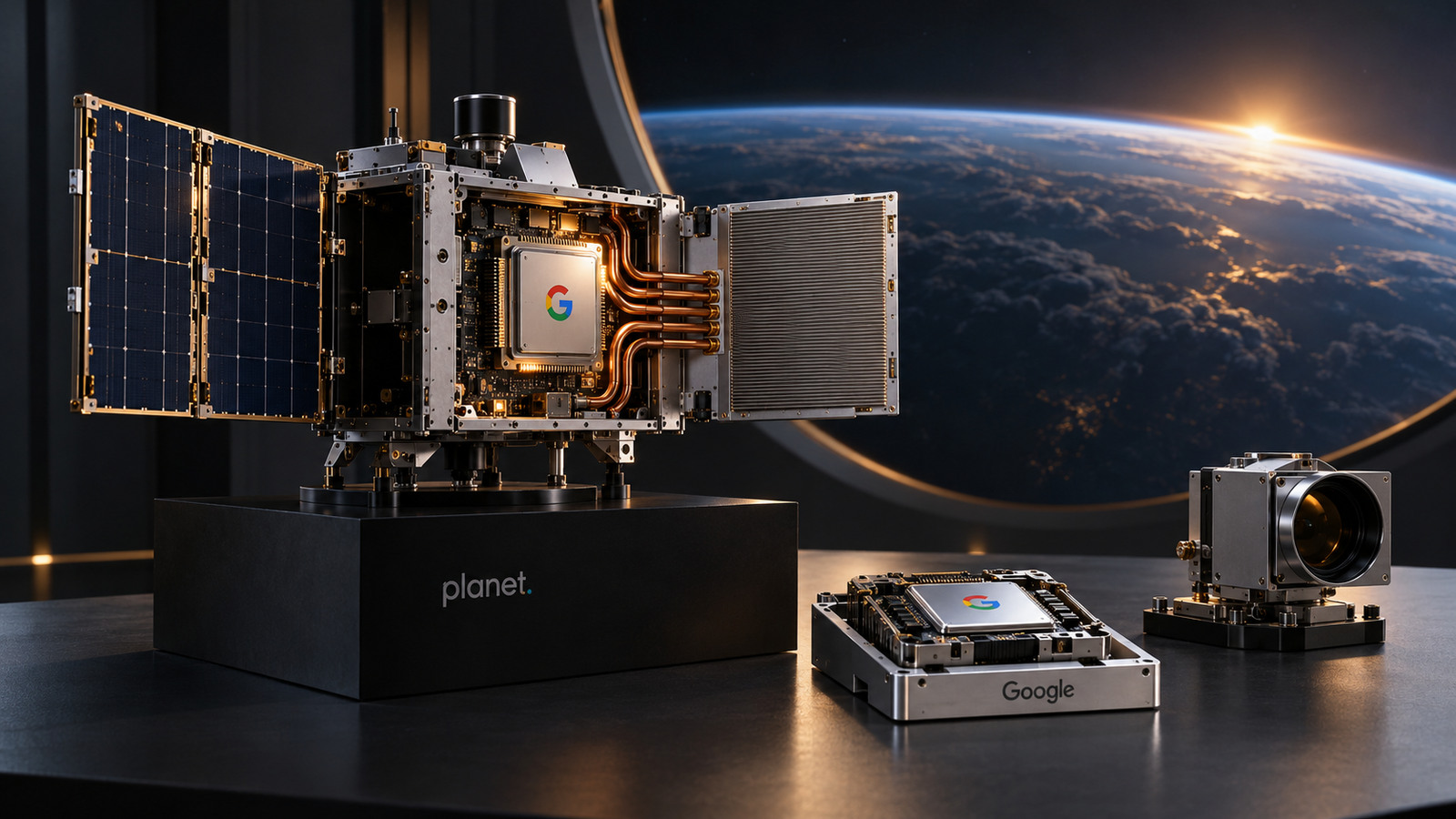
Google has run an artificial-intelligence model on a data-centre-class Tensor Processing Unit (TPU) in low Earth orbit, turning Project Suncatcher’s first spacecraft from a hardware experiment into a functioning—if extremely limited—compute node.
SpaceNews identified the milestone as a step towards Google’s orbital data-centre ambitions. The more precise conclusion is narrower but still significant: a commercially derived AI accelerator survived launch, powered up, accepted a prompt, ran an inference workload and returned the result through a satellite communications chain.
That closes one technical question. It does not yet show that useful volumes of computing can be cooled, networked, maintained or financed in orbit.
A “hello world” test with strategic weight
Google says its prototype launched on SpaceX’s Transporter-18 rideshare mission on 1 October 2026, aboard a spacecraft developed with Planet. After commissioning, operators uplinked a prompt to the onboard Gemma 4 open model during a ground-station pass. The response was generated on a TPU and downlinked as the spacecraft passed Svalbard, Norway.
In its 30 October announcement, Google called this the first AI response from a data-centre-class TPU in orbit. That “first” is a company claim, although the completed prompt-and-response sequence itself is confirmed by Google’s mission update. Independent reporting by TechCrunch says the satellite carries four TPUs, generates up to one kilowatt and can operate only one TPU at a time for about 20 minutes.
Those limitations matter. The test proves execution, not sustained service. Its commercial importance lies in reducing the risk of using high-performance, non-traditional space electronics rather than in demonstrating an orbital cloud product.
The next bottleneck is the system, not the chip
Google’s architecture depends on much more than radiation-tolerant silicon. Its peer-reviewed system paper describes tightly grouped, solar-powered satellites connected by free-space optical links. An illustrative cluster contains 81 spacecraft within a radius of one kilometre. Future vehicles could carry dozens of TPUs; a terrestrial AI rack typically consumes roughly 50–100 kilowatts.
The scale gap is therefore enormous. A useful orbital cluster needs continuous power, large radiators, precise formation control and optical links with data-centre-like bandwidth and latency. It must also move inputs and outputs between space and Earth without turning ground connectivity into the limiting resource.
Google will now measure thermal behaviour and radiation effects under real orbital conditions. Ground tests indicated that Trillium TPUs could tolerate a total ionising dose greater than expected over a five-year mission, but radiation-induced errors, component ageing and workload integrity still need flight data. In vacuum, heat must be transported to radiators and rejected by radiation; there is no air to carry it away.
Planet gains a new platform market
For Planet, Suncatcher expands the addressable market for agile spacecraft platforms beyond Earth observation. Planet said in 2025 that the programme uses the same platform lineage as its Owl mission and that it would build and operate two prototype satellites for Google. The partnership offers a way to monetise constellation engineering, flight operations and high-power payload integration even if orbital data centres remain years away.
That is the nearer-term commercial opportunity. Spacecraft manufacturers, radiator and power-system suppliers, optical-terminal providers and formation-flying software companies can sell enabling hardware before the end market reaches scale. Compute companies also gain a test environment for edge processing of Earth-observation, communications and defence data without sending every raw dataset to the ground.
Competition is broadening. Starcloud and other start-ups are pursuing orbital compute, while SpaceX’s launch and communications infrastructure could support its own approach. Google brings different assets: custom accelerators, model software, capital and a strategic stake in SpaceX. Its entry raises the credibility of the category, but also makes launch access and optical networking more central competitive advantages.
Economics remain conditional on launch costs
Project Suncatcher’s economic case is not established by this flight. Google’s paper assumes launch prices could fall to no more than US$200 per kilogram by the mid-2030s, at which point amortised launch cost per kilowatt might approach terrestrial data-centre energy costs. That is a scenario, not a forecast or contracted price.
Independent work is less forgiving. A 2026 spacecraft-constraints and economics study estimated that launch plus spacecraft construction would need to fit within roughly US$250–1,000 per kilogram under its assumptions, before communications, operations, utilisation and lifetime costs. Separate analysis by Forethought found competitive cases around US$100 per kilogram, or lower in more optimistic scenarios.
Orbital infrastructure also trades terrestrial constraints for new ones. It can access long periods of sunlight and avoid local land and water pressures, but cannot be repaired like a ground facility. Replacement cadence, debris mitigation, insurance, launch emissions and re-entry impacts all affect the full cost. Export controls and national-security concerns may further divide a nominally global compute network into sovereign systems.
The 2027 test is the real architecture gate
The most important next milestone is Google’s planned pair of interconnected satellites in 2027. Planet has described that mission as a test of two spacecraft flying in tandem with high-bandwidth crosslinks. Success should mean more than establishing an optical link: the satellites need to demonstrate stable geometry, useful throughput and a distributed workload across the connection.
Before then, watch for published thermal duty cycles, error rates under radiation, simultaneous processor operation and evidence that the current payload can run for longer than brief passes. After 2027, the decisive questions will be power and radiator mass per unit of compute, cluster reliability, replacement strategy and the launch price actually available to customers.
Google has moved orbital AI from a presentation to a working chip. The harder transition—from one chip answering a prompt to an economical, networked computing service—has only begun.