
Ukraine’s interest in a nationally controlled satellite communications network is an early-stage proposal, not a constellation order. Yet the reason it exists is already changing the market: for defence customers, control over a network is becoming a product in its own right.
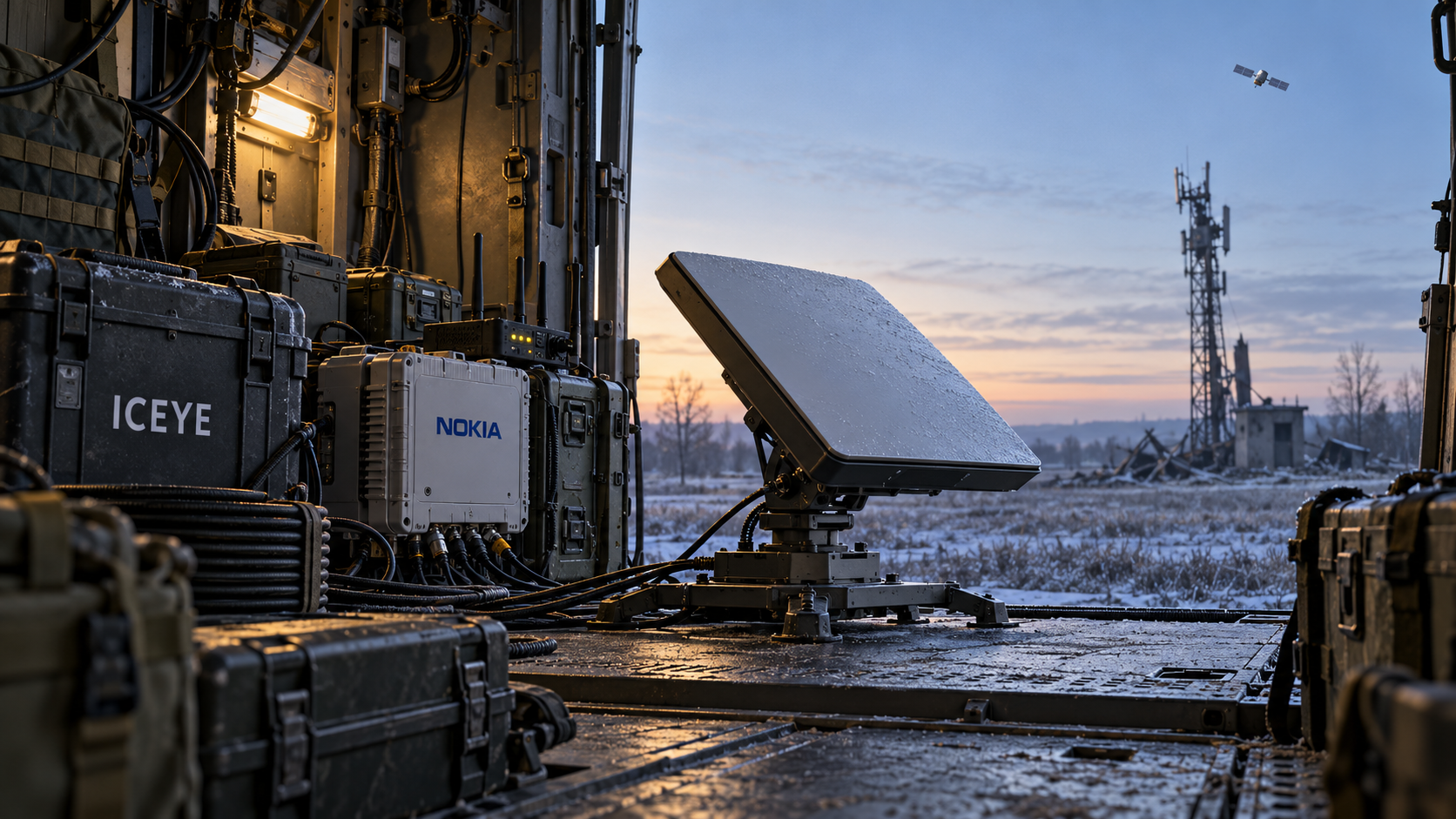
SpaceNews reported that Ukraine is exploring the capability with Finland’s ICEYE and Nokia after restrictions on SpaceX services disrupted military operations. The primary evidence is narrower but significant. On 22 October, ICEYE, Nokia and Ukraine’s Ministry of Defence signed a letter of intent to explore cooperation, particularly sovereign satellite communications.
No contract value, satellite count, funding source, frequency band or launch plan has been disclosed. The agreement should therefore be read as a political and technical commitment to define a programme, not proof that one has been procured.
The trigger is service assurance
The commercial proposition cannot be separated from the operational trigger. Reuters reported that US Senator Richard Blumenthal opened an inquiry after Ukrainian forces lost access to critical Starshield services on 13 October following the application of an equipment speed limit. President Volodymyr Zelensky said the restrictions had weakened air defences.
Associated Press reporting confirmed disruptions to drones and military missions, while documenting conflicting accounts of who authorised the restriction and why. That distinction matters. The interruption is established; responsibility for it remains disputed.
The episode converts an abstract supply-chain concern into a procurement requirement. A government that merely subscribes to a commercial network obtains bandwidth and rapid deployment. It does not necessarily control service policies, configuration changes, traffic priorities or the political decisions that sit above them.
Sovereignty changes what governments buy
ICEYE and Nokia’s broader proposition, announced on 1 October, is unusually explicit. Their planned service combines satellites, ground infrastructure and ruggedised terminals, while offering government customers ownership and control of the space and ground segments. The companies expect the first communications satellites in 2028.
Those are company plans, not demonstrated performance. Claims of high throughput, low latency and resilience will need to be tested. Even so, the architecture points to a different market from mass-market broadband: smaller, mission-focused networks built around assured access to priority regions rather than continuous global coverage.
For buyers, that model raises capital costs and transfers technical risk back to the state. It also offers authority over encryption keys, network management, gateway locations, terminal certification and service rules. In a contested environment, those controls may be worth more than the lowest price per gigabyte.
A targeted network will not replace Starlink quickly
A sovereign system should not be confused with a near-term substitute for SpaceX’s fleet. Starlink’s advantage is scale: thousands of satellites, mature user terminals, extensive ground infrastructure and frequent replenishment launches. A bespoke network beginning deployment in 2028 cannot reproduce that reach immediately.
The more credible objective is layered resilience. The partners themselves describe their system as complementary to existing military and commercial networks. Ukraine could route its most sensitive or policy-critical traffic through a controlled layer while retaining commercial capacity for less sensitive and higher-volume uses.
That approach still faces difficult engineering. Satellite capacity must be matched by spectrum rights, gateways and telemetry infrastructure. Terminals must survive field conditions, integrate with military radios and maintain links under jamming, spoofing and cyberattack. Traffic needs to move between sovereign, allied and commercial networks without creating new security gaps.
Coverage design will be equally important. A constellation optimised for Ukraine and nearby theatres can use fewer spacecraft than a global network, but it creates concentration risk and limited utility outside its intended geography. Capacity, orbital altitude, inclination and replenishment strategy will determine whether “sovereign” also means resilient.
ICEYE and Nokia are moving up the value chain
For ICEYE, the proposal extends a sovereign-service model already established in synthetic-aperture radar. The company has sold governments dedicated access and ownership rather than only individual images. Adding communications could make ICEYE an integrator of national space infrastructure, not simply an Earth-observation supplier.
For Nokia, the opportunity brings terrestrial defence networking into orbit. Its value lies less in building a satellite bus than in connecting space links to secure mobile cores, edge computing and field terminals. If the partnership works, the commercially defensible asset will be the integrated system and its policy controls, not any single spacecraft.
Competitively, this places a focused European offering alongside SpaceX’s Starlink and Starshield, Eutelsat OneWeb, Amazon Leo and Europe’s IRIS² ambitions. Its differentiator is not likely to be headline capacity. It is the promise that a customer can own the infrastructure and define the rules under which it operates.
Strategic autonomy carries a premium
Ukraine’s urgency gives the proposal strategic weight beyond its initial size. European governments have spent years discussing sovereign access to communications, navigation and Earth observation. A wartime customer is now attaching that principle to a concrete operational failure.
If the concept becomes a contract, it could strengthen demand for nationally controlled “minimum viable constellations”: enough capacity to guarantee priority missions without attempting to displace global commercial fleets. That would create openings for European satellite makers, launch providers, terminal specialists, cybersecurity firms and network software suppliers.
The constraint is economics. Sovereignty duplicates infrastructure that a shared service spreads across millions of users. Governments must fund development, launches, replacements and round-the-clock operations, while accepting that a small fleet can be more vulnerable to technical failure or attack. Political control does not remove physical dependence on components, spectrum coordination or launch access.
Milestones before the first launch
The first test is whether the letter of intent becomes a funded procurement with a defined customer and delivery schedule. The second is publication of an architecture: spacecraft numbers, orbit, spectrum, gateway locations, terminal design and responsibility for operations. Prototype terminal trials in Ukraine would provide more evidence than another partnership announcement.
Investors should also watch for a satellite manufacturing award, launch bookings and regulatory filings ahead of the stated 2028 debut. Operationally, the decisive metrics will be availability under interference, terminal mobility, throughput in priority areas and successful handover between sovereign and commercial networks.
Nearer term, the US inquiry may clarify the policy risk that motivated the project. Reuters said the Pentagon was asked to respond by 5 November and SpaceX to brief the Senate by 12 November. Those answers will not build Ukraine a constellation, but they may show whether the October restriction was an isolated control decision or a structural feature of relying on externally governed networks.
The development therefore matters less for what has been ordered—so far, nothing has—than for what is being priced. Bandwidth is no longer the whole service. In defence communications, authority over the network is becoming part of the payload.