
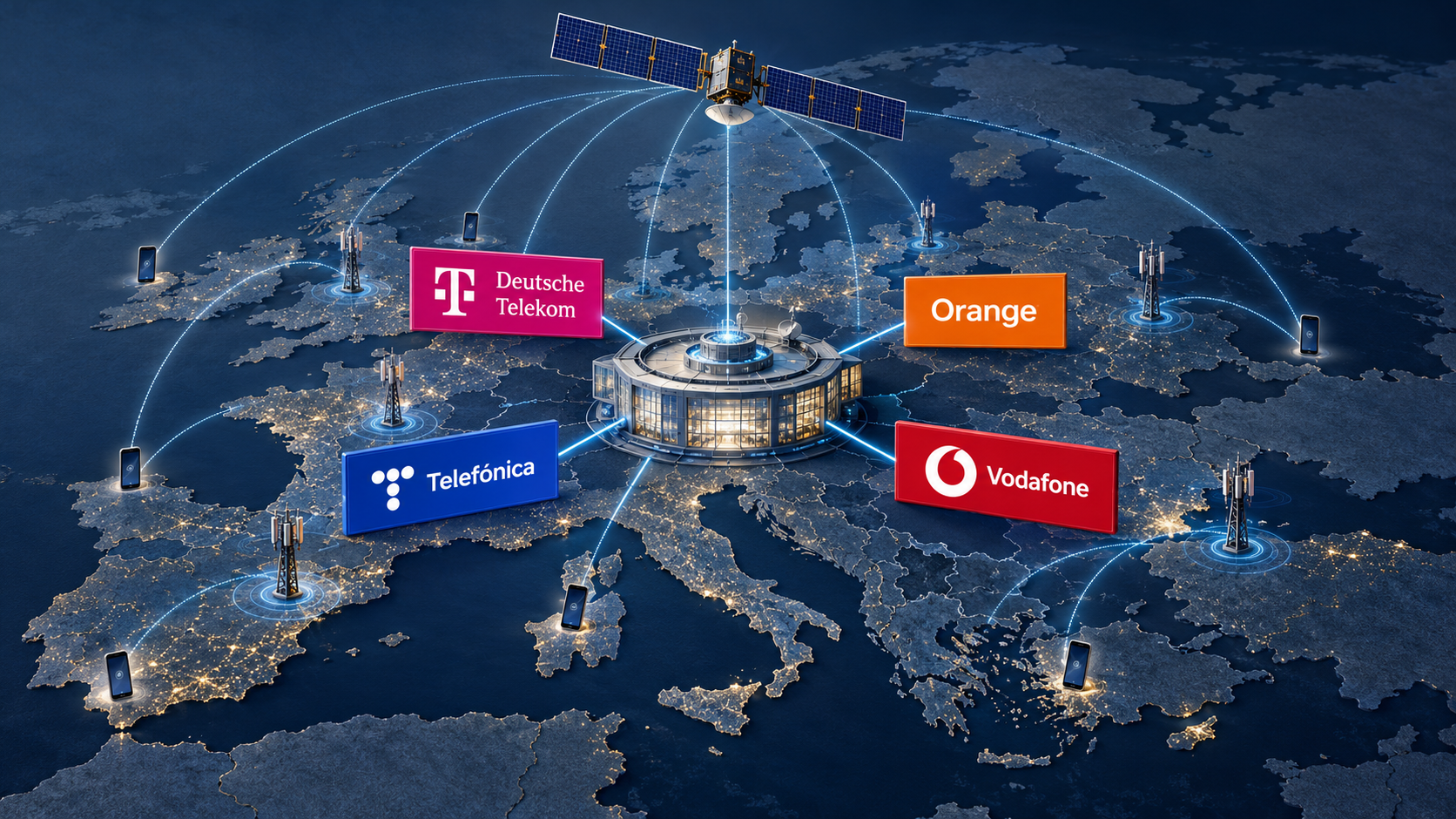
Four of Europe’s largest mobile operators are preparing a joint bid for satellite spectrum. The alliance could give terrestrial carriers greater control over direct-to-device services, but it is not yet a network, licence award or satellite contract.
Deutsche Telekom, Orange, Telefónica and Vodafone have taken the first formal step towards a shared European satellite-to-phone platform. Their 19 October letter of intent commits them to explore a joint bid for Europe’s future mobile-satellite spectrum allocation.
The distinction between exploration and execution matters. No joint venture has been announced, no spectrum has been awarded and no satellite partner has been selected. The four carriers say they would build ground infrastructure and retain coordination and monitoring functions in Europe, while an external provider supplies the constellation.
SpaceNews identified the agreement as a search for a sovereign direct-to-device, or D2D, service. Its economic importance lies less in creating another satellite fleet than in reorganising who controls spectrum, distribution and the customer relationship when ordinary phones connect to orbit.
Spectrum becomes the strategic asset
The immediate prize is the harmonised 2 GHz mobile-satellite band: 1980–2010 MHz for uplinks and 2170–2200 MHz for downlinks. Existing European authorisations expire in May 2027. The European Commission has proposed replacing the 2008 framework with a single EU-level selection and authorisation process.
The proposed regime is not yet settled law. Its political direction is nevertheless clear: part of the band would support governmental, security and defence needs, while commercial capacity would be divided between European-controlled and internationally accessible awards. Current licence holders may also receive restricted transitional extensions, so a May 2027 expiry does not necessarily mean immediate operational handover.
That creates a scarce gateway into Europe’s mobile market. Spectrum alone does not deliver coverage, but an EU-wide licence paired with four large carriers could aggregate millions of customers, roaming relationships, billing systems and terrestrial network assets. Satellite operators would compete not only on spacecraft performance, but also for access to this distribution platform.
A carrier-led counterweight to vertical integration
The alliance points towards a different structure from SpaceX’s vertically integrated model. SpaceX increasingly combines launch, satellites, spectrum and retail service inside one organisation. As Space Insight previously analysed, its Starlink Mobile authorisation and EchoStar spectrum transactions reduce dependence on terrestrial-carrier spectrum leases.
Europe’s carriers are attempting the inverse: pool market access and ground operations while procuring orbital capacity from a specialist. This could improve their bargaining position and reduce the risk that a satellite operator disintermediates them. It could also give smaller European mobile operators wholesale access rather than forcing each to negotiate a separate satellite partnership.
The carriers describe that access as open and non-discriminatory. That is an ambition stated by the companies, not yet a published wholesale contract. Regulators will need to test whether a consortium of four major incumbents genuinely expands competition or instead becomes a powerful gatekeeper for the continent’s D2D market.
The satellite choice is commercially awkward
The unresolved satellite partner is the alliance’s most important commercial decision. Vodafone already co-owns Satellite Connect Europe with AST SpaceMobile, while Orange signed a memorandum with the venture in March and planned Romanian voice, SMS and data demonstrations during the second half of 2026. Those links make AST a credible candidate, but the four operators have not selected it.
Nor does the letter cancel existing partnerships. Orange, Vodafone and other operators have built multi-vendor relationships across AST SpaceMobile, Starlink, Eutelsat and other systems. Preserving those options may protect near-term coverage, but it complicates efforts to present the new platform as fully sovereign.
Eutelsat offers European ownership and strategic alignment, yet its current OneWeb fleet was not designed as a mass-market broadband-to-standard-phone network. AST has purpose-built large-array spacecraft and European carrier relationships, but still faces constellation deployment, financing and capacity risks. Starlink has the greatest operational scale and launch integration, but sits uneasily with the consortium’s sovereignty objective and has opposed elements of the Commission proposal.
The space economy gains a new procurement centre
If it proceeds, the alliance would concentrate demand that is currently fragmented among national carriers. That could support larger capacity commitments, shared gateways and common technical integration, improving the economics for a chosen satellite provider. It may also accelerate standards work across authentication, emergency calling, roaming, lawful access and network handover.
The downside is concentration risk. A single preferred platform could narrow opportunities for rival constellations, and a prolonged award process could delay European deployment while US-led systems scale. D2D capacity also remains physically constrained: ordinary phones have small antennas and limited transmit power, so service quality will depend on satellite aperture, orbital geometry, available spectrum, beam loading and terrestrial integration. Early services are more likely to complement mobile networks in coverage gaps than replace dense terrestrial cells.
Strategically, the project turns satellite connectivity into critical telecoms infrastructure rather than a standalone space service. European control of gateways, monitoring and spectrum could improve resilience and governmental oversight. It cannot, by itself, create sovereign spacecraft manufacturing, launch capacity or a fully deployed constellation.
Milestones that will determine whether it becomes real
- EU lawmakers’ final design and timetable for the 2 GHz MSS authorisation regime.
- Whether the four carriers convert the letter of intent into a binding consortium or joint venture.
- Selection of a satellite partner, including ownership, capacity and deployment commitments.
- Results from European D2D demonstrations, particularly voice and broadband performance on standard phones.
- Competition conditions governing wholesale access for carriers outside the founding group.
The agreement is therefore best understood as market formation, not network deployment. Europe’s largest carriers have recognised that satellite-to-phone connectivity could shift power away from terrestrial operators. By pooling their spectrum bid, they are trying to keep control of the gateway. Whether they can match that commercial leverage with timely orbital capacity is now the test.