
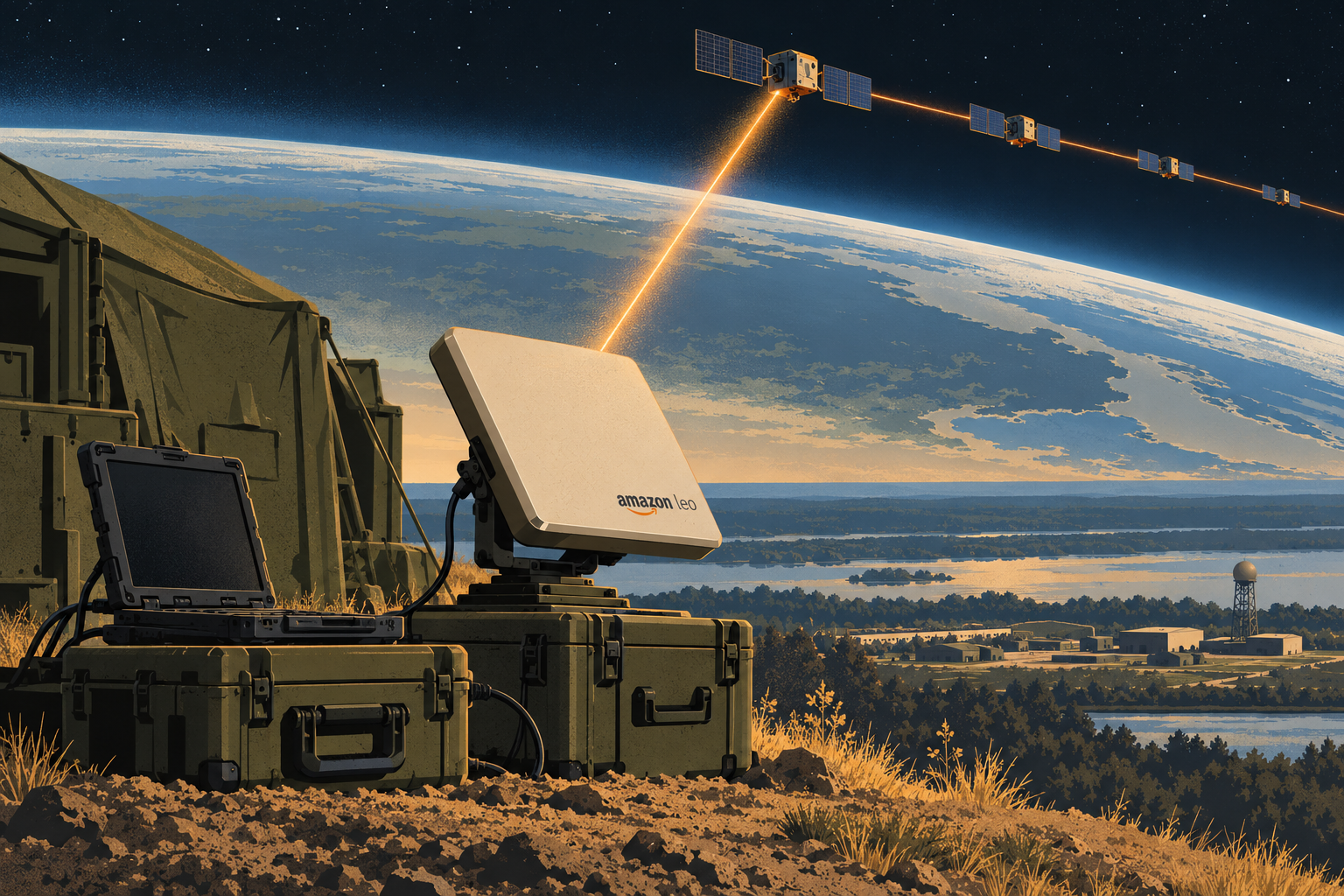
Amazon’s first disclosed demonstration of its Leo satellite network for the U.S. Army is modest in form but potentially important in consequence. A laptop, a fixed user terminal and a peak download rate above 400 megabits per second do not constitute a fielded military service. They do, however, show that the Pentagon may soon have a second hyperscale low-Earth-orbit broadband supplier to test against SpaceX’s Starlink.
That matters less because of one speed result than because military buyers increasingly treat proliferated LEO connectivity as operational infrastructure. Competition at this layer could affect pricing, resilience, cloud integration and the bargaining power of governments that have become reliant on a single commercial constellation.
What the test established — and what it did not
SpaceNews identified the demonstration as a step in Amazon’s effort to enter the military communications market. Amazon’s own 13 October announcement says the U.S. Army Combat Capabilities Development Command’s C5ISR Center hosted the event at Aberdeen Proving Ground in Maryland. More than 30 Army representatives attended, according to the company.
Amazon says its Leo Pro phased-array antenna connected through newly deployed satellites and exceeded 400 Mbps at peak. That is consistent with the terminal’s advertised performance, and Aviation Week independently reported the company’s account. No Army release, test report, contract value, latency figure, uplink rate or availability measurement has been published. The performance result should therefore be treated as an Amazon claim from a controlled demonstration, not an independently validated military benchmark.
The scope was also deliberately narrow. The trial used a stationary terminal and laptop. Amazon says follow-on work will cover higher-speed links, mobile use and integration with Army tactical networks. Those are not incremental details: they are the tests that determine whether a consumer-derived broadband system can support operations exposed to movement, interference, contested spectrum and demanding security controls.
A second supplier changes the market structure
Starlink’s early deployment and SpaceX’s vertically integrated launch system gave it a commanding lead in LEO broadband. Reuters reported in July that Amazon had 394 satellites in orbit, compared with roughly 10,000 for Starlink at that time. Amazon now says it has manufactured more than 1,000 spacecraft and has nearly 400 in orbit.
The Army demonstration therefore does not erase a capacity gap. It does indicate that the gap is no longer the only fact that matters. Once a rival network can support real traffic through production hardware, buyers can begin comparing architectures, terminals, coverage, cybersecurity, service-level terms and integration costs.
For Amazon, government demand can be valuable before global consumer coverage is complete. Defence users will pay for assured connectivity, specialised terminals and integration rather than only mass-market bandwidth. Amazon can also combine Leo with Amazon Web Services, edge computing and existing public-sector relationships. That creates a route to contracts in which the satellite link is one part of a larger data service.
For the Pentagon, a second hyperscale network offers more than price pressure. Multi-vendor communications can reduce exposure to outages, capacity constraints and supplier-specific political or operational decisions. The U.S. Space Force is pursuing the same logic in its Space Data Network experiments, where Amazon is one of five companies selected to test multi-vendor orbital networking. The goal is not automatic interchangeability; it is to make diversity technically usable.
Deployment remains the binding constraint
Amazon’s industrial progress is substantial. The company says its Kirkland, Washington, line has passed 1,000 satellites produced and can manufacture as many as five a day. Production, however, is not orbital capacity.
The Federal Communications Commission waived Amazon’s original interim requirement to have 1,616 first-generation satellites deployed by 30 July 2026. Its 5 June order kept the final deadline: the full authorised 3,232-satellite Gen1 system must be deployed by 30 July 2029 or the licence will be limited to the number operating then. The relief came with spectrum-priority consequences, underscoring that regulatory flexibility is not cost-free.
Launch availability is the central commercial risk. Amazon has booked roughly 100 missions across United Launch Alliance, Arianespace, Blue Origin and SpaceX. Yet Reuters reported in July that delays affecting Vulcan and New Glenn were constraining the build-out. Amazon said last week that its first Vulcan and further Ariane 6 missions were approaching. Until those vehicles fly repeatedly, a growing factory inventory does not translate into geographic coverage or sellable network capacity.
The constellation’s commercial timetable is also unresolved. Amazon says it intends to begin initial service in 2026, but has not published pricing, launch markets or a detailed service map. A military demonstration can support business development, but it cannot substitute for an operational service with sustained availability.
Technical integration will decide the defence opportunity
Raw throughput is only the first gate for tactical users. The Army will need to test connection continuity while moving, terminal acquisition time, performance under load, uplink capacity, interoperability with existing command-and-control networks and behaviour under jamming or cyberattack. The absence of public results on these questions is a constraint, not evidence of failure.
Terminal economics also matter. Flat-panel antennas are often the limiting cost and power component in LEO services. If Leo Pro can be manufactured at scale and managed through familiar Amazon infrastructure, Amazon may compete on total system cost rather than satellite count. Conversely, bespoke military hardening could erode the cost advantages of commercial volume.
There is a wider strategic implication. Governments in Europe, Asia-Pacific and the Middle East want resilient satellite communications but remain wary of dependency on a single U.S. commercial operator. Amazon Leo would add supplier choice, although it would not provide sovereign control. Its arrival could also pressure Eutelsat OneWeb, SES and emerging government-backed systems to define where they offer differentiated coverage, security or national authority.
Milestones that will separate signal from marketing
The next evidence should be operational rather than promotional. The most important markers are a public start of commercial Leo service; successful Vulcan and Ariane 6 deployment campaigns; disclosed coverage and service-level data; and Army tests involving mobility and tactical-network integration.
Investors should also watch satellite activation rates, not just launch totals, and whether Amazon converts trials into task orders or multi-year service agreements. For defence planners, the decisive question is whether two large commercial networks can be orchestrated as resilient infrastructure rather than purchased as separate stovepipes.
The Aberdeen trial does not answer that question. It makes it reasonable to start asking it.