
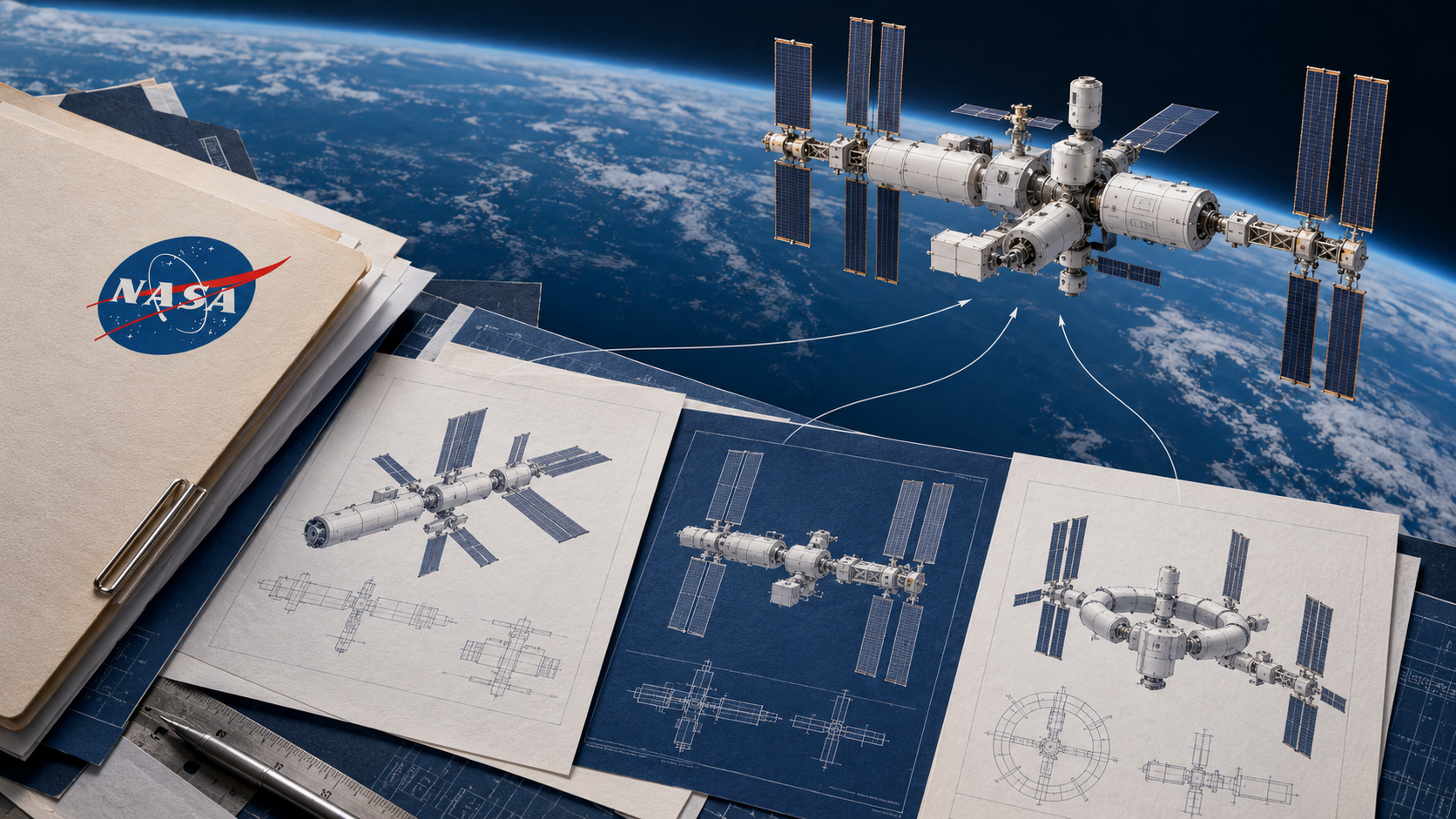
NASA has opened the formal competition for commercial space stations intended to preserve a continuous US human presence in low Earth orbit after the International Space Station retires. The decisive change is not that a replacement has been selected—it has not—but that station concepts must now survive a procurement built around fixed-price milestones, certification, transportation and credible private demand.
SpaceNews reported the release of the final request for proposals on 12 October. The underlying event occurred on 9 October, when NASA issued the final solicitation for its Commercial Low Earth Orbit Destination Contract. Proposals are due on 8 December 2026 and awards are expected in spring 2027.
For the space economy, this moves the post-ISS market from agency-backed design studies towards a competitive purchasing structure. It also exposes the sector’s central weakness: prospective station operators need NASA as an anchor customer, but NASA wants commercially owned destinations whose economics do not depend on NASA alone.
The ceiling is large, but the commitment is narrow
The controlling federal solicitation, numbered 80JSC027R0004, establishes a multiple-award, indefinite-delivery/indefinite-quantity vehicle. NASA plans firm-fixed-price task orders, an eight-year base ordering period and options that could extend ordering to 15 years.
The contract’s US$34.063 billion ceiling is therefore not an appropriation, an award value or a revenue forecast. It is the maximum NASA could order across the vehicle. The initial guarantee is much smaller: at least US$100 million for each Phase 1 winner. NASA says it expects to choose two or more contractors for early development, then run another competition for final design, testing, evaluation and certification before buying services from one or more providers.
That staged structure preserves competition and limits NASA’s exposure before hardware and financing mature. For bidders, it creates a harsher investment problem. A company can win an initial contract and still fail to reach the later certification or service phase. Equity investors and strategic partners must fund development against a government demand signal that is meaningful, but neither exclusive nor fully committed.
The competition now measures execution, not presentation
Axiom Space, Voyager’s Starlab venture and Vast are expected to bid, according to independent reporting by Ars Technica. Blue Origin received earlier NASA support for Orbital Reef, although its participation in this round has not been confirmed publicly. Company statements expressing an intention to compete should not be confused with NASA selection, funding beyond the minimum guarantee or certification.
The RFP changes what will count as competitive advantage. Architectural ambition still matters, but bidders also need credible schedules, safety cases, manufacturing plans, supply chains, transport arrangements and balance sheets. Smaller stations may benefit if they can demonstrate usable capacity earlier and with less capital. Larger platforms could offer more research volume and commercial flexibility, but face higher financing and utilisation risk.
NASA’s use of fixed-price task orders is strategically important. It shifts more cost and schedule risk to contractors than a traditional cost-plus development programme. That can reward disciplined engineering and private investment, as commercial cargo and crew programmes did, but a space station is a longer-lived infrastructure asset with uncertain demand. Suppliers of modules, life-support systems, docking hardware, robotics, power systems and microgravity payload services will increasingly be judged by whether they fit a certifiable operating business—not merely a technically persuasive concept.
Transportation relief exposes a deeper bottleneck
The final terms offer bidders important relief on crew and cargo access. NASA can furnish transportation for the first four guaranteed service missions when a station provider does not supply its own end-to-end transport. The solicitation assigns planning prices of US$325 million for a four-seat crew flight and US$300 million for a cargo flight in 2030, with later-year escalation.
This reduces the immediate burden of securing launch and visiting-vehicle commitments, but it does not solve the market permanently. SpaceX has indicated that Crew Dragon will not operate indefinitely, while Boeing’s Starliner has not yet become a routine operational alternative. NASA’s offer applies to the first guaranteed missions; operators still need credible access for additional government, sovereign, research and private customers.
Transport therefore becomes both a technical dependency and a competitive lever. A station with lower recurring crew and cargo requirements may be easier to sustain. A provider aligned with more than one visiting vehicle could offer resilience and negotiating power. Conversely, a destination that depends on a single expensive transport chain may struggle to develop profitable non-NASA demand even if its station hardware performs well.
NASA wants to be an anchor, not the whole market
NASA’s stated objective is to become one customer among many in a broader low-Earth-orbit economy. That is a policy goal, not a confirmed market outcome. National astronaut missions, pharmaceutical research, materials processing, tourism and media projects are potential revenue sources, but none has yet demonstrated demand at the scale needed to support several continuously crewed stations.
The procurement may still reshape the market before any station is operational. Winning teams gain technical collaboration, contractual credibility and a stronger position with investors and suppliers. Losing teams may consolidate, narrow their designs or exit. The result could be fewer platforms than today’s concept pipeline suggests, but deeper industrial partnerships around the survivors.
Strategically, the United States is trying to prevent a gap between the ISS and its successors while keeping low-Earth-orbit infrastructure commercially led. A delay would weaken research continuity, astronaut training and US influence over operating standards. Success would establish a model in which government guarantees a baseline of demand while private operators own the assets and pursue international customers.
Milestones that will separate plans from programmes
The first near-term tests are procedural: NASA’s pre-proposal conference on 15 October, meetings with prospective prime contractors on 16 October and the deadline for written questions on 21 October. Amendments after those sessions could materially affect pricing, liability, transportation or certification assumptions.
The 8 December proposal deadline will reveal which teams are prepared to commit. The anticipated 15 April 2027 award date is the next major market signal, but investors should distinguish Phase 1 selection from a full station build. Later task-order competitions, financing closes, module manufacturing, launch bookings, integrated safety reviews and crew-transport commitments will provide stronger evidence of progress.
The most important technical milestone will be certification backed by representative hardware and operations, not a rendered station or announced launch date. The most important commercial milestone will be contracted demand beyond NASA.
NASA’s final RFP gives the post-ISS market a route from concepts to services. It does not remove the capital, schedule or transport risks. Instead, it makes those risks measurable—and sets up a competition in which business durability may matter as much as orbital architecture.