
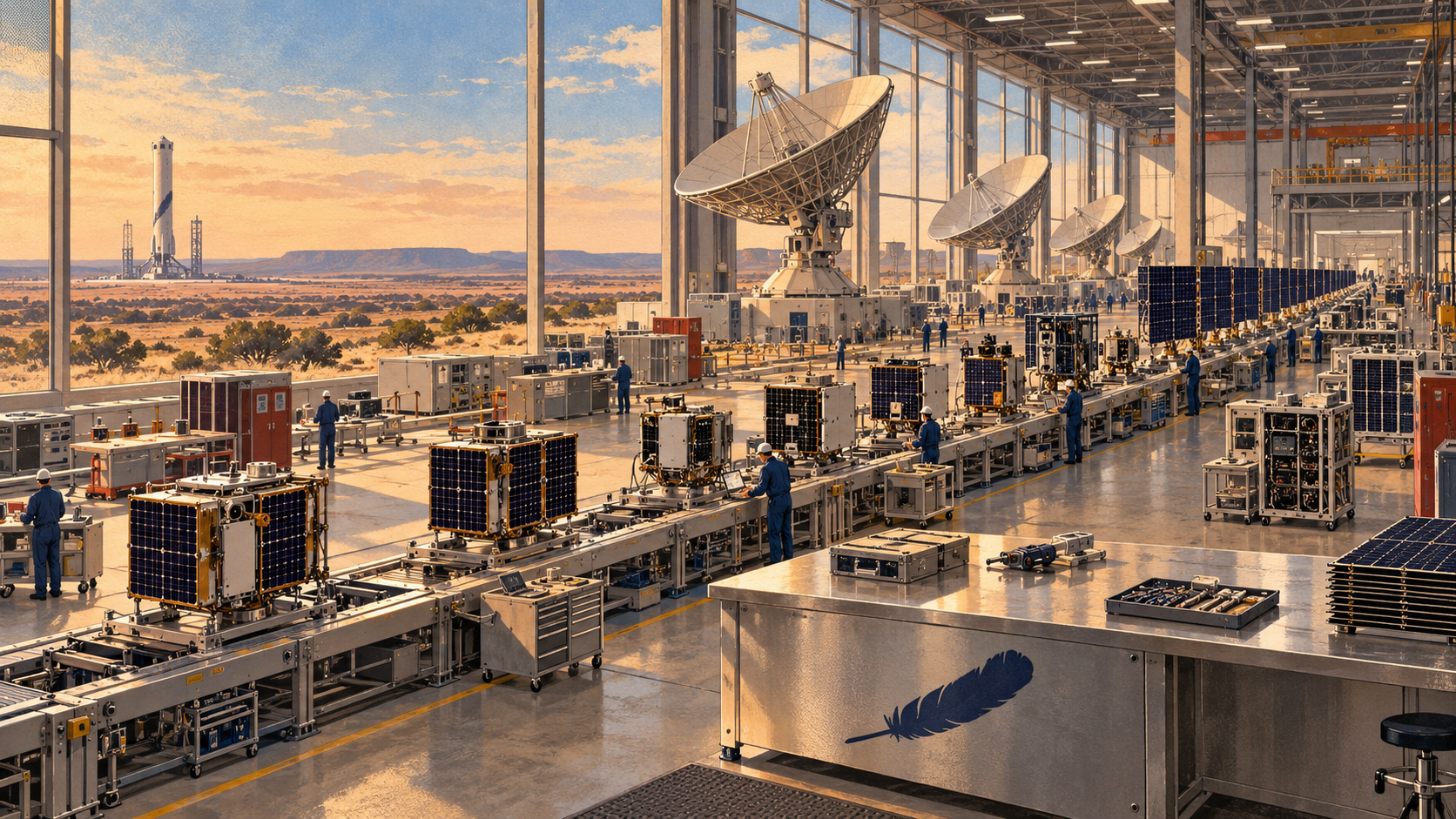
Blue Origin is making a physical commitment to a satellite business that, until now, has largely existed as filings, specifications and corporate ambition.
The company will build Constellation Park, a 1.3-million-square-foot — about 121,000-square-metre — manufacturing campus in Hutto, Texas. The state says Blue Origin Manufacturing will invest US$554.78 million and create more than 2,000 jobs over ten years. The project is intended to support TeraWave, Blue Origin’s planned multi-orbit communications constellation, its Quartz ground network and satellite subsystems.
As SpaceNews reported on 9 October, the factory announcement coincides with founder Jeff Bezos openly considering an eventual initial public offering. Together with Blue Origin’s first large outside funding round, that makes Constellation Park more than a regional expansion. It is evidence that the company is trying to become a vertically integrated space-infrastructure operator—and preparing for the financial scrutiny that comes with scale.
From bespoke spacecraft to production economics
Blue Origin’s official announcement says Constellation Park will manufacture hardware for TeraWave and Quartz, along with solar arrays, avionics, telecommunications equipment and other satellite components.
That is a broader industrial role than Blue Origin’s public identity as a launch and lunar company. Reusable New Glenn rockets, BE-4 engines and Blue Moon landers remain central, but a high-volume satellite factory would add recurring production and network operations to the portfolio.
The commercial logic resembles the integration that helped SpaceX reshape launch economics: manufacture satellites, launch them on an in-house rocket and sell services delivered by the resulting network. Internal demand can support launcher cadence, while control of the launch schedule reduces dependence on external providers.
The comparison has limits. SpaceX has already demonstrated sustained high-cadence launch and mass satellite production. Blue Origin has not. Constellation Park establishes intended capacity; it does not prove that the factory can reach rate production, that New Glenn can deploy the network economically or that customers will buy the promised service.
TeraWave targets a narrower, higher-value market
Blue Origin says TeraWave will comprise 5,408 optically linked satellites: 5,280 in low Earth orbit and 128 in medium Earth orbit. The company claims distributed customers could receive connections of up to 144 gigabits per second through radio-frequency links, while optical links between major hubs could reach 6 terabits per second.
Those are company design claims, not demonstrated service levels. The Federal Communications Commission’s accepted-for-filing notice confirms that Blue Origin is seeking authority for a non-geostationary fixed-satellite system spanning LEO and MEO and using Q/V, E, S and Ka-band spectrum. Regulatory review, deployment approvals and international market access remain ahead.
TeraWave is aimed at enterprise, data-centre and government users rather than mass-market consumer broadband. That positioning avoids a direct replication of Starlink’s retail model and could support higher revenue per customer. It also puts Blue Origin into competition with established fibre, subsea cable, terrestrial microwave and satellite providers serving critical networks.
Quartz adds a ground-segment dimension. Blue Origin says its 3.7-metre antennas will provide S-band and X-band links for LEO missions. If the company can offer spacecraft, launch, ground infrastructure and connectivity together, it could compete for government and commercial programmes as an integrated prime rather than a component supplier.
Capital has become part of the strategy
The factory arrives as Blue Origin’s financing model changes. Reuters reported on 8 October that the company raised US$10 billion from outside investors for the first time. Bezos said he had invested US$28 billion personally since founding Blue Origin in 2000 and that an IPO would probably make sense at some point, several years from now.
An IPO is therefore a stated possibility, not a filed transaction. Blue Origin has not announced an exchange, underwriters, timetable or prospectus. Reuters also cited a Wall Street Journal report valuing the recent private round at US$140 billion; that is a private financing valuation, not a tested public-market capitalisation.
Even so, the shift matters. Outside capital imposes different expectations around milestones, disclosure and returns. A public listing would give investors a second large-scale US space-infrastructure vehicle alongside SpaceX, but it would also expose Blue Origin’s capital intensity, programme delays and revenue mix to regular comparison.
The Texas support is material but not decisive. The governor’s office confirmed a performance-based Texas Enterprise Fund grant of US$18.171 million plus a US$10,000 veteran-job bonus. That is about 3.3% of the announced capital investment, so the project’s economics will depend principally on Blue Origin’s own financing and execution, not the state incentive.
Competition will extend beyond launch
Constellation Park could affect several layers of the space supply chain. Component manufacturers may gain a large customer, but Blue Origin’s in-house production of solar arrays, avionics and communications equipment may also displace suppliers. Local employment and supplier clustering could strengthen central Texas as a spacecraft-manufacturing region alongside its existing semiconductor and technology base.
For launch competitors, TeraWave could become a major source of captive New Glenn demand. That would improve vehicle utilisation if New Glenn returns to flight and achieves reliable cadence. It may also reduce commercially available capacity if Blue Origin prioritises internal missions during the constellation build-out.
Satellite-network competitors face a different pressure. Starlink has scale, Amazon Leo has substantial backing and established operators have spectrum, customers and ground infrastructure. Blue Origin is entering late, but its combination of launch, manufacturing, government relationships and fresh capital makes it more credible than a standalone constellation startup.
The strategic dimension is equally important. A network designed for enterprises, data centres and governments could become part of resilient national communications architectures. That raises the value of multi-orbit routing and optical links, while increasing scrutiny of cybersecurity, spectrum coordination, orbital debris and government dependence on privately controlled infrastructure.
The milestones that will test the thesis
The first milestone is construction. Blue Origin and public authorities have not disclosed a start date, completion date or production target for Constellation Park. Hiring, supplier awards and factory-equipment installation will show whether the ten-year jobs promise is turning into near-term capacity.
The second is regulatory progress. FCC action on TeraWave, international spectrum coordination and authorisations in target markets will determine how much of the proposed network can operate and on what timetable.
The third is launch execution. Bezos said New Glenn is expected to fly again in December 2026 after a May launch-pad explosion disrupted the programme. A return to flight is necessary; repeated launches and recovery performance are what would validate the integrated economics.
Finally, investors should watch for verifiable TeraWave hardware, customer commitments and disclosed unit economics. Factory size and headline throughput do not establish demand.
Constellation Park changes Blue Origin’s industrial footprint immediately, even though its largest promises remain unproven. The company is no longer relying solely on Bezos’s balance sheet or positioning itself only as a rocket builder. It is assembling the capital, manufacturing base and vertically integrated product stack needed to compete across the space economy. Whether that becomes a durable network business—or an exceptionally expensive capacity bet—will be decided by the milestones that come after the ground-breaking.