
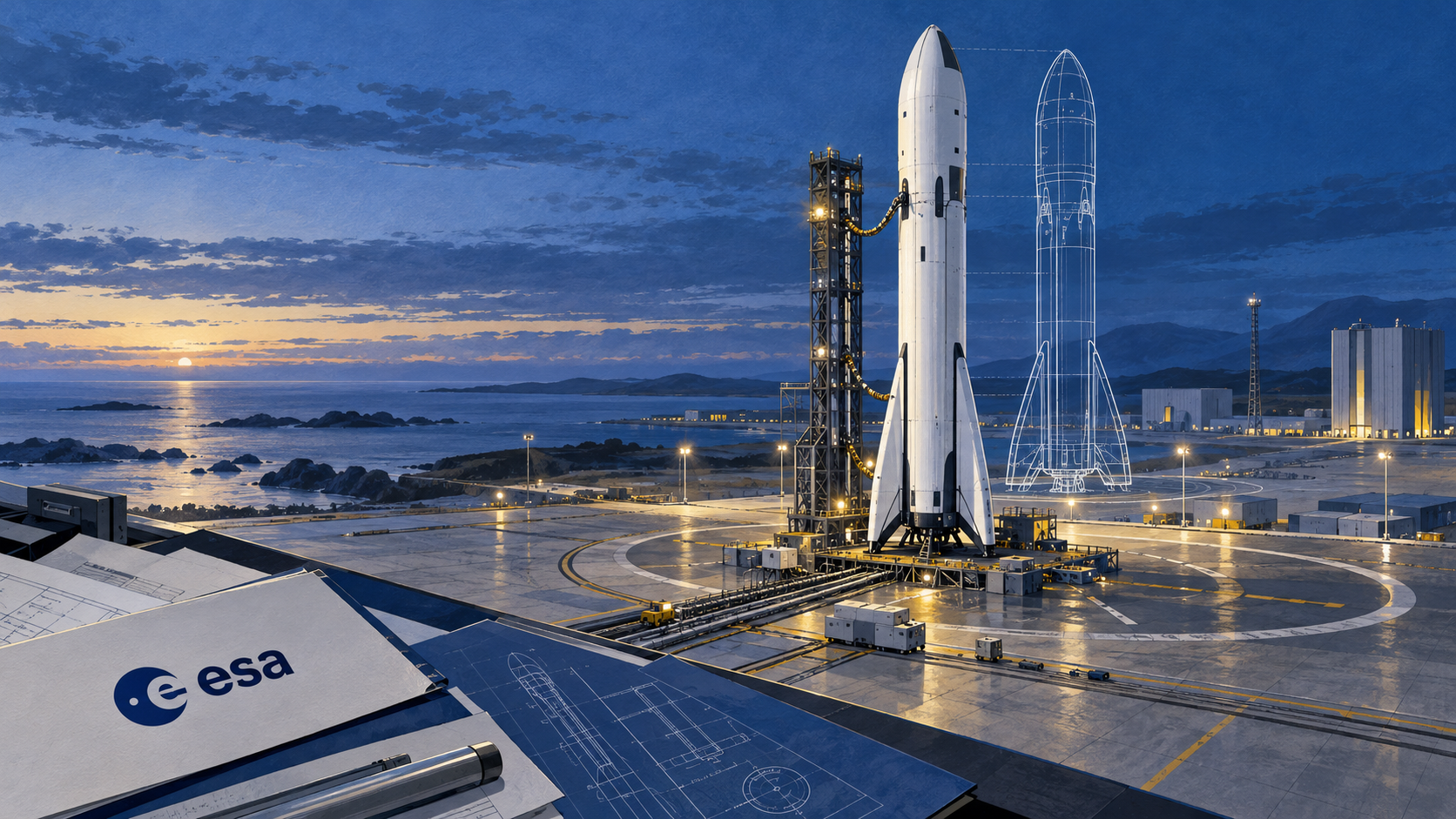
A European Space Agency assessment has crossed an important threshold: a very-heavy reusable launcher is no longer being treated only as an aspirational response to SpaceX. According to SpaceNews, reporting from the International Astronautical Congress on 8 October, ESA’s latest work found that Europe could pursue such a system on technically and financially credible terms.
That conclusion matters, but it is not a programme approval. No launcher has been selected, no development budget has been committed and no flight date has been authorised. The finding instead moves the argument from “could Europe build this?” towards harder questions about demand, industrial organisation, public risk-sharing and political appetite.
For the global space economy, that shift is consequential. A credible European entrant in high-cadence, reusable heavy lift would eventually widen customer choice and reduce dependence on US providers. Yet the same study also exposes why copying a rocket architecture is easier than recreating the market conditions that make reusability pay.
The study case is larger than Ariane 6
ESA has been examining this terrain for several years. Its earlier PROTEIN studies, conducted by ArianeGroup and Rocket Factory Augsburg, considered launchers and the ground infrastructure required to support extremely high payload volumes. ESA said in November 2024 that development within roughly a decade was possible in principle, provided technology work and testing began immediately.
The study concepts were deliberately ambitious. Independent trade publication European Spaceflight reported that RFA examined vehicles able to place 100 to 115 tonnes into low Earth orbit, while ArianeGroup studied semi-reusable and fully reusable concepts around the 100-tonne class. Modelled launch prices ranged from about €200 to €285 per kilogram.
Those figures are study outputs, not market offers. They depend on reuse assumptions, flight rates, maintenance performance and capital structures that have not been demonstrated. ESA’s subsequent Pathfinder activity narrowed the immediate objective to a system delivering up to 60 tonnes to low Earth orbit and focused explicitly on a sustainable business case, risk allocation, infrastructure and industrial organisation.
That progression is the real development: Europe is connecting technical architecture to a financing and operating model instead of treating a future launcher solely as a state-designed vehicle.
Reusability needs a market, not only an engine
A reusable launcher becomes economical only when it flies often enough to spread development, manufacturing and fixed operating costs across many missions. Europe therefore faces a circular problem. Lower prices could stimulate demand for large orbital infrastructure, but investors will hesitate to finance a vehicle until that demand is visible.
ESA’s original use cases included orbital solar-power infrastructure and data centres. Both could create very large mass-to-orbit requirements, but neither is yet a mature anchor market. Human exploration, cargo transport and sovereign constellation deployment may add demand, although those missions will be governed as much by public policy as by commercial economics.
This makes institutional purchasing central. ESA’s European Launcher Challenge already shifts the agency towards acting as a customer of privately led services. More than €900 million has been earmarked for that programme, with new providers required to demonstrate orbital capability and later capacity upgrades. A very-heavy system would be a different scale of commitment, but the same principle—buying services and paying against milestones—could shape its procurement.
The commercial opportunity is substantial if Europe can aggregate demand across civil, security and private customers. The risk is equally clear: an oversized launcher with an insufficient manifest would lock governments into continuing support while competing against established US capacity and rapidly advancing Chinese systems.
A competitive opening—and a policy fault line
The study also sharpens competition inside Europe. ArianeGroup brings propulsion, systems integration and access to the Ariane industrial base. RFA represents the newer, vertically integrated launcher sector. Other firms developing engines, stages and in-space logistics will argue that a future system should remain modular and contestable.
How ESA structures the next phase may therefore matter as much as the selected vehicle. A single traditional prime could concentrate accountability but reproduce the cost and schedule incentives of earlier institutional programmes. Parallel demonstrators and milestone-based competition could preserve options, although they risk duplicating scarce engineering effort.
National politics will be unavoidable. France, Germany, Italy, Spain and other member states will weigh strategic autonomy against industrial return. Those negotiations can broaden support, but they can also distribute work for political balance rather than programme efficiency. Europe’s challenge is to retain geographic legitimacy without fragmenting design authority.
Globally, even a funded European programme would not alter launch pricing immediately. Its near-term effect would be strategic: signalling that reusable heavy lift may become a multi-provider capability rather than an overwhelmingly US domain. That could influence satellite factory investment, orbital infrastructure plans and negotiations by customers seeking redundancy.
The technical gaps remain material
Europe does have relevant building blocks. ESA’s Prometheus methane engine programme and the Themis reusable-stage demonstrator are intended to prove throttling, landing and rapid-reuse operations. In July 2026, Themis completed a wet dress rehearsal at Esrange in Sweden, but it has not yet demonstrated a powered hop, much less orbital recovery.
ESA has also identified a high-thrust staged-combustion engine as a technology gap. Ground transport, propellant supply, launch and landing facilities, range capacity and refurbishment operations are not secondary details; they determine whether high cadence is physically and economically possible.
Environmental claims require similar caution. Methane or hydrogen can reduce some operational emissions, particularly when produced with low-carbon electricity, but lifecycle impact depends on production, leakage, construction and flight frequency. Reuse reduces discarded hardware; it does not make launch impact-free.
What to watch next
The decisive milestone is a political one: whether ESA member states fund a competitive development phase rather than another round of studies. Any proposal should be judged on committed customers, realistic annual cadence, private capital at risk and transparent treatment of refurbishment costs.
Technical evidence should follow quickly. The first Themis hop, progress on high-thrust engines and repeated recovery tests will show whether Europe can convert component programmes into an operational reuse system. Procurement rules will reveal whether ESA intends to select a single architecture early or maintain competing pathways.
The new assessment changes the baseline. Europe can plausibly build a reusable heavy-lift launcher. It has not yet shown that it can assemble the demand, funding discipline and industrial governance required to make one competitive. The next commitment—not the latest concept drawing—will determine whether this becomes infrastructure for a larger European space economy or another technically credible study that stops at the ministerial table.