
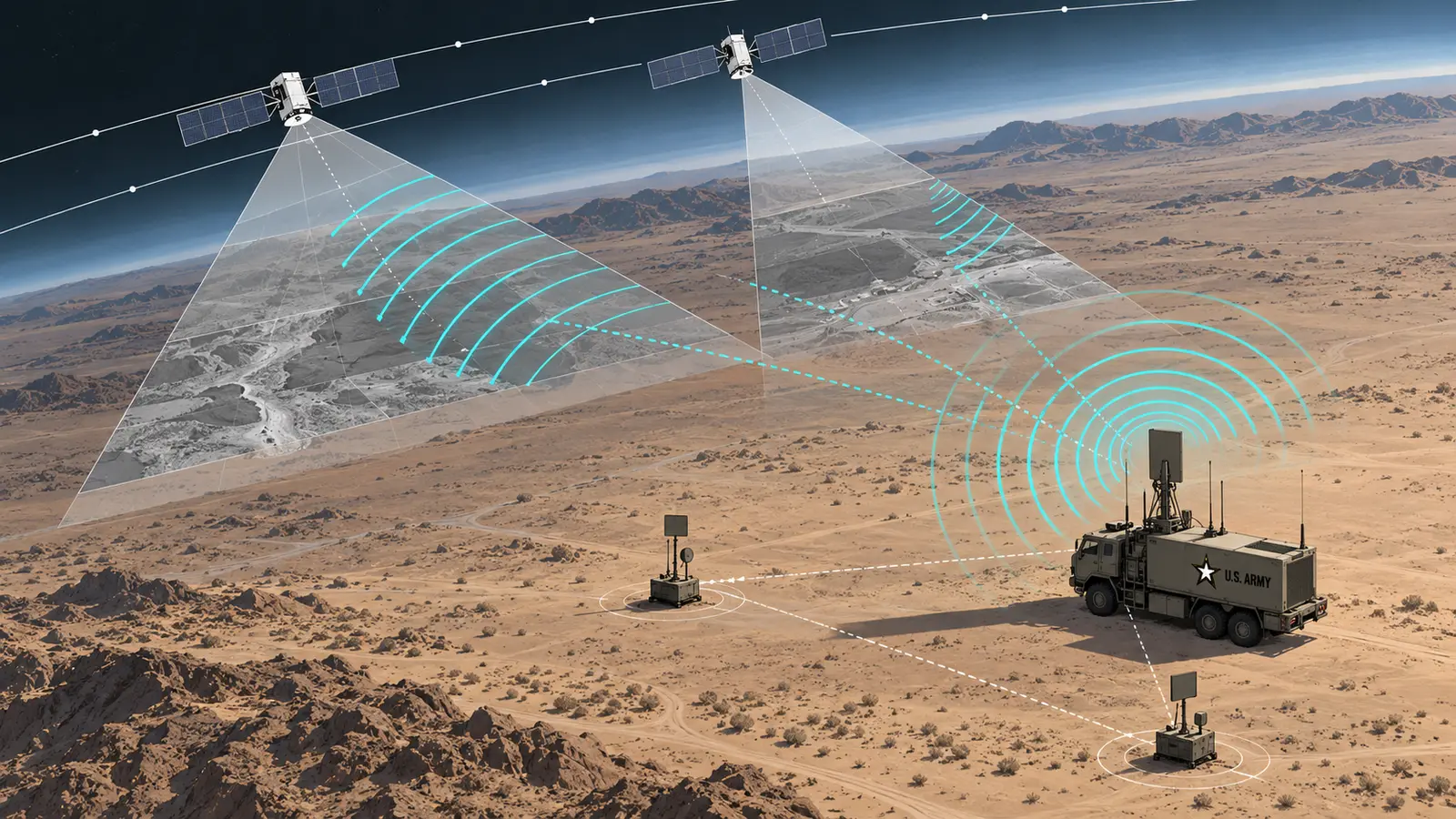
The U.S. Army has committed $66.6 million to five competing electromagnetic-warfare prototypes intended to stop space-based surveillance from becoming targeting data against ground forces.
The awards are modest beside major satellite procurements, but strategically important. They turn counter-surveillance and reconnaissance, or CSR, from doctrine and budget language into funded hardware development. They also expand the space economy’s competitive perimeter: value will accrue not only to companies that collect and analyse data from orbit, but increasingly to those that can detect, manage and disrupt the resulting sensor-to-shooter chain from the ground.
SpaceNews identified the awards as the leading new military-space development. The primary Army notice, published on 30 September, confirms that the work remains a prototype competition—not a production programme—and leaves the systems’ detailed performance classified.
Five awards, one emerging mission
The Army’s Capability Program Executive for Intelligence and Spectrum Warfare awarded five standalone Other Transaction Authority agreements: $22.4 million to KBR’s Kord Technologies, $18.8 million to Ideas, Commitment, Results, $10.9 million to Systems & Technology Research, $7.6 million to Raytheon and $6.9 million to Northrop Grumman’s Xetron subsidiary.
Each agreement covers an 18- to 20-month period. Development is meant to end in field experiments and exercises where soldiers and evaluators will assess effectiveness, suitability, survivability and whether any prototype can be scaled rapidly into production.
Those terms define the programme’s current limits. The $66.6 million is confirmed prototype funding, not a production ceiling, expected programme value or guarantee of follow-on work. The unequal awards may reflect different technical approaches or work packages; they are not a public ranking of the competitors’ chances.
The competition follows a 2025 Army market survey for terrestrial systems against space-based threats. That notice required vendors to have prototype-production capability, cleared personnel and secure facilities, signalling that the service wanted mature technology that could move quickly into classified testing rather than open-ended research.
Counter-space becomes force protection
The Army’s framing is commercially significant. CSR is not presented principally as a contest to destroy satellites. Public fiscal 2026 budget documents describe a ground-based family of systems combining electronic support, situational awareness, planning tools and non-kinetic effects against space-based surveillance.
The documents call for three capability lines linked by a fire-control planner and a common execution tool. They also specify low-probability-of-detection and low-probability-of-attribution effects intended to break an adversary’s kill chain while preserving freedom of manoeuvre.
That is a demanding systems problem. A useful capability must identify when orbital sensors threaten a unit, choose an appropriate response, coordinate it with wider operations and avoid exposing the countermeasure itself. It must also keep pace with mobile formations rather than depend on a fixed strategic site.
The exact mechanisms have not been disclosed. Electronic attack, deception and interference with sensor collection are plausible categories, and Army officials have previously discussed disrupting satellite communications and reconnaissance. It would be speculative, however, to assign a specific effect or target type to any of the five contractors without further evidence.
The remote-sensing boom creates a counter-market
The commercial logic begins with the rapid improvement of Earth-observation services. Optical, synthetic-aperture radar and radio-frequency constellations now revisit areas more frequently, while cloud delivery and automated analytics shorten the time between collection and action.
CSIS analysis of lessons from Ukraine found that commercial imagery became timely enough for tactical use and that commercial RF data could map interference for operational planning. A separate 2026 GAO review documented U.S. defence purchases of commercial imagery, analytics and tactical surveillance services.
The same accessibility applies to competitors. As commercial and sovereign constellations proliferate, ground forces must assume more persistent observation and faster targeting. Counter-ISR therefore becomes a companion market to remote sensing: every improvement in revisit rate, resolution, multi-sensor fusion and automated detection increases demand for concealment, deception, spectrum awareness and non-kinetic protection.
For satellite operators, this creates both opportunity and risk. Defence customers may pay more for resilient architectures, protected tasking, rapid retasking and evidence that services remain useful under interference. At the same time, operators could face more deliberate attempts to degrade collection, stricter export controls and greater scrutiny of how commercial data enters military kill chains.
Competition extends beyond traditional space primes
The vendor mix is notable. Raytheon and Northrop Grumman bring established electronic-warfare and space portfolios, but the largest awards went to Kord Technologies and ICR. STR adds a research-heavy contractor with experience in sensing and signal processing.
Using separate OTA agreements preserves multiple technical options through prototyping and lowers the barrier for non-traditional suppliers. It also delays clarity over the durable revenue pool. Investors should distinguish near-term funded work from a programme of record: production quantities, unit architecture, sustainment requirements and acquisition budgets have not been announced.
The organisational foundation is becoming more permanent. In July, the Army combined Tactical Exploitation of National Capabilities and Tactical Space Superiority under a new Project Manager for Space Superiority and Exploitation. This week’s separate creation of an enlisted space-operations career field reinforces the direction of travel. Procurement, doctrine and personnel are beginning to align around tactical space effects.
The milestones that will define a real market
The first checkpoint falls roughly between March and May 2028, based on the stated 18- to 20-month periods. Watch for field-experiment results, a production down-select and explicit funding in subsequent Army budgets.
Technical evidence will matter more than demonstrations alone. The prototypes must show they can operate while mobile, integrate with the common planning and fires architecture, manage spectrum safely and remain effective against changing orbits, sensor types and collection tactics. Low probability of detection and attribution will be particularly difficult to verify outside classified channels.
The decisive commercial signal will be a funded production pathway with quantities, deployment echelons and sustainment requirements. Until then, the awards establish a credible market test rather than a mature market.
Even so, the direction is clear. Persistent orbital surveillance is no longer treated solely as a space problem. It is becoming a force-protection requirement for land warfare—and a new competitive layer in the global space economy.