
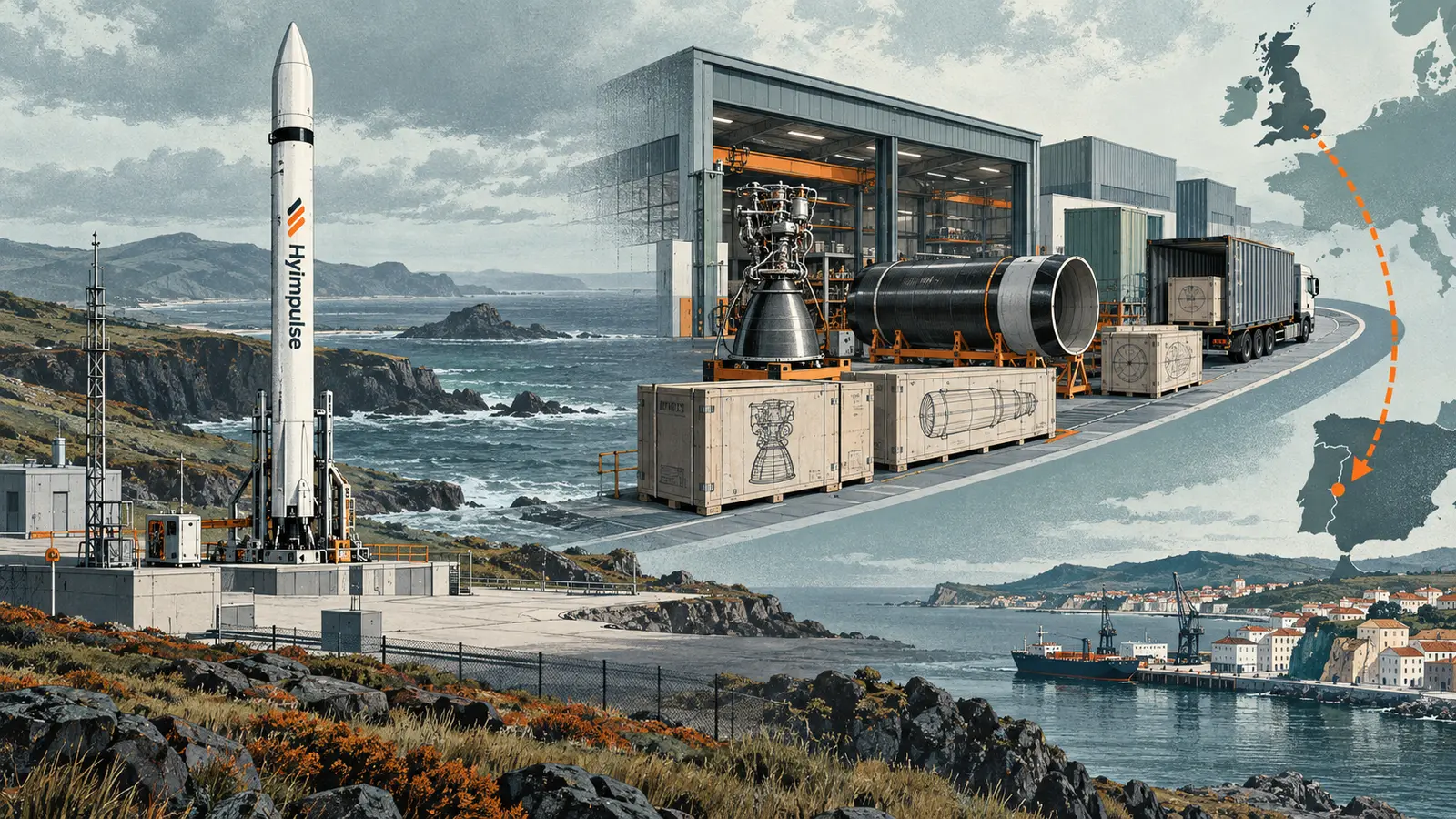
Britain’s small-launch landscape produced two sharply contrasting signals this week. Germany’s HyImpulse received a UK spaceflight operator licence for a suborbital launch from SaxaVord Spaceport, while the manufacturing assets and intellectual property of insolvent British launcher developer Orbex were sold to Portugal’s Omnidea.
Taken together, the developments are less a story of one winner replacing one loser than a test of what Europe now values in sovereign launch. Regulators can approve a flight, and industrial assets can survive a company’s failure. Neither outcome, by itself, creates a dependable orbital service.
SpaceNews first brought the paired developments into focus. The important distinction for customers and investors is that HyImpulse’s licence covers its SR75 suborbital demonstrator—not its planned SL1 orbital launcher—while Omnidea has acquired assets rather than Orbex as an operating business.
A licence for a stepping stone
The UK Civil Aviation Authority’s public register lists HyImpulse’s SR75 spaceflight operator licence as current from 1 October 2026. A separate reporting plan sets the notifications and information the company must provide to the regulator.
That approval is meaningful. It gives HyImpulse a regulated route to fly from SaxaVord in the Shetland Islands and provides evidence that Britain’s post-Brexit launch-licensing framework can process another operator. But it does not authorise an orbital service.
SR75 is a single-stage, paraffin-and-liquid-oxygen hybrid rocket. HyImpulse says it can carry up to 250 kilograms to an altitude of 200 kilometres. The company is targeting a flight from SaxaVord in spring 2027, subject to completion of remaining operational work with the spaceport and regulator. Earlier CAA consultation material described an initial cadence of one SR75 launch a year from the site.
The vehicle’s commercial value is therefore partly indirect. SR75 can carry microgravity and technology payloads, but it is also a flying testbed for propulsion, operations and recovery methods intended to reduce risk on SL1. HyImpulse’s planned three-stage orbital vehicle is a much larger system: the company lists a 54-tonne lift-off mass and an initial payload capacity of 600 kilograms to low Earth orbit.
HyImpulse says its hybrid propulsion can halve current launch costs and ultimately support up to 12 launches a year, with a goal of 50 launches by 2030. Those are company targets, not demonstrated economics. A successful SR75 campaign would validate only part of the proposition; orbital staging, turbopump performance, guidance, range operations and repeatable production remain separate hurdles.
Orbex survives as capability, not continuity
The Orbex transaction illustrates the other side of the market. Omnidea has bought much of Orbex’s UK production equipment, technical data, intellectual property and brand. The corporate entities remain in administration, and the sale excludes Orbex’s liabilities and its former spaceport project in Sutherland.
That distinction matters. Customers should not read the transaction as the rescue of an existing launch schedule. Omnidea plans to assess the inherited technology and develop a simplified successor to Orbex’s Prime small launcher, called PrimeNEO. The Portuguese company has ring-fenced more than €10 million for integration, a UK team and operations in Forres, according to European Spaceflight’s account of the transaction.
Omnidea chief executive Tiago Pardal told ECO that a launch by 2028 is not realistic and that 2035 may be a more credible horizon. The company expects to need outside capital from around 2028. It has also dropped Orbex’s proposed medium-lift Proxima concept and is considering future launch options in Scotland and the Azores.
The sale preserves engineering knowledge and specialised tooling that might otherwise have been dispersed. It also shifts the centre of gravity of the programme across borders. That is useful for Europe’s collective industrial base, but it complicates national narratives around sovereign capability and the return on public support. Orbex entered administration after receiving substantial state backing, including £26 million in UK government loans reported by The Guardian.
Capital and cadence are becoming the real barriers
Europe’s small-launch contest is moving beyond the era when a prototype, spaceport agreement or regulatory milestone could establish a credible market position. Customers increasingly need evidence of financing through first flight, a repeatable production system and a launch cadence that reduces schedule risk.
That favours a smaller number of better-capitalised providers. Isar Aerospace, for example, secured roughly €200 million under the European Space Agency’s European Launcher Challenge in August, part of a programme backed by more than €900 million in member-state commitments. HyImpulse announced more than €50 million of financing in September and previously received €11.8 million from ESA for SL1 development. Orbex’s failure shows that even significant public and private funding can be insufficient when development stretches and new capital does not arrive.
Dedicated small launch still has a defensible market in responsive defence missions, bespoke orbits and payloads that cannot tolerate rideshare schedules. Yet those benefits must compete with lower-cost rideshare on established vehicles and with European launchers that are already crossing the orbital threshold. Licence count will matter less than completed missions, contracted backlog and the speed with which factories can turn a vehicle around.
Milestones that will separate progress from promise
For HyImpulse, the first test is whether SR75 flies from SaxaVord in spring 2027 and whether the mission produces usable propulsion and operations data. The next signals should be integrated SL1 stage testing, a clearly financed orbital campaign, an orbital operator licence and firm customer missions—not only capacity reservations.
For Omnidea, the priorities are a credible PrimeNEO development plan, retention of Orbex’s engineering team, clarity on UK and Danish export approvals, and a decision on whether any ESA funding associated with Orbex can follow the assets. A launch-site decision and external financing will reveal whether the acquisition becomes an operational programme or remains a long-duration technology holding.
The broader lesson is that Europe is not short of launch concepts. It is short of systems that combine technical maturity, regulatory approval, capital and cadence at the same time. HyImpulse has advanced one of those four elements. Omnidea has preserved pieces of another programme. The market will judge both on what reaches orbit—and how often—not on what survives on paper.