
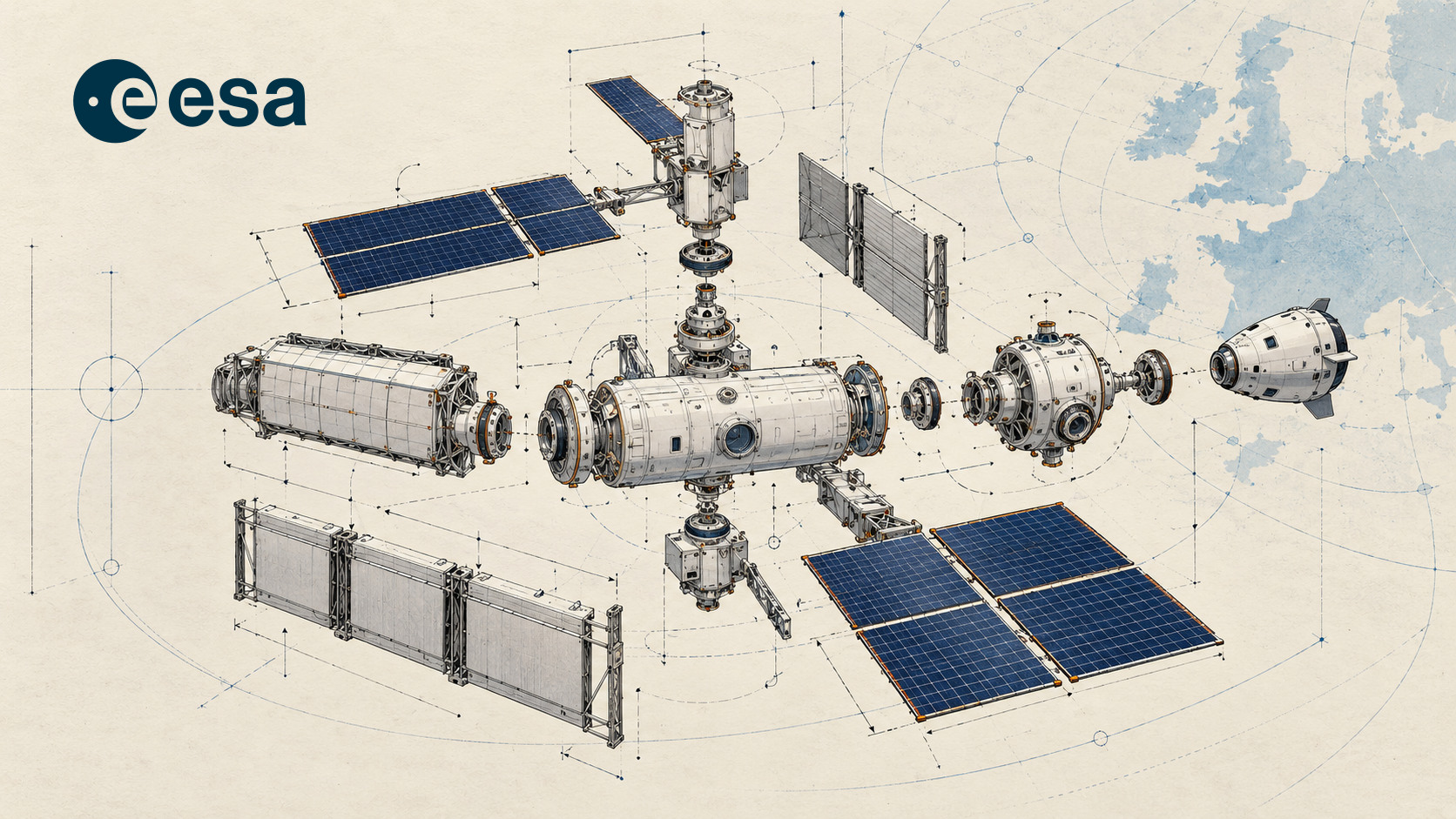
Europe has moved a sovereign successor to the International Space Station from policy discussion into competing industrial designs. SpaceNews reported on 29 September that the European Space Agency selected consortia led by Airbus Defence and Space and OHB for parallel studies of a European-led station in low-Earth orbit.
The award is strategically significant, but its status needs careful framing. These are early design studies, not approval to build a station. ESA has not publicly disclosed contract values, detailed consortium membership or a construction budget. The work puts an autonomous European option on the table; it does not yet make that option affordable or politically agreed.
A third option enters Europe’s post-ISS planning
The studies originate in a February tender for two Pre-Phase A concepts. European Spaceflight’s account of the procurement said the teams were asked to assess feasibility, architecture, utilisation and technology requirements for a modular, multi-partner outpost, with results intended to inform ESA decisions by the end of 2026.
That work examines the most ambitious of three broad paths. Europe could buy services entirely from US-led commercial destinations; combine purchased access with European modules and equipment; or lead development of its own station while accepting contributions from other governments and companies.
ESA has not abandoned the first two routes. It already has non-exclusive arrangements to explore access to Axiom Space, Vast and Starlab. Its published post-ISS policy calls for multi-flight agreements, priority for European industry and commercial involvement. The new studies therefore create bargaining power and optionality rather than a single-track programme.
The commercial signal matters before the hardware
For Airbus and OHB, the immediate prize is influence over the architecture and industrial map of a future programme. A station decision would shape decades of demand for pressure vessels, life-support systems, robotics, power, docking, logistics, communications and operations.
The parallel approach also preserves competition at a time when Europe is debating consolidation across its space sector. Airbus brings human-spaceflight heritage and is already a partner in Starlab. OHB offers an alternative prime-contractor centre and a route for a broader supplier base. That creates a useful design contest, but also a potential conflict between building a European-led platform and supporting a transatlantic commercial station.
The business case remains the harder problem. Government-funded research and astronaut flights can anchor demand, but a commercially sustainable station needs additional customers in pharmaceuticals, materials, in-space manufacturing, tourism or sovereign missions. Those markets are promising but not yet proven at the scale required to finance and operate a crewed outpost.
Europe would need an ecosystem, not just a station
A sovereign destination does not by itself provide sovereign access. Europe currently relies on partners for crew transport, while cargo-return capability is still under development. In 2024, ESA awarded €25 million each to The Exploration Company and Thales Alenia Space for the first phase of competing cargo-return services, targeting an ISS demonstration ideally in 2028 and no later than 2030.
A credible European station architecture must therefore be matched with launch availability, cargo logistics, emergency return, crew certification and an operating model. It must also decide which capabilities should be European-owned and which can be purchased internationally. Full autonomy maximises strategic control but raises cost and schedule risk; selective interdependence is cheaper but preserves exposure to foreign policy and provider decisions.
Technical choices will affect the economics. A single-launch station could reduce assembly complexity but constrain growth and launcher options. A modular platform spreads capital spending and allows international contributions, but requires repeated launches, docking standards and long-term integration management. The studies should reveal whether ESA is designing primarily for continuous crew, periodic missions or a mostly autonomous laboratory.
A hedge against a fragile global transition
The timing reflects uncertainty on both sides of the Atlantic. NASA plans to retire the ISS around 2030 and become a customer of commercial stations. Yet a June 2026 US Government Accountability Office assessment said the transition plan remained in flux and identified an ambitious schedule, uncertain private demand and the risk of a gap in continuous crewed presence.
That uncertainty strengthens the strategic case for a European option. It does not automatically strengthen the financial case. A separate European station could duplicate infrastructure and divide a still-small customer pool among too many platforms. Conversely, relying only on US destinations could leave European research priorities and astronaut access subordinate to NASA procurement changes or private operators’ economics.
The most plausible outcome may be a European-led core designed for interoperability: modular enough to accept international elements, use more than one visiting vehicle and support both institutional and commercial customers. That is analysis, not a declared ESA architecture, and the study results will show whether industry reaches the same conclusion.
Milestones that turn an option into a programme
The first milestone is publication of the Airbus- and OHB-led study outputs, including mission models, cost ranges and industrial workshare. ESA member states must then choose an architecture and commit development funding. Until that happens, schedule claims should be treated as scenarios rather than programme dates.
Investors should also watch for binding astronaut-flight and research commitments, progress in Europe’s cargo-return competition, a decision on independent crew transport, and agreements with Canada, Japan or other potential partners. A station becomes commercially credible only when those transport, utilisation and customer layers advance together.
ESA’s study award therefore changes the post-ISS market by adding a credible European design track to a field dominated by US commercial concepts. Its consequence is optionality, not construction. The economic test is whether Europe can convert strategic autonomy into a focused programme without recreating the ISS cost structure or fragmenting the emerging low-Earth-orbit economy.