
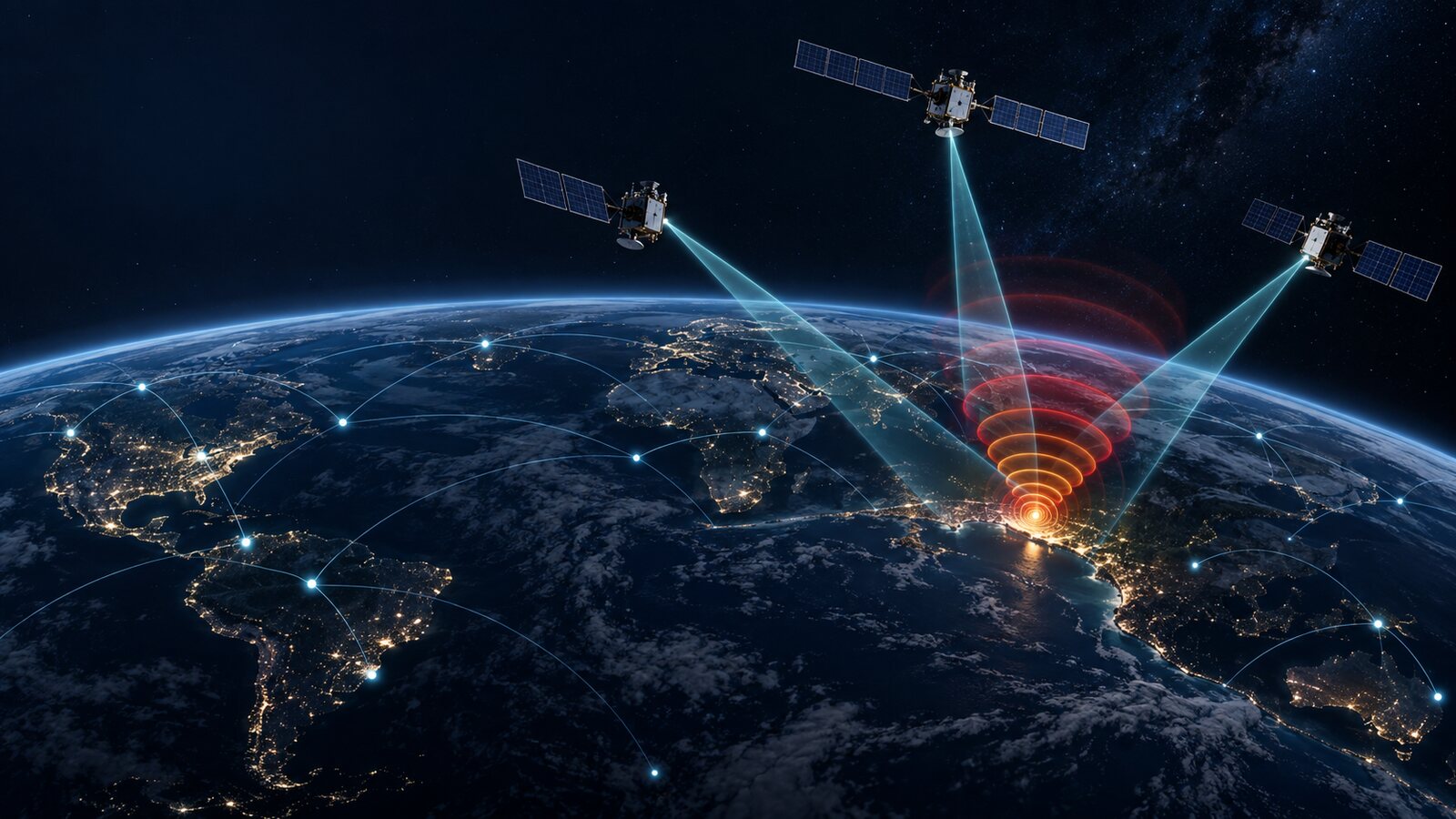
The U.S. Space Force is moving commercial satellite monitoring of radio-frequency interference from experimentation into a standing global operation. That creates a more durable defence market for space-based RF data, but it also puts procurement, validation and command integration—not sensor availability—at the centre of the risk.
From useful experiment to operational service
SpaceNews reported on 20 September that the Space Force is expanding its use of commercial satellites to detect and locate GPS jamming and other electromagnetic interference. Barbara Golf, who leads the Joint Commercial Operations cell, described the effort at the AMOS conference in Maui on 18 September as a standing global operation rather than a temporary trial.
That distinction matters. Governments have bought commercial space data for years, but episodic demonstrations do not create the predictable demand that allows operators to finance constellations, improve revisit rates or maintain round-the-clock analyst teams. A recurring operational requirement can.
It is also a logical extension of the JCO’s established role. Created by U.S. Space Command in 2020, the cell fuses unclassified commercial observations for military users and allies. Golf’s 2024 AMOS paper already identified electromagnetic-spectrum operations, space weather and space-based collection as expansion areas beyond the organisation’s original space-domain-awareness focus.
Why orbit changes the jamming problem
Interference is usually experienced locally: a receiver loses position or timing, a communications link degrades, or a navigation solution becomes implausible. Identifying the source is harder. A satellite can observe a wide area without depending on access to the affected territory, and multiple observations can geolocate an emitter by comparing signal arrival time, frequency or angle.
Commercial constellations add persistence and geographic reach without requiring the government to build every sensor. Their unclassified products can also be shared more readily with allies and civilian agencies. That is valuable for aviation, shipping and critical infrastructure as well as military operations.
Yet detection is not attribution. A commercial system may establish that interference exists and estimate where it originates, but deciding who caused it, whether it was deliberate and what response is justified requires other intelligence. Accuracy also depends on geometry, frequency coverage, signal strength, collection permissions and the provider’s processing methods. None of the public announcements supplies performance figures for the new standing operation.
Iran provided the operational pressure
SpaceNews said recent Iran operations accelerated the initiative. That fits the broader record, although the public evidence remains deliberately incomplete. In July, Lt Gen Gregory Gagnon, head of Space Force Combat Forces Command, said U.S. forces were operating in a contested electromagnetic environment and claimed a “return to U.S. spectrum dominance”. Air & Space Forces Magazine reported that he linked space support to missile warning, precision weapons, satellite communications and spectrum operations.
Those are official claims about operational effect, not independently measurable proof of how well any particular commercial sensor performed. The Space Force has not publicly named the providers used for this mission, disclosed task-order values, published geolocation accuracy or explained how many alerts reached operational commanders. Investors should therefore treat the shift to a standing mission as evidence of demand, not as evidence that a single supplier has secured a large or exclusive programme.
A market signal with an acquisition warning
The commercial opportunity extends beyond spacecraft operators. A usable service needs RF payloads, ground stations, cloud processing, signal libraries, automated anomaly detection, secure application programming interfaces and analysts able to distinguish interference from normal spectrum congestion. Companies that can deliver decision-ready warnings may capture more value than those selling raw detections.
The addressable customer base is also broader than Washington. The JCO is explicitly multinational. The United Kingdom established its own JCO cell in 2023, while New Zealand’s Ministry of Defence published an August 2025 Cabinet decision supporting continued participation in the JCO space-domain-awareness programme. A common unclassified operating picture could make commercial RF monitoring a coalition service rather than a purely U.S. purchase.
However, the buying system is not yet mature. An August 2026 Government Accountability Office review found that JCO spent US$76.8 million on data and services through the Global Data Marketplace between January 2023 and September 2025. GAO also found fragmented visibility across the Department of Defense and recommended better coordination of commercial-data purchases.
That finding is central to the business case. A standing operational label will not automatically produce stable revenue if requirements remain scattered, users cannot discover existing contracts, or programme offices buy overlapping products. The market needs repeatable tasking, common quality standards and budget lines that survive the transition from experiment to operations.
Competition will turn on trust and latency
Commercial providers will compete on more than constellation size. The decisive measures are likely to include how quickly an event is detected, how precisely it is located, how confidently it is classified and how easily the result enters military command systems. Resilience against cyberattack, deception and deliberate saturation will matter because a service used during conflict becomes a target.
Government-owned sensors will not disappear. Classified systems can offer sensitivity, tasking priority and assured control that commercial services cannot always match. The emerging model is hybrid: commercial sensors provide breadth, surge capacity and shareable data, while sovereign systems verify, deepen and protect the most sensitive assessments.
This creates competitive tension on two fronts. RF-monitoring companies must prove that their data improves operational decisions rather than merely adding another feed. Traditional defence contractors must show they can integrate fast-moving commercial services without turning them into slow, bespoke programmes.
Milestones that will show whether the model scales
The next evidence should be concrete. Watch for named contracts or task orders for electromagnetic-spectrum monitoring; disclosed service-level measures for coverage, latency and geolocation; integration with operational command-and-control systems; and additional allied cells contributing data or operators.
Also watch how the Space Force responds to GAO’s coordination findings. A visible catalogue of available commercial products, common validation rules and an enduring budget would be stronger market signals than another demonstration.
The strategic change is nevertheless clear. Commercial space data is moving closer to the point where forces detect, interpret and respond to interference. If the Space Force can turn that access into trusted, rapid and shareable warnings, spectrum awareness will become a recurring service market. If it cannot, the standing operation risks becoming a larger collection of disconnected feeds.