
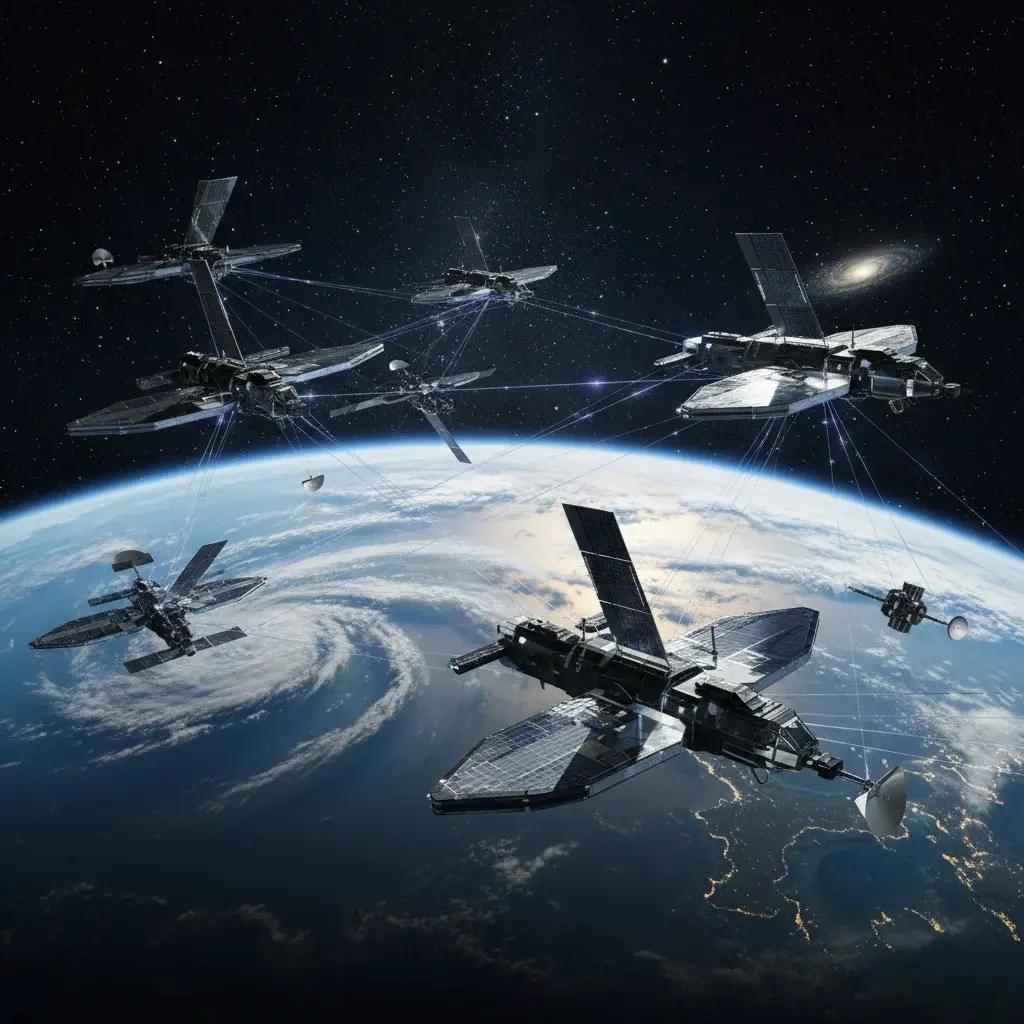
The United States Space Force and international rivals, notably China, are accelerating efforts to integrate “agentic artificial intelligence” into orbital operations, marking a critical shift in modern military strategy. Driven by the proliferation of satellite constellations and increasingly sophisticated counterspace threats, defense officials warn that the ability to sense and act at machine speed will determine who controls the space domain.
Agentic AI represents a significant leap beyond traditional machine learning tools used for data analysis. Unlike standard AI that simply processes information, agentic AI operates as a system of autonomous agents capable of independent, goal-directed decision-making. These systems can interpret complex orbital environments, generate actionable courses of action, and execute operational tasks without waiting for human prompts.
The Shift from Analytics to Autonomy
Currently, the U.S. Space Force utilizes artificial intelligence primarily to manage the massive volumes of data generated by modern space missions. These models synthesize satellite locations, mission activities, and maneuver patterns across thousands of orbital objects, dramatically improving space domain awareness.
However, military strategists view this as merely a foundational step. Agentic AI functions as a proactive, reasoning collaborator rather than passive analytics software.
Like an intelligence analyst operating at machine speed, an agentic system continuously interprets large data streams to detect emerging threats and generate real-time operational responses.
China’s Rapid Advancements
Global competitors are heavily investing in this technology, underscoring the urgency of the space race. Chinese researchers reportedly developed Manus, characterized by industry observers as the world’s first fully autonomous AI agent.
Experts have dubbed this development a “Second DeepSeek Moment,” signaling rapid maturation in Beijing’s artificial intelligence capabilities.
Simultaneously, China has launched early orbital experiments for its Three-Body Computing Constellation. This system processes data directly in space using AI, bypassing traditional reliance on vulnerable ground infrastructure.
This infrastructure will ultimately support China’s Star-Compute Program, a planned 2,800-satellite network designed for distributed computing and autonomous coordination. These developments indicate a deliberate state-directed strategy to embed AI directly into the architecture of future space operations.
Managing Proliferated Constellations
The primary operational driver for agentic AI is the sheer scale of future space architectures. Tomorrow’s orbital networks will feature hundreds or thousands of satellites operating simultaneously in highly dynamic environments.
As these constellations maneuver, communicate, and evade threats, the complexity of managing them will quickly exceed the cognitive limits of human operators.
Agentic AI enables individual satellites to independently analyze their surroundings, optimize communications, and coordinate maneuvers with neighboring spacecraft.
By embedding these autonomous agents within both satellites and ground command systems, military planners envision self-aware, self-healing orbital networks. These systems could maintain critical operations despite active jamming, cyberattacks, or kinetic strikes.
Military Integration and Commercial Challenges
General Chance Saltzman, Chief of Space Operations for the U.S. Space Force, has publicly emphasized that the next era of space warfighting relies heavily on artificial intelligence, autonomy, and maneuver operations.
Military leaders, including former Space Force officials Lt. Gen. (Ret.) Nina Armagno and Maj. Gen. (Ret.) Kim Crider, warn that the U.S. risks losing strategic access to space if it fails to outpace competitors in fielding these systems.
However, adapting commercial AI technology for national security presents significant hurdles. A recent defense study revealed that some commercially developed large language models—a foundational component of agentic AI—refused up to 98% of military-related queries.
This limitation highlights a critical vulnerability. The military requires secure, operationally relevant data infrastructures built specifically for combat environments, rather than relying solely on commercial off-the-shelf solutions.
Furthermore, military doctrine dictates that human judgment must remain within the kill chain. Effective human-machine teaming and rigorous model verification are required to ensure autonomous systems maintain accountability and adhere to strategic intent.
Infrastructure and Innovation Funding
To operationalize agentic AI, the defense sector must urgently overhaul its data infrastructure. Machine-speed analytics require trusted, real-time data streams aggregated across satellite sensors, commercial feeds, and joint warfighting networks.
The Space Force is currently pushing to accelerate funding for AI-enabled command-and-control architectures. Programs like Rapid Resilient Command and Control (R2C2) and advanced space battle management systems are critical for managing proliferated constellations at machine speed.
Bridging the gap between commercial innovation and military deployment remains a structural challenge. Defense innovation initiatives, such as SpaceWERX’s Strategic Funding Increase (STRATFI) and Tactical Funding Increase (TACFI), are essential for transitioning breakthrough technologies from startups into deployable military systems.
What to Watch Next
The race to achieve space superiority is now inextricably linked to the deployment of agentic AI. As Beijing commits billions in state-directed funding to build autonomous satellite networks, the U.S. defense establishment faces mounting pressure to field operational systems.
Industry observers will be closely monitoring upcoming congressional appropriations for military AI infrastructure and the rapid prototyping of autonomous space systems.
The next major milestone will likely be the successful demonstration of fully autonomous, AI-directed satellite maneuvers in a contested orbital environment. The nation that first operationalizes these machine-speed capabilities will dictate the strategic reality of the space domain for decades to come.


Leave a Reply